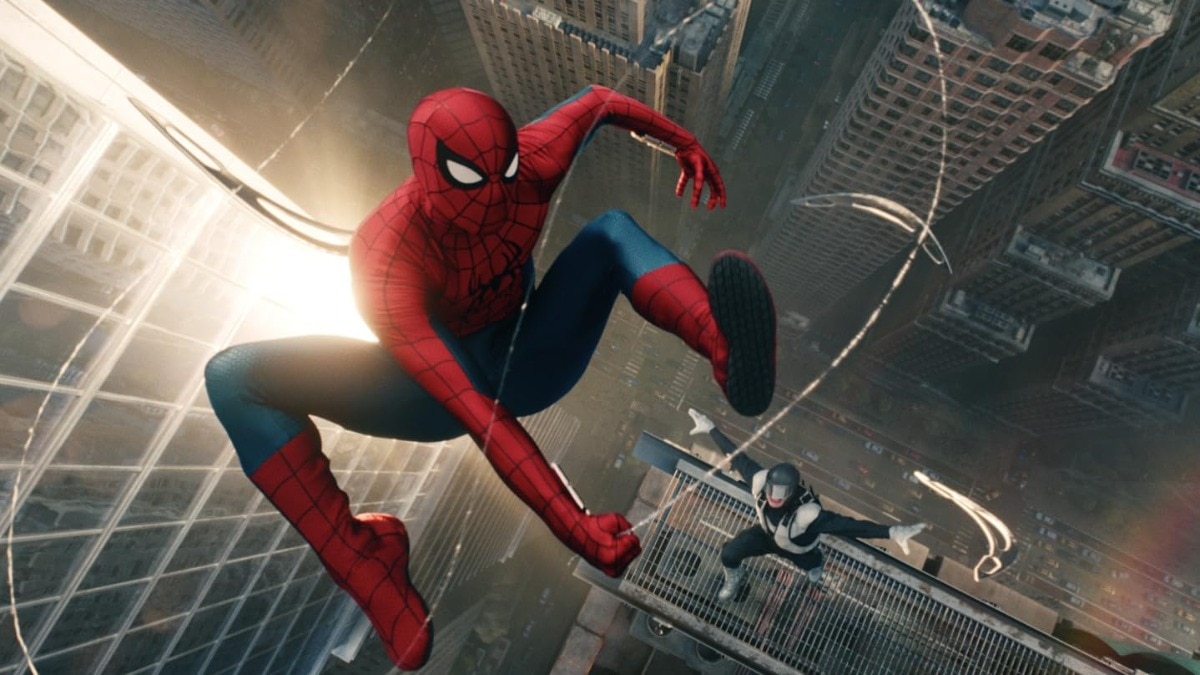
Spider silk is gram for gram stronger than steel and tougher than Kevlar, one of the toughest materials on Earth. As Spider-Man: Brand New Day reaches Indian screens, here is the real science of why spider webs are so strong.Spider-Man: Brand New Day is out in India. Here is the real science of why spider silk is stronger than steelWalk into a cinema anywhere in India this week, and the screen will soon fill with a familiar silhouette: a figure in red and blue, casting silver ropes of web between the towers of Manhattan. Spider-Man: Brand New Day opened across India on July 30, and it revives the question every arachnid-struck child eventually asks.Could a thread spun by a spider really hold the weight of a grown adult swinging between skyscrapers?It is a question worth pondering on, particularly for anyone who has followed how the legend has mutated on screen. The 1962 comics blamed the bite of a radioactive spider. Sam Raimi’s 2002 film Spider-Man recast the culprit as a genetically engineered one, and let Peter Parker, played by Tobey Maguire, spin silk from his own wrists.The Marvel Cinematic Universe went the other way, handing its Peter a set of mechanical web-shooters he built himself with help from his father figure, Iron Man. The fiction keeps rewriting itself. The biology it borrows from does not, and the real material is stranger, and far cleverer, than any screenwriter has dreamed up. WHY IS SPIDER SILK STRONGER THAN STEEL?Begin with the headline claim, because it is nearly true. Gram for gram, the dragline silk a spider uses for the spokes of its web and as its own safety line, is roughly five times stronger than steel.Its raw tensile strength, or the pulling force it withstands before snapping, is comparable to that of steel in absolute terms, yet silk is about six times lighter, which is why by weight it wins so comfortably. But strength is only half the story, and arguably the less impressive half. What sets silk apart is toughness, the total energy a material soaks up before it breaks. A thread that is merely strong, like glass, shatters. A thread that is merely stretchy, like a rubber band, cannot hold much. Spider silk pairs rigid beta-sheet nanocrystals with stretchy protein coils, which makes it both strong and springy. (Photo: Unsplash) Spider silk has strength as well as toughness. It can stretch by 20 to 40 per cent before failing, and the capture spiral at the heart of a web can extend by well over 200 per cent.The toughest known example, the dragline of Darwin's bark spider from Madagascar, absorbs on average 350 megajoules per cubic metre and, in the best samples, up to 520, over 10 times the toughness of Kevlar, a strong, heat-resistant synthetic fibre, according to the 2010 study that first measured it.The bark spider strings river-spanning webs up to 2.8 square metres across, on bridge lines reaching 25 metres.WHAT IS SPIDER SILK ACTUALLY MADE OF?Silk is almost pure protein. The molecules responsible are called spidroins, short for spider fibroins, and dragline silk leans mainly on two of them. One, rich in the amino acid alanine, packs into stiff crystals that supply strength. The other, rich in glycine, stays loose and coiled and supplies stretch.Picture microscopic bricks tied together by microscopic springs. The alanine-heavy stretches fold into tightly stacked layers, called beta-sheets, that form crystals only a few nanometres wide. The glycine-heavy regions between them behave like tangled elastic.When a fly strikes the web, the springy coils uncurl first, swallowing the impact, before the load passes to the rigid crystals that stop the thread tearing apart. Strength and stretch, held in a single fibre.HOW DO WEAK BONDS MAKE SILK SO STRONG?Here lies the genuine surprise. Those beta-sheet crystals are held together not by powerful chemical bonds but by hydrogen bonds, among the feeblest links in nature. It is the same faint attraction that makes water droplets cling to one another. So how do they add up to something that rivals steel?The answer is size. A 2010 study led by Markus Buehler at the Massachusetts Institute of Technology showed that when these crystals are confined to just a few nanometres, the hydrogen bonds are forced to share the strain and give way together rather than one after another, like a zip unfastening. Millions of weak hydrogen bonds, packed into crystals only nanometres wide, act together to resist breaking. (Photo: Unsplash) Squeezed that small, they can even slip and re-form, releasing energy instead of failing outright. Larger crystals would turn brittle. Smaller ones would be weak.Evolution parked silk at precisely the size that is both strong and tough. Millions of weak bonds, well-organised, defeat a handful of strong ones.HOW DO SPIDERS TURN LIQUID INTO SOLID THREAD?Perhaps the most humbling part is the manufacturing. A spider does not squeeze out finished thread like toothpaste. Inside the gland, the spidroins sit as a concentrated liquid.As that fluid is drawn down a narrowing duct towards the spinneret, its acidity rises, salts such as sodium and chloride are pumped out, water is stripped away, and the pulling motion combs the tangled proteins into alignment. Inside the spider, silk begins as a liquid and hardens into thread using only shifts in acidity, salts and pulling. (Photo: Unsplash) In milliseconds, liquid becomes an ordered, insoluble fibre.We manufacture Kevlar with fierce heat, concentrated acids and industrial machinery. A spider achieves something arguably finer: a special liquid protein in the arachnid’s body, at room temperature, powered by the simple act of drawing the thread with its own legs. These are materials scientists still cannot fully replicate.WHY IS A WEB STRONGER THAN A SINGLE THREAD?The silk is only half the design. The web is engineered too. Stiff radial spokes and stretchy, glue-beaded spiral threads carry different jobs, and together, they spread an insect’s impact across the whole structure rather than concentrating it in one spot, much as a suspension bridge shares a load among its cables.When one strand does snap, the geometry often lets neighbouring threads take up the shock, so the web as a whole survives. The sticky droplets add their own flourish, drawing moisture from the air to stay tacky and reeling in slack thread like tiny spools.COULD A SPIDER BITE REALLY MAKE A SPIDER-MAN?Which returns us to the cinema. The silk is extraordinary, but a spider weighs mere milligrams, and its thread is evolved to catch insects, not to arrest a falling 80-kilogram human against forces several times its body weight.Nor could any bite rewrite a person’s genome to grow silk glands overnight. The very physics that makes a web a marvel is what keeps Spider-Man exactly where he belongs, on the screen. Brand New Day, gloriously, gets to ignore all of it.Thankfully for audiences, Spider-Man: Brand New Day doesn't have to obey the laws of biology.- EndsPublished By: Radifah KabirPublished On: Jul 31, 2026 16:53 IST
How does Spider-Man swing? The science behind spider silk stronger than steel
Full Article
Original Source
Read the full article at Indiatoday →KhanList aggregates and links to publicly available news content. We do not host full articles from third-party sources. Always verify important information with original sources.