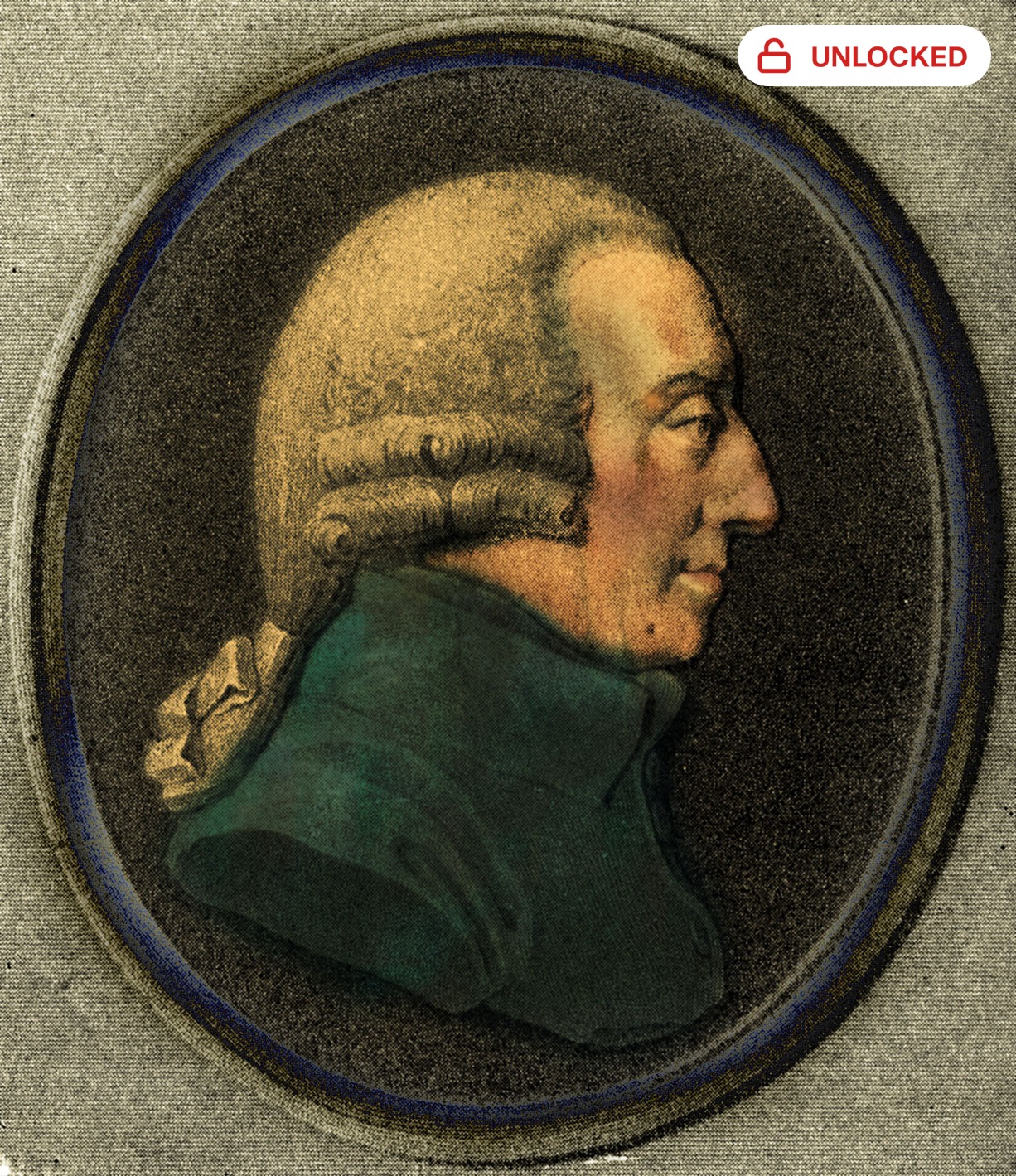
Turn any article into a podcast. Upgrade now to start listening. Members can share articles with friends & family to bypass the paywall. It’s a scenario every American is familiar with, especially lately: You go to the store looking for a particular item and find that it’s more expensive than usual. Maybe you’re back-to-school shopping for your children and you notice that the price of a box of pencils has increased by a dollar or two. You might not buy as many boxes as you were planning to, or maybe you purchase pens instead. You probably don’t spend much time speculating about what might have caused the price of pencils to increase. Unexplained price changes like this happen all the time, and for most of us they’re objects of mild annoyance rather than wonder. And yet an increase in the price of pencils involves a series of coordinated responses to market signals spanning industries, continents, and hundreds of thousands of people—a group of which you, without realizing it, are part. None of the individuals and companies involved fully understand the process they are a part of, because it’s larger than any one person could fathom. That immense organizing property of the free market was most famously described by Scottish economist and philosopher Adam Smith, who called it an “invisible hand.” His book The Wealth of Nations, published in 1776, an auspicious year for all things revolutionary, explored for the first time ideas of specialization and self-interest that would become foundational in the field of economics. Smith used the term “invisible hand” only once in the book’s 900-odd pages, but economists say the underlying concept is vital to his work. “If you read [Smith’s] work … it’s all about what we would now call the invisible hand,” Eamonn Butler, director of the Adam Smith Institute, a policy think tank, told The Dispatch. “In other words, how does our individual action affect society?” Smith used the metaphor in a section about why a rich man might choose to invest in his own community. “By preferring the support of domestic to that of foreign industry, he intends only his own security; and by directing that industry in such a manner as its produce may be of the greatest value, he intends only his own gain, and he is in this, as in many other cases, led by an invisible hand to promote an end which was no part of his intention.” The idea that self-interested behavior could contribute to the common good went against the prevailing economic wisdom of Smith’s time, particularly on the subject of trade. The prevailing economic system in the 18th century was mercantilism, under which nations aimed to increase their wealth through a favorable balance of trade, aided by import quotas and tariffs. Thus, only the side that increased its stock of gold and silver—usually the exporter—was viewed as benefiting from a trade agreement. To build wealth, the great powers of the 18th century waged wars of conquest and heavily restricted the economic freedom of their subjects, as Britain did in preventing the American colonies from trading with other countries. But Smith, after traveling across Europe and noting the ways in which the Industrial Revolution had transformed every nation’s economy, came to the conclusion that trade was more than just an exchange of wealth—it actually created wealth. “Smith completely demolished the mercantilist idea that in international trade there’s a winner and a loser,” Butler said. “Adam Smith said, ‘No, that’s not true. Both sides can benefit from the exchange.’” As such, Smith was instrumental in bringing about our modern era of free trade. But since his time, the ideas in The Wealth of Nations, and in particular the invisible hand, have become synonymous with capitalism more generally. Free market economists like Milton Friedman referred to the concept as “cooperation without coercion” and made the invisible hand a foundational piece of economic theory. Meanwhile, critics attacked the idea that the invisible hand organized the market in the best possible way. Karl Marx facetiously compared the invisible hand to “the fate of the ancients”: an outdated, capricious system without concern for human welfare. He and many of the Marxian economists who came after him, such as Oskar Lange and Abba Lerner, argued that the government could more effectively control the market and steer it toward what was best for the people. It was in this context of renewed distrust in the free market that economists like Ludwig von Mises and Friedrich A. Hayek mounted a new defense of Adam Smith’s theories. Most notably, in a 1945 essay called “The Use of Knowledge in Society,” Hayek illustrated how the invisible hand works in modern, complex, and decentralized markets. To understand Hayek’s idea, it’s helpful to have an example. Economist Russ Roberts uses a scenario involving the market for graphite, a raw material supplied only by companies that mine it and purchased only by makers of pencils and tennis rackets. Suddenly, a new use of graphite is discovered: Graphite powder stabilizes friction and reduces heat buildup in brake pads. Now car manufacturers want graphite, and a lot of it. They enter the market, but the mining companies have only enough raw material to supply the pencil and racket manufacturers. Socialists viewed the answer from here as simple—appoint someone, a hypothetical “graphite commissioner,” to decide which allocation of graphite best benefits everyone. But Hayek pointed out that anyone in such a position would need a huge amount of information on which to base his decisions. For example, could he direct the pencil manufacturers to invent a thinner pencil design, or the car manufacturers to make do with an alloy? Could schools reduce writing tasks, or mining companies locate more graphite-rich deposits? And what about the end-line consumer, the thousands and thousands of people who use pencils, tennis rackets, and cars—how easy is it for them to change their behavior in such a way that demand for graphite decreases? These questions are enough for a lifetime of research, but the graphite commissioner is tasked with making the market function for everyone right away. “This is what Hayek identified as the fatal conceit—the belief that somehow we could be these all-knowing, omniscient beings that could control the economy,” George Mason University economics professor Peter J. Boettke told The Dispatch. “And instead, what happens is all of the knowledge … is created within the interaction of the market process itself.” In a free market with no graphite commissioner, graphite prices would increase, sending a signal to the mining companies that graphite is more valuable and driving them to seek ways to extract more of it. The price increase could also lead pencil manufacturers to make thinner pencils, car manufacturers to change brake pad designs, and tennis racket manufacturers to switch to carbon fiber. Even the back-to-school shopper mentioned above participates in this process without realizing it; whatever decision the shopper makes based on the higher price of pencils sends a signal to the market about the demand for graphite. “The marvel,” Hayek wrote, “is that in a case like that of a scarcity of one raw material, without an order being issued, without more than perhaps a handful of people knowing the cause, tens of thousands of people whose identity could not be ascertained by months of investigation, are made to use the material or its products more sparingly; i.e., they move in the right direction.” All of us have participated in processes like this thousands of times; our preferences have been factored into systems so complex that nobody understands them fully. Grocery stores stock more high-protein foods to account for the widespread use of GLP-1 drugs, the development of AI leads to a new type of “superconducting” electrical cable, and turkey farmers plan their hatching cycles around the Thanksgiving holiday. Each individual acts according to his own self-interest and, guided by the invisible hand, promotes an end that is no part of his intention: the coordination of the free market as a whole. As Adam Smith himself put it, “It is not from the benevolence of the butcher, the brewer, or the baker, that we expect our dinner, but from their regard to their own interest. We address ourselves, not to their humanity but to their self-love, and never talk to them of our own necessities but of their advantages.” Daniel Sipes is a Dispatch intern from Washington, D.C. He graduated in 2026 from the University of Chicago with degrees in economics and public policy and a minor in English and creative writing. His hobbies include weightlifting, reading, and continually writing and then throwing away the first 10 pages of the Great American Novel.
How Does Adam Smith’s ‘Invisible Hand’ Work?
Full Article
Original Source
Read the full article at Thedispatch →KhanList aggregates and links to publicly available news content. We do not host full articles from third-party sources. Always verify important information with original sources.