
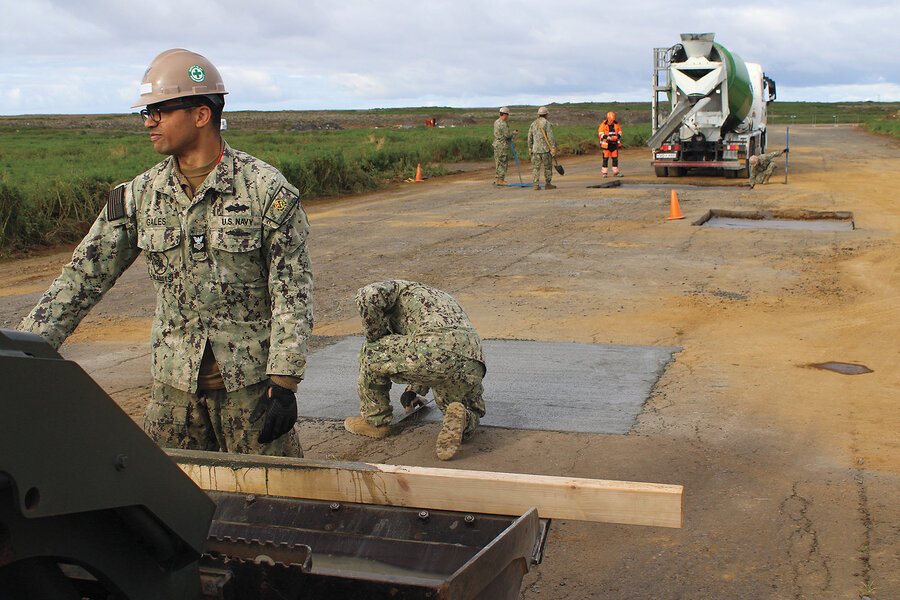
Reykjanesbær, Iceland | Oct. 14, 2026, 2:10 p.m. ET | 5 min read The men and women in camouflage move amid the moonscape plains of western Iceland with well-practiced dispatch. This old military airfield was abandoned at the end of World War II and has now been reclaimed by creeping grasses among the black, rock-strewn landscapes that stretch to the low volcanic peaks on the horizon.The troops’ task: Repair parts of this derelict strip of tarmac as preparation for the real thing, should war ever bear down on this remote island.The crew has done the drill countless times before, pouring the concrete into geometric “damage” holes, then leveling it with long two-by-fours dragged edgewise over the wet compound. It’s a classic bit of practical military know-how, but these defenders of Iceland are still learning new lessons, like how to effectively mix concrete within a whisker of the Arctic Circle. They have never done airfield damage repair this far north – because none of them is Icelandic.They are American Seabees: naval engineers from bases in Mississippi and Spain, as well as reservists from across the United States. They are here for Northern Viking, a United States-led NATO exercise held in Iceland every two years, most recently from Aug. 22 to Sept. 3.For many nations, such exercises speak to cooperation and readiness. For Iceland, they are essential to existence because the country has no armed forces. For 75 years, Iceland has solved this problem by outsourcing its defense almost entirely to the U.S. But recent years have begun to raise doubts about that arrangement, which means the future of Icelandic security looks a lot like Northern Viking – still clearly U.S. led, but with an ever-larger sprinkling of helpers, from Germany to traditional Nordic neighbors.For Iceland, the intent is clear. It has never had a military and has no intention of starting now. To pull that off at a time of increasing Russian and Chinese interest in the Arctic means inviting as many friends to the island as possible.“As a small state, it has constructed its security through relationships,” says Neil Melvin, head of the Arctic and High North Programme at The Swedish Institute of International Affairs in Stockholm.Those relationships have always pivoted around the U.S., he adds. But “can it strengthen some of its other relationships to give itself more options?”An Arctic aircraft carrierThe keystone of Icelandic security is a 1951 pact that charges the U.S. with defense of the island. Concerns began in 2006, when the relative peace of the post-Cold War years led the U.S. to close its base in nearby Keflavík – much to many Icelanders’ dismay. More recently, President Donald Trump’s wavering support for NATO, as well as his threats against Greenland, Iceland’s nearest neighbor, have raised anxieties. One map published on social media by Mr. Trump showed an American flag covering not only Greenland, but Iceland as well. The hope is the tensions with Greenland are now past after Denmark, Greenland, and the U.S. signed a new defense pact in September. And Icelandic officials insist the relationship with the U.S. is as strong as ever. But that hasn’t stopped them from courting other allies, too.Iceland has found no lack of dance partners thanks to its location. It sits in the middle of the gap between the United Kingdom and Greenland. To move into the North Atlantic, Russia’s fleet has to pass through that gap. That makes Iceland the West’s largest “Arctic aircraft carrier,” and more countries want access. Jacob Turcotte/Staff Take Germany. In 2024, it released its revised Arctic Policy Guidelines. For the first time, security in the high north became the most important point.That meant meeting with Iceland and forging a new defense pact last year. Iceland agreed that Germany could operate its three new P-8 maritime surveillance aircraft there, and Germany is now staffing up a permanent logistics hub at Keflavík.“We want to be more present in the region: aircraft, ships, submarines,” says a spokesperson of the German Ministry of Defense, who was not authorized to give their name in talking to the press. “Iceland becomes an important part in this deeper military cooperation.”That is just one example. The British-led Joint Expeditionary Force recently used Iceland as its headquarters for a regional exercise, and Iceland has played a significant role in the ramped-up Nordic Defence Cooperation, a military collaboration between Iceland, Sweden, Denmark, Norway, and Finland. In all these cases, Iceland’s role is not war-fighting; it is support and coordination. “I don’t think it’s about creating the Icelandic tank battalion,” says Dr. Melvin. “It’s about helping NATO to defend Iceland. They don’t have to have a military to do these things.”Icelanders definitely do not want one. A 2025 Gallup poll found that 72% of Icelanders do not want a national military. It simply has never been a part of the Icelandic identity. “We feel safe,” says Hallgrímur Oddsson, director of the think tank Evrópustraumar in Brussels. “We don’t have the history of being impacted by wars.”Gracious, professional hostsWhen British forces arrived in 1940 to prevent the island from falling into Nazi hands, the prime minister criticized the violation of Icelandic sovereignty, but exhorted Icelanders “to treat the British soldiers ... as guests and to show them courtesy.”The Seabees at the World War II-era Patterson Field felt that eagerness to help many times over during Northern Viking.With his construction helmet and broad smile, Lt. Art Hines is every bit the engineer in action. As airfield damage repair officer in charge, his job is to get things done, quickly. When he arrived, he found that some staples he uses for concrete in the U.S. weren’t available. But local authorities located “everything we need.”It has been a challenge in the cold Icelandic drizzle, but they’re making good progress and Lieutenant Hines has been thoroughly impressed. “I’ve got nothing but good words to say about the people we’ve worked with here in Iceland. They’ve been fantastic.”Capt. Leslie Slootmaker, officer in tactical command of Northern Viking, has seen it, too. “They are the most gracious hosts, the most professional hosts.” Deepen your worldviewwith Monitor Highlights.Politics with respectGet political stories with respectful analysis.There‘s a world of new ideas in everyBooks newsletter.There‘s more to life, enrich yours withCulture & Learning weekly.Follow humanity‘s discoveries withScience & Nature stories in your inbox.Gain a spiritual perspectivefrom the stories in your inbox.Want to understand the deeper impact of critical events? Learn the Monitor‘s insight.Already a subscriber? Log in to hide ads. “We’ve been able to do more in this exercise than we have in previous ones,” she adds. “It has built a level of trust, and that’s what you need when you speak about a partnership.”It also happens to be what Iceland knows it needs to continue defending itself with no military. ALREADY A SUBSCRIBER? LoginReal news can be honest, hopeful, credible, constructive.The Christian Science Monitor was founded in 1908 to lift the standard of journalism and uplift humanity. We aim to “speak the truth in love.” Our goal is not to tell you what to think, but to give you the essential knowledge and understanding to come to your own intelligent conclusions. Join us in this mission by subscribing.
How does a country defend itself without a military?
Full Article
Original Source
Read the full article at Csmonitor →KhanList aggregates and links to publicly available news content. We do not host full articles from third-party sources. Always verify important information with original sources.