
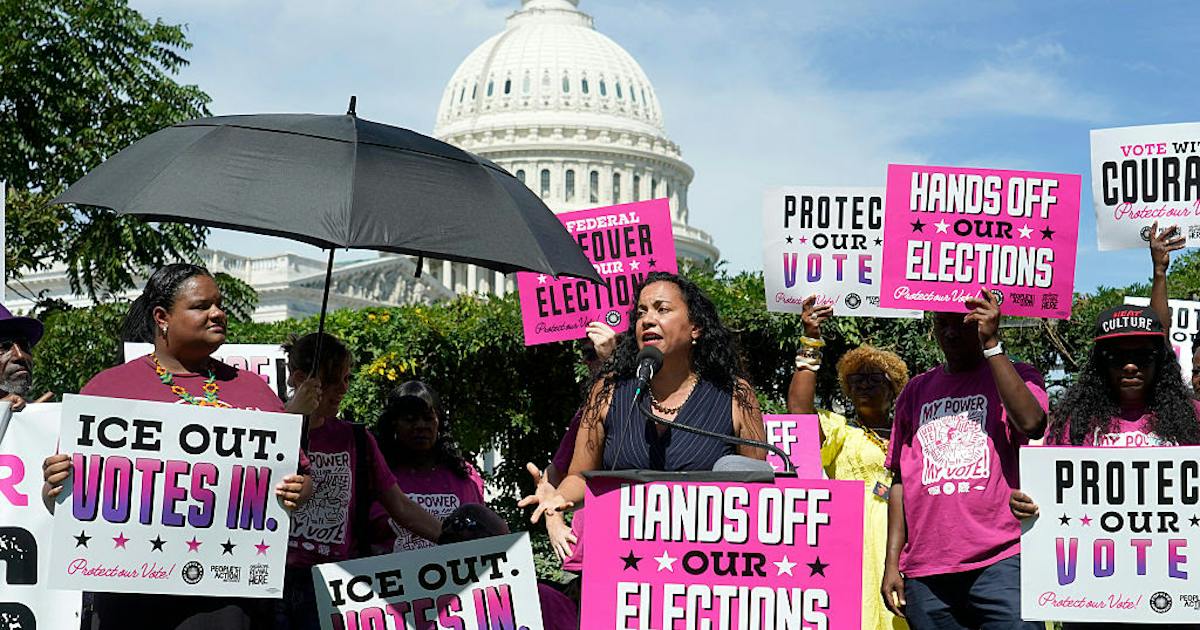
You’re reading The TNR Blue Book. Get daily scoops, strategy, and developments inside the liberal ideas factory delivered right to your inbox. Sign up for free.Inside WashingtonHow do you stop election tampering before it happens?A potential crisis was averted last week when the Supreme Court blocked President Trump’s plan to restrict mail-in voting. But election integrity experts and lawmakers are still lying awake at night worrying about threats on the ground: physical intimidation at polling places, ballots seized, and postelection insurrection.On Friday, a coalition led by the NAACP filed a lawsuit asking for a court order to prevent the Trump administration from deploying federal agents to the polls “in a manner that unlawfully intimidates voters or anyone urging or aiding voters.” The coalition, which includes a number of labor unions, is concerned that Immigration and Customs Enforcement or National Guard presence at the polls could discourage naturalized citizens or Hispanic voters from voting.But that’s not the only scenario worrying people. “We have no idea what Trump will do next because his entire presidency this time and last time has been totally unpredictable and chaotic,” said Jane Kleeb, the vice chair of the Democratic National Committee and president of the Association of State Democratic Committees, or ASDC. “What I am really worried about is the possibility of a law enforcement warrant to seize election materials and ballots,” said Shelby Wayment, a staff attorney at UCLA Law’s Safeguarding Democracy Project. The group recently released a guide for judges if they do receive a request for a warrant to seize election materials. The government has attempted to do similar seizures before—the FBI seized 2020 voting records in Fulton County, Georgia, and the Department of Justice has attempted to get warrants for 2024 voting records in Wayne County, Michigan.Wayment is particularly concerned that this could happen in states like California (where tabulating the vote notoriously takes a long time) or in counties that are critical to determining who ultimately takes control of the House. “If the chain of custody is disrupted” by having ballots seized, Wayment explained, “you don’t really have clear evidence of who has handled those ballots, where those have been.” Even though Trump’s plan to restrict mail-in ballots was blocked, advocates are looking at other aspects of the March executive order that established that plan. In that same executive order, Trump instructed the federal government to create lists of citizens in each state and send the lists to the state election officials. The idea behind the citizenship lists, explained Aria Branch of Elias Law Group, would be to force states to purge voters who aren’t on those lists, no matter that the lists could be incorrect. Litigation is ongoing to prevent this, but Branch is still concerned. “I don’t think that we are out of the woods on that issue at all,” she said.Democratic lawmakers, election officials, and civil society groups have been collaborating in the lead-up to November. On September 14, the ASDC launched the New Battlefield Project to protect the midterms across all 50 states. The project is threefold—training up to 10,000 volunteers to be poll watchers, pushing voters to vote as early as possible, and establishing the Democracy Defense Network, a group of analysts who monitor election disinformation and scare tactics and inform state parties about what they’re seeing.“What keeps me up at night is the idea that all of the insurrectionists [Trump] pardoned would be summoned to get their buddies and go outside of polling locations and drop-box locations to intimidate voters,” said Kleeb. To counteract that threat, the ASDC will train volunteers to show up at polling places and peacefully observe, gathering any information necessary for lawsuits if something goes wrong. The New Battlefield Project is also funding “Election Protection Directors” in 20 states that didn’t have the resources to hire anyone for the role. These directors will coordinate with the DNC if anything goes awry in their state’s elections, assemble teams of lawyers, and help coordinate the poll-watching volunteers.Last week, Representatives Analilia Mejia, Emanuel Cleaver, Emily Randall, and Suhas Subramanyam introduced a resolution affirming the House’s commitment to enforcing the Fourteenth and Fifteenth Amendments and protecting voting rights. “Congress must act before the next election is upon us,” Mejia wrote in a statement to The New Republic. She pointed to the John R. Lewis Voting Rights Act, though that legislation is unlikely to be passed anytime soon. “Congress has a constitutional responsibility to oversee elections, and we are derelict in our duties,” Mejia said.Her co-sponsor, Subramanyam, is looking ahead to what could happen after the election. “I’m concerned that after the election, when Democrats win the majority, at least in the House, the president will call into question the results of the election and try to make that a mainstream Republican viewpoint,” he told The New Republic. He worries that there could be another January 6–style insurrection. If that happens, he explained, “certainly we’ll appeal to the courts to make sure that they implement the results of any election.” But if Republicans and the administration don’t back down, he said, “people will need to take to the streets.” Branch agrees that November 3 won’t be the end of things. “Election Day is sort of the beginning of this,” she said. “We also have to get the election certified, and then we have to get our members seated.”—Emma JanssenOutside WashingtonPlaying with fire: “Only eight of 160 utility companies that operate in fire-prone areas of Texas” have complied so far with a 2025 law requiring them to submit wildfire mitigation plans, The Texas Tribune reports. GOP state Representative Ken King, who spearheaded the 2025 law, is displeased. But there’s some interesting context to this news item that might not be immediately apparent to readers outside the state.Focusing on electrical utilities has been a relatively popular GOP response to wildfires in recent years. GOP Senate candidate Ken Paxton, for example, as state attorney general, sued the electrical company believed to be responsible for the Smokehouse Creek fire. Any talk of how climate change is increasing wildfire risk, by contrast, is off the agenda. (Bizarrely, Paxton actually suggested ESG—a.k.a. “environmental, social, and governance” business practices—might have led to the fires.) The 2025 wildfire mitigation law known as H.B. 145, though, was actually one of a trio of laws passed in response to the deadly 2024 Panhandle wildfires. The other fires burning around the time of the Smokehouse Creek fire are believed to have been caused not by a utility company but by private lines supplying an oil field. Accordingly, H.B. 143 and 144, which King also spearheaded, gave the state (especially via the Texas Railroad Commission, which regulates the oil industry) more regulatory oversight over oil and gas field electrical equipment. Anything involving the oil industry in Texas is, obviously, a little more politically sensitive. (Even King in 2024 prefaced these proposals by telling the Tribune he would “never do anything to damage the oil and gas industry in our state.”) Right now, fossil fuels are a white-hot issue in the fight for Texas’s vital Senate seat. Paxton, a lifelong fossil fuel champion, has accused Democrat James Talarico of having “dedicated his career to trying to destroy the oil and gas industry.” Talarico, who has previously backed emissions-reductions targets and whose campaign materials cite wildfires as one of the dangers associated with climate change, has taken pains in recent weeks to emphasize his support for a fossil fuel–inclusive, “all of the above” energy policy (a position that gives climate activists nightmares).Meanwhile, the race for a spot on the body newly tasked with inspecting oil field electrical equipment—the Texas Railroad Commission—has garnered national attention, after Republican candidate Bo French’s racist tweets prompted “shocked, shocked!” responses from state Republicans who cannot possibly have been surprised by this. Karl Rove even took to The Wall Street Journal to declare his allegiance to Democrat Jon Rosenthal instead.Elsewhere:Record diesel prices are hammering the agriculture and trucking industries. NPR talks to fourth-generation farmer John Boyd Jr. in Virginia, and highlights the plight of Black farmers at risk of losing their farms. MPR News in Minnesota features the perspective of truckers who may “fill up 200 to 240 gallons at a time”—an act that now costs “more than $1,200.” Republicans are getting visibly nervous, and have proposed a diesel export ban and more.—Heather Souvaine HornThe Ideas FactoryWednesday at 5 p.m., the Brookings Institution, America’s Rural Future, West Virginia University’s Reed School of Media and Communications, and the American Enterprise Institute co-host an event at West Virginia University about the loss of local news and its impact on rural communities. Speakers include Mayor Amy Shuler Goodwin of Charleston, West Virginia, and Rebuild Local News director of policy Matt Pearce.Tuesday at 11 a.m., the Center for American Progress hosts a conversation with Senator Tammy Duckworth on “the evolving challenges posed by the People’s Republic of China, as well as opportunities for strategic engagement within the bilateral relationship.” CAP senior vice president Damian Murphy will offer opening remarks, and senior fellow Jonathan Fritz will join Duckworth onstage for the discussion.In case you missed it: The Progressive Policy Institute last week released an intriguing report profiling Democratic candidates who have succeeded in working-class districts. A rather pointed quote from the interview Robin Johnson, the report’s co-author, did with Vox for the release: The successful candidates, Johnson said, “are from a variety of backgrounds … and we want to contrast that with the consultants who tried to make the perfect Frankenstein candidate out of [former Maine Senate candidate Graham] Platner. These people are out there—you don’t need to create it. They’re out there.”—Heather Souvaine HornIn Closing: Four Questions ForDustin Gouker, journalist covering gambling and prediction marketsQ: Who are you, and what are you working on right now?A: I am a longtime journalist who currently self-publishes two newsletters: The Closing Line, which focuses on gambling, and The Event Horizon, which focuses on prediction markets. I am trying to figure what’s next for prediction markets and for me. It’s easy not to look past the next newsletter, given the aggressive news cycles these days.Q: What is the most common misconception you regularly see about how prediction markets operate?A: I think too many people see prediction markets as a binary thing that is good or bad, and gambling or not gambling. There is a lot of good in prediction markets, but it’s accompanied by some nonsense. And while betting parlays and sports sides are pretty clearly gambling, there are markets that are legitimately useful from a price discovery and economic value standpoint. I don’t think prediction markets should be pigeonholed.Q: Is internal enforcement enough for keeping prediction markets in check, or would you like to see more regulation?A: I am afraid of what will happen if there’s not more regulation of prediction markets. Don’t get me wrong, there is definitely regulation, and much of it is good. But some of that regulation doesn’t treat prediction markets as gambling products, and I don’t think there are enough guardrails in some areas.Q: What keeps you going in these stressful times?A: I have always been a writer, and the task of writing and publishing two newsletters pretty much every day is something I can fall back on. I am blessed that I get to work for myself and do something I love and that other people value.Interview by Grace SegersPolitical Trivia Question of the DaySince it’s U.N. week, a rare question on international rather than U.S. politics. The first two secretaries-general of the U.N. were both from Scandinavia. Can you name them and the countries they came from? (Sign up for The TNR Blue Book to find the answer in tomorrow’s newsletter.)
How Do You Stop Election Tampering Before It Happens?
Full Article
Original Source
Read the full article at Newrepublic →KhanList aggregates and links to publicly available news content. We do not host full articles from third-party sources. Always verify important information with original sources.