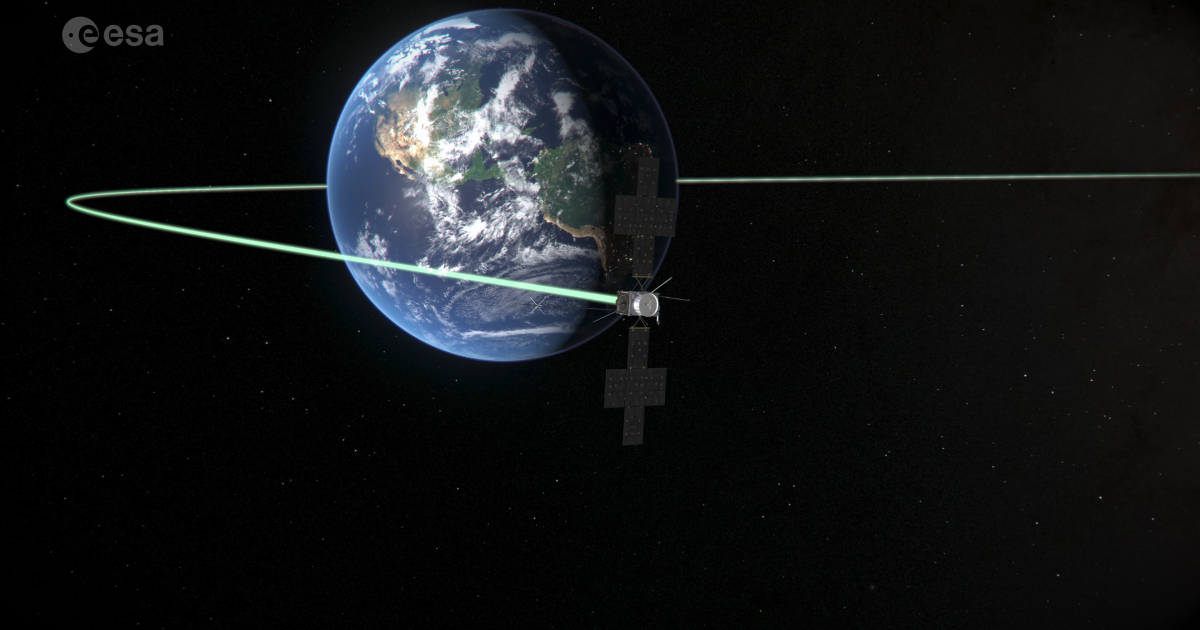
During a slingshot maneuver, the planet and spacecraft draw close enough together for an exchange of energy to occur. | Published: August 17, 2026 ESA's JUICE spacecraft, bound for Jupiter's Galilean moons, performed flybys of the Moon and Earth to help boost it on its way. Credit: ESA - European Space Agency If a satellite’s velocity increases as it approaches a planet during a slingshot maneuver, why does it not decrease by the same amount when it leaves the planet? How can it experience a net gain in velocity? Robert WaltyStephens City, Virginia Slingshot maneuvers can seem counterintuitive. We know that a spacecraft speeds up as it approaches a planet but slows down as it pulls away. Consequently, you might think that the close passage of a spacecraft near a planet should have zero net effect. But spacecraft can and do use gravitational slingshot maneuvers to receive a substantial velocity boost. Let’s break down such an encounter. As a spacecraft approaches a planet, the planet’s gravity draws it forward. During the close approach, the planet imparts a fraction of its orbital momentum to the vessel: The planet will slow imperceptibly in its orbit while the craft is accelerated to a higher velocity. This is because a system’s overall momentum must be conserved. In this case, it is conserved by the balance between the planet’s negligible speed loss and the vessel’s considerable speed gain. So, as the spacecraft leaves the planet’s vicinity, why does it not give back the speed that it gained? In fact, from the planet’s point of view, it does: If you were on the planet and looked at the spacecraft an equal amount of time before and after the craft’s closest approach, it would be moving at the same speed both times. But the planet itself is orbiting the Sun. The planet’s momentum thus accelerates the spacecraft in a different direction than the path the craft came in on, causing it to swing around the planet, increasing its speed through the solar system. Quite often, a spacecraft will be programmed to ignite its rockets at the moment of close approach to maximize this velocity boost. The Voyager missions extensively employed slingshot maneuvers to guide the two probes through the outer solar system. Voyager 1 was slingshotted by Jupiter toward Saturn, while Voyager 2 used gravity assists from Jupiter to take it to Saturn, from Saturn to take it to Uranus, and from Uranus to take it to Neptune. (In this illustration, a dot appears on the spacecraft’s flight path every four hours.) Credit: Astronomy: Roen Kelly, after NASA; Adobe Stock There is a well-known analogy that involves a person throwing a ball into the path of a passing train; the ball will be moving faster after it hits the train than it was prior to the impact. (Note that from the train’s point of view, assuming the ball and train are perfectly rigid, the ball bounces off with the same velocity with which it struck the train.) This collision also impedes the train’s motion, but the difference in the train’s speed is imperceptible because of the substantial mass difference between the two objects. In a slingshot maneuver, even though the planet and spacecraft don’t actually collide — fortunately for the spacecraft — they draw close enough together for this energy exchange to occur. It’s a win-win-win situation: the probe zips off at a greater clip (win), the planet’s orbit doesn’t change perceptibly (win), and therefore the beleaguered, overworked astronomers involved don’t have to adjust their ephemerides (win). Edward Herrick-GleasonAstronomy Educator, St. John’s, Newfoundland and Labrador
How do slingshot maneuvers work to propel spacecraft?
Full Article
Original Source
Read the full article at Astronomy →KhanList aggregates and links to publicly available news content. We do not host full articles from third-party sources. Always verify important information with original sources.