
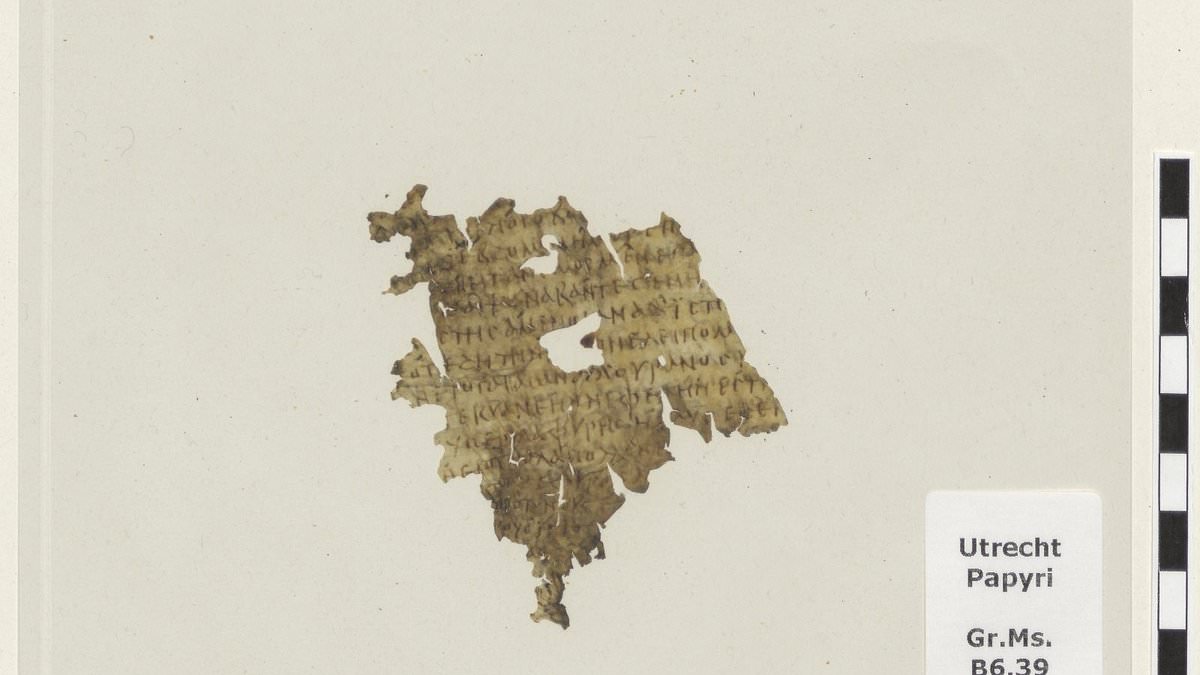
A rare 1,700–year–old fragment of Homer's Odyssey has been found tucked between the pages of a Dutch library book.A researcher was looking through a collection of old Egyptian texts at Utrecht University Library when he came across a torn piece of parchment.Closer inspection revealed the fragment, which measures just 2.6 by 3 inches (6.6 by 7.7cm), includes verses from Book 12 of the epic Greek poem.It describes what happened when Odysseus's crew ate the immortal cattle of the sun god Helios – despite his express prohibition.Helios is so furious, he asks the other gods for revenge – and Zeus sends a terrible storm to rob Odysseus of his ship and companions.This marked a 'tipping point' in the poem, experts said.And, since there are only around 30 similar fragments of the Odyssey found so far, this is a remarkable discovery.They explained: 'This page, written on both sides, will have been a part of a pocket edition of the complete Odyssey – about the size of a Kindle – owned by a fan of Homer living in around 300AD.' The fragment, which measures just 2.6 by 3 inches (6.6 by 7.7cm), includes verses from Book 12 of the epic Greek poemThe parchment was discovered by Dr Mark de Kreij, a Greek literature expert and professor at Radboud University in the Netherlands.He found the parchment while studying early Christian manuscripts at the Utrecht University Library.The majority of these texts were written on parchment in Coptic – the Egyptian language written using the Greek alphabet – but the set included a few Egyptian and Greek papyri.Hidden among these, first regarded as an unremarkable 7th–century fragment, was a damaged and discoloured fragment with very small, neat letters.De Kreij soon recognised a few words typical of the Homer epics.'Book 12 is the final book in Odysseus' nested narrative, before his actual return to Ithaca,' Utrecht University said in a statement.'In book six, he arrived at the island of Scheria, home to the Phaeacians, after a storm wrecked his ship and killed all of his companions.'After his arrival, Odysseus tells his hosts in books nine to 12 about the journey that brought him from Troy to Scheria.' A fresco painted by Pellegrino Tibaldi in 1556, depicting the moment Odysseus' men steal the sacred cattle The downfall of Odysseus and his men comes when they arrive at Thrinacia, the island of Helios. Pictured: A scene from the latest film, with Matt Damon playing OdysseusThe journey includes encounters with Cyclops and the powerful goddess Circe, which both Odysseus and most of his crew escape from.But their downfall comes when the men arrive at Thrinacia, the island of Helios.The poem tells how Odysseus' right–hand–man begs him to let them land and find food. Odysseus agrees but forbids them from harming any cattle.When food supplies run low, the crew kill and eat the sacred beasts – leading to the wrath of Helios and the revenge of Zeus, which destroys their ship and all the crew, except for Odysseus.'The verses (found within the library book) describe exactly the moment Helios finds out what Odysseus' companions have done,' the university said.'This leads to the lowest point of Odysseus' 10–year journey, but also the start of his mission of revenge against the men who are trying to take charge of his wife Penelope and his palace on Ithaca.'This is a crucial tipping point in the Odyssey, and not by chance roughly halfway through the 24 books.'Earlier this year, a fragment from another of Homer's epics – the Iliad – was found inside the gut of an Egyptian mummy dating back 1,600 years.This marked the first time a Greek literary text had been found incorporated into the preservation process.It was found in a Roman–era tomb in the ancient Egyptian city of Oxyrhynchus, situated 118 miles (190km) south of Cairo in an area now known as Al–Bahnasa.The researchers say the papyrus was placed in the abdomen as part of the embalming ritual, which involved dehydrating the body and wrapping it for protection.Excavations have already uncovered examples of Greek writing included in the mummification process, but all contained magical or ritualistic content.The Iliad, which dates back to 800BC, is divided into 24 books.It mainly focuses on the Trojan War and the heroic deeds and tragic fate of Achilles, the greatest warrior of the Greek army. Who was Homer? Homer is traditionally regarded as the earliest known Greek epic poetHe is credited with composing the Iliad and the OdysseyThe Iliad tells the story of the Trojan War, while the Odyssey follows the journey of Odysseus Scholars believe he lived around the late 8th or early 7th century BCVery little is known about his life, and some historians question whether he was a real personHis works come from an oral storytelling tradition, meaning they were likely performed before being written downAncient Greeks often believed Homer was blind, though there is no proof of thisHe is usually depicted as an older man with a beard and sightless eyesOther works, such as the Homeric Hymns, were later attributed to him but are not considered authenticA group of performers called the Homeridae claimed to carry on his storytelling tradition
How did that get there? 1,700-year-old fragment of Homer's Odyssey is discovered hidden between the pages of a Dutch library book
Full Article
Original Source
Read the full article at Dailymail →KhanList aggregates and links to publicly available news content. We do not host full articles from third-party sources. Always verify important information with original sources.