
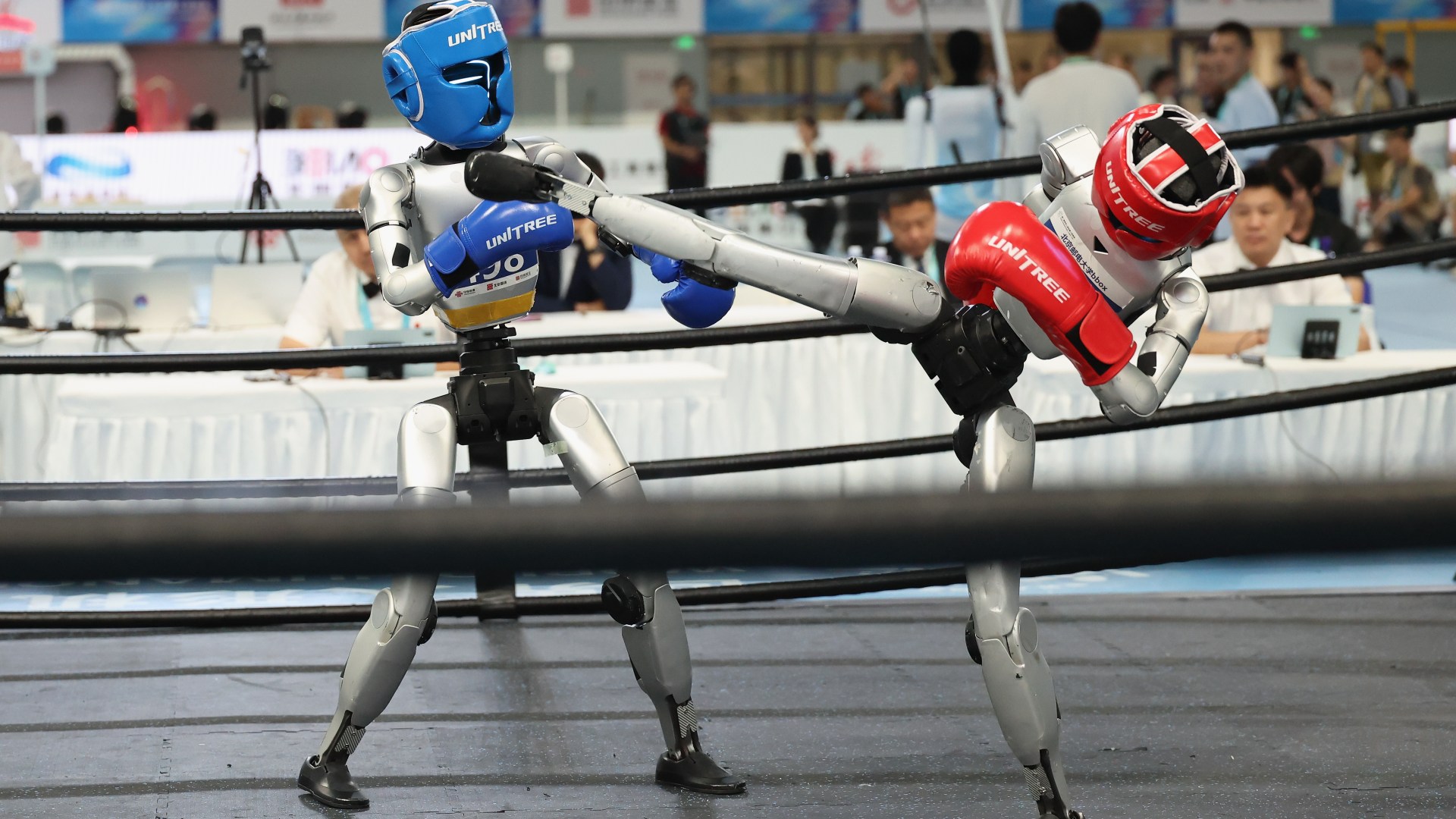
WHEN Usain Bolt became the fastest man on Earth in 2009, he performed that trademark victory pose — stretching out his arm towards adoring fans. In sharp contrast, Tiangong Ultra — the robot that beat the Jamaican sprint legend’s 9.58-second record in the 100m at the weekend — needs to do a bit of work on its celebration. Humanoid robots compete in the lightweight combat event during the 2nd World Humanoid Robot Games in Beijing, China Credit: Getty A robot competes in the long jump event during day two of the games Credit: Getty After crossing the finish line in a blistering 9.39 seconds, it crashed into a padded wall, collapsed on the ground and went to sleep. Welcome to the 2nd World Humanoid Robot Games — part sci-fi fantasy and part knockabout comedy. Sign up for the Tech newsletter Thank you! The five-day event in Beijing, which began on Saturday, has revealed both how far machines have come and how far they have yet to go. The crowd laughed as some of the ungainly robots smashed into pieces, bumped into each other or fell over. Others burst into flames and had to be doused down by marshals — a far worse outcome than the false starts or pulled muscles witnessed in the traditional Olympics. But the audience also cheered as the best of the machines surpassed humans in speed and distance, breaking records in the 100m, 400m, 1,500m and high jump. And for the tech companies taking part — the vast majority of them Chinese — there is fierce rivalry as they jostle to become leaders in a field that is projected to earn vast fortunes. At last year’s games, Unitree Robotics’ androids showed off their kung fu and kickboxing skills. Most read in Tech Tennis is among the sporting events that the robots can take part in Credit: Getty This pair of football bots didn’t crumble under pressure but some bumped into each other, swung wildly at the ball and huddled together Credit: Getty Last week Unitree, based in Hangzhou, launched on the Shanghai stock market to great fanfare. On its first day of trading, its share value rose more than 460 per cent. Despite the excitement, at this year’s games there have been plenty of empty seats in the arena, suggesting audiences still prefer to watch human athletes over soulless robots. But robotics expert David Levy told The Sun: “The idea of the robot Olympics is a great one because the companies taking part are pushing forward the frontiers of knowledge. “This is what happened in computer chess — programs got better and better due to championships. “Although there have been some problems this year with the robots crashing, it is very good for the development of robotics.” More than 2,000 human-like machines from 666 teams across the globe are taking part in 51 events at the games, more than double the number that attended last year. As well as showing off their sporting prowess, the androids are also competing to show how fast they are at such events as Power Tool Assembly and Tweezers Bean Picking, and how dextrous they are at Jenga. The robots take the weightlifting event seriously Credit: Getty As well as showing off their sporting prowess, the androids are also competing to show how fast they are at events including Jenga Credit: Reuters Among the sporting events are tennis, table tennis, football, boxing, gymnastics, tug of war, weightlifting and cheerleading, with probably the most entertaining events being the 100m and 400m obstacles. Even though the hurdles were far lower than the ones faced by human athletes in the steeplechase, many of the bots still tripped over them. Manchester City’s goal machine Erling Haaland can also rest easy in the knowledge that he won’t lose his place to a robot any time soon. The football bots bumped into each other, swung wildly at the ball and huddled together, though one of the more talented ones did perform Cristiano Ronaldo’s jumping “Siuuu” celebration without mishap. Similarly, the robot boxers would not have troubled late heavyweight legend Muhammad Ali — although one punch was able to send a droid flying out of the ring. Where human Olympians might need to worry is in sprint events and the high jump. After smashing Usain Bolt’s 100m world record by nearly a fifth of a second, Tiangong Ultra broke the decade-old 400m world record set by South Africa’s Wayde van Niekerk at Rio’s Olympic Games. It finished in 38.16 seconds, beating Wayde’s 43.03 seconds, while lesser competitors strayed into the wrong lane, wobbled about while trying to keep up and fell over before reaching the finish line. The robot boxers would not have troubled late heavyweight legend Muhammad Ali Credit: AP The audience cheered as the best of the machines surpassed humans in speed and distance – while the worst crashed and burned Credit: Getty The 1,500m was over in two minutes, 21 seconds, annihilating Moroccan Hicham El Guerrouj’s 1998 record time of three minutes, 26 seconds. Cuban Javier Sotomayor’s high-jump record of 2.45 metres has stood since 1993, but robotics firm X-Humanoid’s machine smashed that achievement by managing 2.88m. All these headline-grabbing triumphs were achieved by robots made in China. More than 90 per cent of the androids competing in the games are from the Communist nation, which leads the world in robotics. A humanoid robot fell and caught fire after crossing the finish line in the 100 meter preliminaries Credit: Getty Staff use extinguishers after a humanoid robot caught fire after finishing a 100m large-sized group preliminary race Credit: Reuters David, author of the book Love And Sex With Robots, warned: “We should be sitting up and taking notice. The Chinese are way ahead in robotics. Development of robotics is expensive and the Chinese Communist Party is making sure all the research universities have the funds to add to the current state of knowledge.” At the moment the United States leads the way in artificial intelligence and is trying to catch up with China when it comes to robots. The world’s richest man Elon Musk wants to build massive factories to build his two-legged Optimus bots, which he hopes will become commonplace in people’s homes. The truth is that the robots on display on the athletics track this week are not likely to replace the likes of Usain Bolt one day — they are there to showcase what these firms’ products can do on the domestic and work front. The robot of CUEB Zhizao competes during the final of Tai Chi Credit: Alamy THE RECORDS 100mHuman: 9.58secsRobot: 9.39sec 400mHuman: 43.03secsRobot: 38.16secs 1,500mHuman: 3mins 26secsRobot: 2mins 21secs High jumpHuman: 2.45mRobot: 2.88m In future they will be carrying out domestic chores and replacing jobs, and for that reason the Robot Games also had less spectacular events such as Garden Management, Book Sorting and Powder Weighing. Even so, rapid improvements in AI are sure to lead to further leaps at next year’s games. The faster that machines can learn by themselves — which is where AI comes in — the sooner they will be able to replicate human dexterity. David said: “Any AI can be added to robots to make them more human.” Except they won’t be making mistakes like we do. We might be laughing at the bumbling bots right now, but this is a very serious competition. Comment now
How crazy robot games sees AI-powered droids shatter human world records while others crash into walls and explod
Full Article
Original Source
Read the full article at Thesun →KhanList aggregates and links to publicly available news content. We do not host full articles from third-party sources. Always verify important information with original sources.