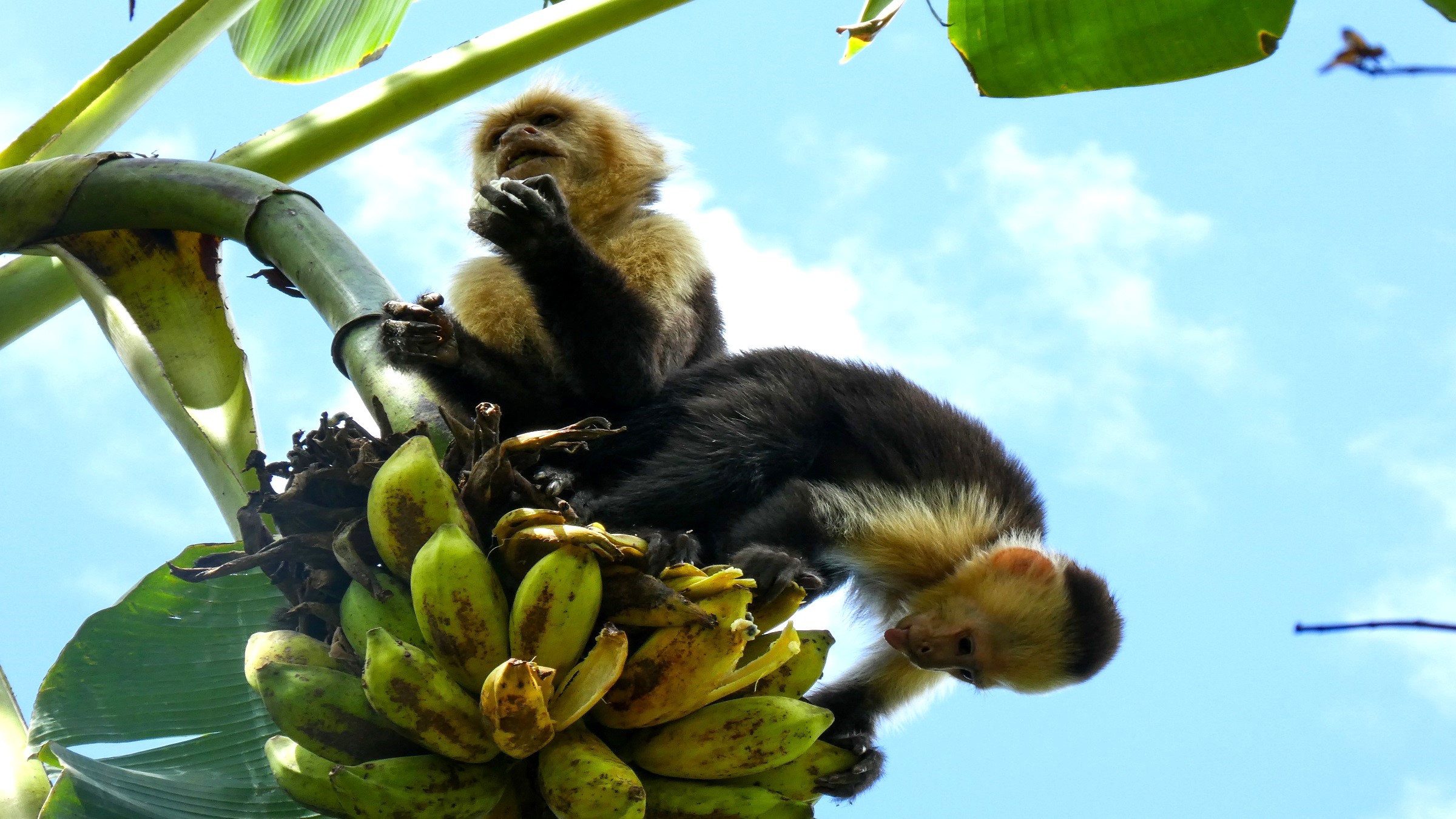
For 33 years, a research team has studied white-faced capuchin monkeys in the tropical dry forests of Costa Rica, gathering data on their complex social lives.A new study from the team shows that during extreme climate events, large groups of capuchins may go hungry, while smaller groups may fare better.Climate extremes alter the physical landscape, causing animals to change their societal behaviors. For capuchins, this means greater competition for food, heightened territorial sensitivity and fluctuating group sizes.While capuchins can adapt to environmental changes over time, there are limits to their resilience, as seen during the severe droughts caused by the El Niño in 2014-2016, when dwindling food sources caused capuchins to abandon societal norms in search of food. COSTA RICA: Dawn is yet to break when primatologist Susan Perry and her field research team move through Costa Rica’s tropical dry forest for a day in the field studying Central American white-faced capuchin monkeys. Despite the darkness, the forest is humming. Perry calls this juncture “the changing of the guard,” when nocturnal animals end their day and diurnal species are just beginning theirs. As the team approaches the site where the capuchin (Cebus imitators) sleep, the location of which changes nightly, spiders’ glittering eyeshine emblazons the ungraspable dark of the forest. Perry, an evolutionary anthropology professor at UCLA, has researched capuchin monkeys living in and near the Lomas de Barbudal Biological Reserve for the past 33 years. She documents their complex social behaviors and group dynamics with a revolving team of scientists, capturing the intricacies of capuchin society while remaining on the periphery. A new study analyzing Perry’s observations of 12 neighboring capuchin groups over her 33 years in the field documents how extreme climate events, such as El Niño, alter the costs and benefits of living in large groups for capuchins. In the field, the researchers go through a highly intentional process to remain separate: Perry leaves her study subjects untagged and uncollared, and instead, identifies and gets to know each individual. These monkeys are listed as vulnerable by IUCN. They live in one of the most endangered and biodiverse habitats in the world:tropical dry forest. Due to deforestation and fire damage, just 1% of the original primary tropical dry forest in Costa Rica remains intact. Capuchin monkeys socialize on a rock. Image by Keith Heyward. New research details capuchin behavior This body of research concludes that capuchin societies are adaptable to fluctuating environments. However, extreme climate events challenge the advantages of living in large groups and restructure their way of living and interacting with one another. “This study found that climatic extremes compounded the ecological stresses on capuchin groups, and were not beneficial for capuchin welfare or survival,” says Laura Bolt, a primatologist at the University of Toronto, in an email to Mongabay. “There really are no positives to capuchin reactions to climate change, except that so far, they have shown resilience and adaptability in human-modified landscapes and similarly, have survived at species level during climatic extremes.” While animal social behavior has historically fluctuated with shifting environments, long-term climate change could direct the evolutionary trajectory of capuchin social behavior, says says Odd Jacobson, a wildlife ecologist at the Max Planck Institute of Animal Behavior who works with Perry and led the study. “Our findings highlight a potential mechanism explaining how and why group sizes vary widely within populations and over time.” A capuchin family hangs out on a tree branch. Image by Keith Heyward. In the field with capuchins As the sun rises and morning drifts, the team follows the troupe as it travels through the forest, feeding on scorpions, ants and guácimo fruit, or gnawing on sticks. Groups range widely in size, anywhere from just four animals to 39, Jacobson says. The team’s data collection is meticulous and the terrain they traverse is harsh. Decades of immersive insight into the complexity of capuchin social groups, across generations, is essential to understanding how time and environmental changes gradually affect the cognition, politics and culture of animal societies. As the day wears on, the team scales lush hills and cliffs and crosses cool rivers and streams, a respite from the aching heat. The researchers dodge thorn brush, cacti and barbed wire: The land was cattle pasture before it was protected. It’s an extremely biodiverse region and, as omnivores, capuchins are generalist feeders that have lots of food options. Owing to their mobility and intelligence, they’re highly adaptable: They have the largest brain-to-body size ratio of any primate besides humans and have been using stone tools for at least 3,000 years, Perry says. “Until pretty recently, I had this feeling that they could just adapt to anything.” Susan Perry and her daughter, Kathryn, observe and collect data on capuchin monkeys in the field. Image by Keith Heyward. Impacts of a changing climate It wasn’t until an El Niño-induced drought in 2014-2016 that Perry realized the capuchins were hitting their limits. This climate phenomenon alters weather patterns, including intense dry spells in Central America. As severe drought desiccated the forest, the capuchins suffered. They became more territorial and spent entire days foraging for resources with little luck. Ribs protruded beneath their fur. Perry noted that 84% of infants born during the drought died; 26-30% is typical. Twenty of the 59 females in her study also died. For the first time, she documented female capuchins ignoring their infants’ cries and leaving them to die while they searched helplessly for food. “Clearly, at the end of that drought they had lost their ability to cope,” she says. Normally, larger capuchin groups tend to have resource-gathering advantages because of their sizable ability to outcompete smaller neighboring groups. But the researchers discovered that during extreme climate events, especially severe drought, living in large groups became less beneficial because of high competition for limited food resources. “The way they’re adjusting for the climate is via more subtle mechanisms,” Perry says. “Some of it is dispersing to a group of a better size.” It isn’t inherently negative for capuchin groups to downsize, but there are tradeoffs. Smaller groups, while dealing with less internal competition as they search for food during extremes, may not be able to defend their territory against larger groups. Competition within and between groups is exacerbated during the dry season, which lasts from December to the end of April in Costa Rica, when resources are concentrated in areas along waterways. During periods of environmental stability, the costs of large-group living are low and the benefits high. But as the climate grows more unstable, extreme heat, drought and flood are expected to happen more often, become more intense and last longer, according to the U.N. Intergovernmental Panel on Climate Change (IPCC). According to the latest climate models, there is a 90% chance that the current El Niño could break records as the strongest ever. For capuchins, living in smaller groups could be more sustainable in times of environmental duress, says Jacobson. Weather extremes, amplified by climate change, not only alter the physical landscape for wildlife, but can also cause animals to distinctly modify their societal behaviors, the study said. The tree canopy covers the terrain of the study zone. Image by Odd Jacobson. An adaptable species Three decades of data show that capuchin societies have historically adapted to environmental change in various ways: By expanding their territories; fluctuating the sizes of their groups; or shifting the ways they interact with rival groups. This is especially apparent during dry conditions, Jacobson says, when resources become spatially limited and it becomes more likely that groups of capuchins must interact or defend resources from other groups. Though the monkeys can adapt, there are limits to their resilience, as seen in the physical and behavioral changes that occurred from 2014 to 2016. “Clarifying how these processes interact over time is important because it helps us better understand the evolution of sociality, the environmental conditions under which it is favored and its trajectory in a rapidly changing world,” Jacobson says. As afternoon bleeds into evening and evening into dusk, the capuchin group that the researchers are monitoring comes to a stop and looks for a suitable tree to sleep in. Perry’s team hears birdsong giving way to the sound of frogs, crickets and whining mosquitoes. They are bug-bitten, exhausted and ready for bed, too. “It is always my hope that any form of publicity for the capuchins will encourage humans to take the kinds of conservation action that will make their lives a bit easier,” Perry says. She suggests starting fewer forest fires, refraining from deforestation and reforesting deforested areas with heat and fire-resistant species that provide food for capuchins and neighboring wildlife. The capuchins’ ability to adapt to fluctuating climates is both a testament to their resilience and a warning bell for other species facing worsening environmental changes that may occur more quickly than they can adjust. A capuchin monkey jumps from one tree to another. Image by Keith Heyward. Banner image: Under difficult circumstances when food is scarce, capuchin monkeys alter their behavior. Image by Odd Jacobson. Adam Litchkofski is a documentary photographer and journalist from northeast Pennsylvania who explores the intersection of environmental science and culture. More to explore: What is a white-faced capuchin? Candid Animal Cam meets monkeys Citation: Jacobson, O. T., Crofoot, M. C., Finerty, G. E., Barrett, B. J., & Perry, S. E. (2025). Environmental fluctuations alter the competitive trade-offs of group size in a social primate. Nature Ecology & Evolution, 10, 919-931. doi:10.1101/2025.08.12.669921 FEEDBACK: Use this form to send a message to the author or editor of this post. If you’d like to post a public comment, you can do so at the bottom of the page. Credits Topics
How Costa Rica’s extreme climate changes the social behaviors of white-faced capuchin
Full Article
Original Source
Read the full article at News →KhanList aggregates and links to publicly available news content. We do not host full articles from third-party sources. Always verify important information with original sources.