
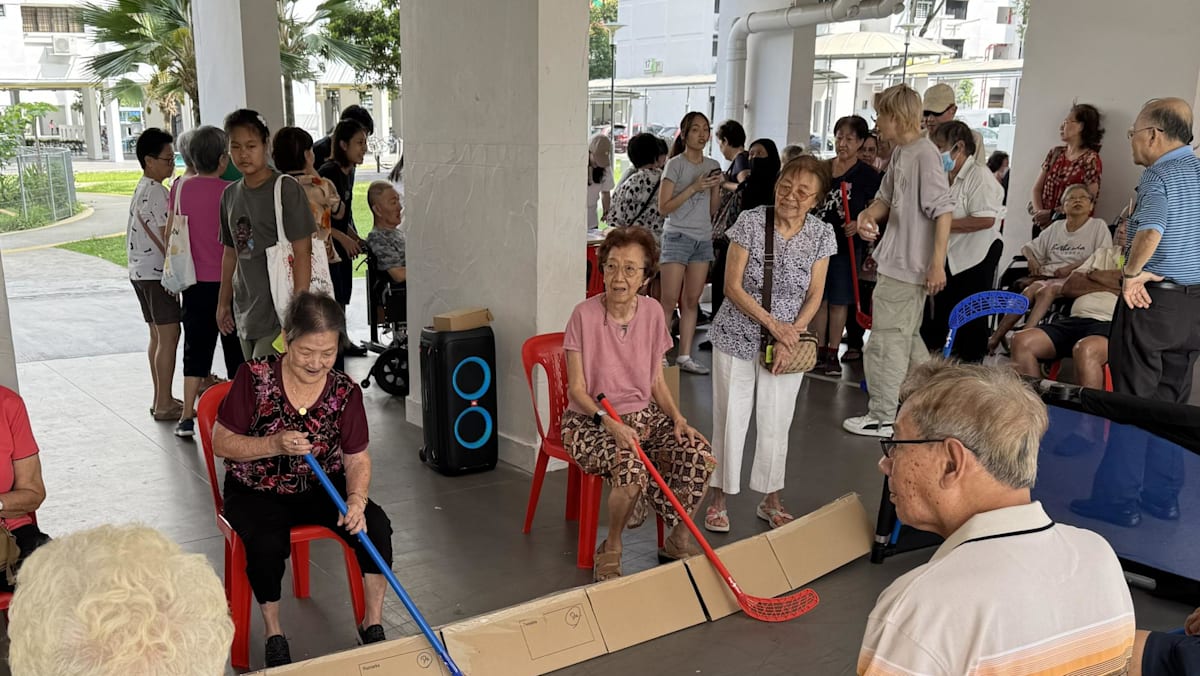
Advertorial As 4S marks its 30th anniversary, two care recipients show how personalised support, community partnerships and opportunities to contribute can help people take greater charge of their lives. Seniors play seated hockey during an activity session at a 4S Active Ageing Centre. (Photos: 4S) New: You can now listen to articles. This audio is generated by an AI tool. 04 Nov 2026 08:13AM (Updated: 04 Nov 2026 08:15AM) When Ms Rose* first arrived at Thuja Home – a welfare home run by social service organisation 4S – even remembering to take her daily medication was a challenge. Facing financial difficulties and family violence, she had no job or family support and little confidence in herself. Over seven years at the home, Ms Rose progressed from taking her medication under staff supervision to managing her own schedule, with occasional staff check-ins over WhatsApp. Today, she handles her own health needs independently in the rental flat she shares with her friend, Ms Lilac*, whom she met at Thuja Home. Their transition from welfare home residents to living independently in the community reflects 4S’ philosophy of person-centred care, which tailors support to each care recipient’s circumstances, needs and aspirations.“Person-centred care understands the person as a whole – their strengths, relationships, interests and aspirations – and creates the conditions for them to continue participating, contributing and finding meaning in their lives,” explained Ms Nura Hassan, CEO of 4S. Ms Nura Hassan, CEO of 4S, says better coordination across care services is key to meeting each individual’s needs. 4S, which marks its 30th anniversary this year, is the managing agent appointed by the Ministry of Social and Family Development for four welfare homes – Acacia Home, Bukit Batok Home for the Aged, and Tembusu Home and Thuja Home at Pelangi Village. 4S also runs the 4S Active Ageing Centre @ Eunos Crescent and the 4S Eldercare Centre @ Eunos Crescent. The eldercare centre provides day care, rehabilitation and nursing support for seniors and their caregivers. Across these homes and centres, it provides different levels of support, from helping seniors age well in the community to providing care and stability in its welfare homes. Between 2025 and 2026, 4S supported 665 welfare home residents and 993 clients at its active ageing and eldercare centres, said Mr Siu Yow Wee, president of 4S. He said: “Thirty years have taught us that meaningful care cannot be measured only by the number of services provided. It is also reflected in whether the person receiving care feels seen, respected, included and empowered.” Mr Siu Yow Wee, president of 4S, believes meaningful care goes beyond the services provided to how valued and empowered recipients feel. SUPPORTING RESIDENTS’ PATH TO INDEPENDENCENow 45, Ms Rose works as a cleaner while Ms Lilac, 44, works as service crew at a cafe. Before moving into their flat in April, the pair shared a dormitory room at Thuja Home to get used to living together. “Over the following year, our caseworker continued checking in with us, and we went for outings and sessions to prepare for independent living, including learning about budgeting and community resources,” said Ms Rose. Staff also taught the pair how to manage and pay household bills and use Google Maps to get around Singapore.Successful reintegration means more than being discharged from a welfare home, said Ms Nura. “It is about whether the individual has developed the confidence, capabilities and support network to sustain life in the community,” she said. Residents at Tembusu Home and Thuja Home also learn to use digital devices with help from volunteers through 4S’ collaboration with the Infocomm Media Development Authority under the Digital for Life movement. The devices are funded by Micron through the Community Chest. Such partnerships are important because no social service agency can address every aspect of a person’s needs on its own, said Mr Siu. “The future of care must be built as a network rather than as a collection of standalone services,” he said.GIVING CARE RECIPIENTS A SENSE OF PURPOSEVolunteers play different roles across 4S, from Canberra Secondary School students who befriend residents at Acacia Home to seniors who find ways to contribute.One of them is Mr Sa’aban Ali, a 79-year-old former professional musician who attends day care at 4S Eldercare Centre @ Eunos Crescent. Mr Sa’aban spent three decades performing Latin American music with his band Los Santos in Singapore – with tours in Japan and Taiwan – before retiring in 1999. After becoming visually impaired and needing help to move around, he continued playing at home, but much less often. A volunteer helps Mr Sa’aban Ali as he accompanies a fellow senior on the guitar. At the eldercare centre, the care team learnt about his musical background and encouraged him to play more regularly. A staff member donated a guitar to the centre and changed its strings to suit his preference. Staff also gave him space to practise and used YouTube to help him revisit songs he had forgotten. Last year, the 4S care team arranged for him to perform at an event in Sentosa organised by Changi General Hospital. “It felt wonderful to be performing in front of an audience once more,” he recalled. “The encouragement and opportunities the staff gave me helped me to regain my confidence as a musician.”Today, Mr Sa’aban guides other seniors at the eldercare centre in singing. As part of a mini band with other senior volunteers, he performs once every fortnight at the 4S Active Ageing Centre @ Eunos Crescent’s Silver Brews and Bites sessions. “I am happy that I can continue using the experience I gained over many years as a musician to share music with others,” he said. Mr Sa’aban’s journey from care recipient to volunteer shows how care can support not only a person’s health and functional needs but also their confidence, relationships and sense of purpose, said Ms Nura. “Our role is not just to deliver rehabilitation, day care or social activities as separate services, but to consider how these different forms of support can work together around the person.”Looking ahead, Ms Nura said sustaining this approach would require 4S to adapt as care needs evolve. “That requires us to keep strengthening our capabilities, rethink how we work and respond to emerging needs with greater agility,” she added. Residents and volunteers from 4S’ welfare homes on an outing at Gardens by the Bay. For 4S, this also means evolving without losing sight of what should remain constant – its mission, values and commitment to person-centred care.As 4S enters its next chapter, Mr Siu hopes it will be remembered for the experience people have in its care. “For me, that is the reputation worth building over the next 30 years: not simply to be better known, but to be known for care that people can feel,” he said.4S’ 30th anniversary fundraising campaign aims to raise S$30,000 and runs until September 2027. Funds raised will support its welfare homes and community care centres. Visit 4S’ website or social media channels for more information. *Residents’ names have been changed to protect their privacy.
How coordinated care can help seniors and vulnerable individuals find independence and purpose
Full Article
Original Source
Read the full article at Channelnewsasia →KhanList aggregates and links to publicly available news content. We do not host full articles from third-party sources. Always verify important information with original sources.