
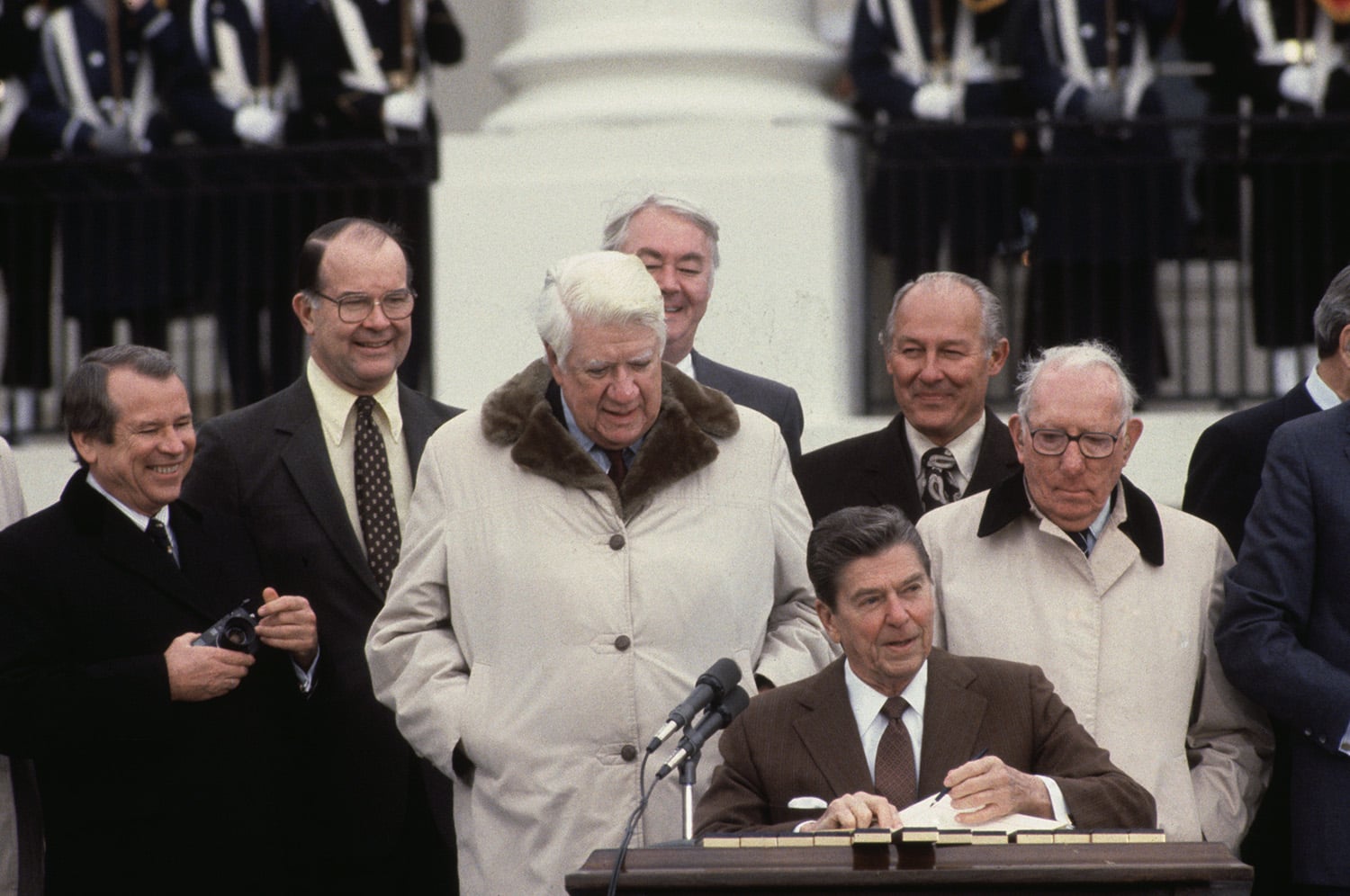
Social Security faces a major fiscal challenge. The program, which has provided retirement, survivor, and disability benefits to millions of Americans since its creation in 1935, is projected to soon cost more than its total income. The budgetary shortfall is already prompting the government to draw down reserves, which will reach unsustainable levels by the early 2030s. As more baby boomers retire, the number of beneficiaries is rising faster than the number of workers contributing payroll taxes. A September report from the Congressional Budget Office warned that, without reforms, benefits may have to be cut by 26 percent. Although the program’s creators in 1935 envisioned building up reserves, Social Security has been financed largely on a pay-as-you-go basis since Congress enacted changes between 1939 and 1950. The payroll taxes collected from current workers and employers, together with taxes on benefits and interest income, finance the benefits of current retirees. What will Congress do? In a hyperpolarized environment on Capitol Hill, with a president who has shown little concern about governing, the prospects for a resolution remain uncertain. The stakes are high. Millions of Americans depend on this program for their retirement income. After paying taxes throughout their time in the labor force, retirees expect the benefits they were promised. Allowing this pillar of the social safety net to collapse would be disastrous for U.S. workers and the broader economy. In the early 1980s, Congress faced a similar crisis and acted. Although the solution that a bipartisan coalition put into place in 1983 has itself contributed to the challenges policymakers face today, the political approach they took remains instructive. Indeed, it is the only viable path forward. At a critical moment, elected officials from both parties demonstrated that they could forge an agreement necessary to govern. Congress created Social Security in 1935, and was paid for through an earmarked payroll tax that funded the benefits of retirees. President Franklin Roosevelt supported the tax because he wanted workers to see Social Security as a “contributory” system rather than public welfare. “With those taxes in there,” Roosevelt later said, “no damn politician can ever scrap my social security program. Those taxes aren’t a matter of economics, they’re straight politics.” Under the original plan, workers and employers would begin paying Social Security taxes in 1937, while monthly benefits would not be distributed until 1942. The delay would allow the government to build reserves that would be invested in government bonds. Initially, the program covered primarily industrial and commercial workers. Domestic and farm workers, the self-employed, government civil servants, and other categories of work would be incorporated over time. With the Social Security Amendments of 1939, Congress accelerated the distribution of benefits while extending coverage to survivors and dependents. Policymakers also scaled back the plan to build a large reserve, in large part because they feared that old-age assistance, a means-tested welfare program funded through general tax revenues (also part of the Social Security Act of 1935), was far more popular in the states. Economists were also concerned about the consequences of accumulating an enormous federal reserve fund. The Social Security Amendments of 1950 further entrenched a shift toward a pay-as-you-go system, in which payroll taxes finance monthly benefits. The program’s actuaries make recommendations based on 75-year projections. The program continued to grow over time and to become popular among Republicans and Democrats. In 1954, Republican President Dwight Eisenhower, who was no radical, wrote, “Should any political party attempt to abolish social security, unemployment insurance, and eliminate labor laws and farm programs, you would not hear of that party again in our political history.” Congress continued to expand the program over the next decade, with both parties regularly agreeing to increase benefits. In 1965, Congress created Medicare, raising payroll taxes to finance hospital insurance for the elderly in a program connected to Social Security. In 1972, Congress passed additional Social Security amendments, which indexed benefits to inflation by tying them to the Consumer Price Index. A flaw in the new formula, “the double-indexing” problem, however, produced benefit increases that were larger than lawmakers had anticipated. During the 1970s, Social Security entered a period of financial crisis. High inflation drove up benefits, while high rates of unemployment reduced the number of workers paying into the system. In 1977, Congress attempted to address the short-term crisis by raising payroll taxes and correcting the technical error in the 1972 law. But the Social Security Amendments of 1977 did not resolve the program’s financial challenges. By the early 1980s, policymakers recognized that Social Security faced a short-term financial shortfall that could hit by 1983, caused by stagflation as well as a long-term imbalance stemming from the anticipated retirement of the baby boom generation and longer life expectancy. The path toward a resolution was contentious, partisan, and grueling. In the spring of 1981, President Ronald Reagan’s first attempt to address the problem turned into a political disaster. His administration proposed deep reductions in early retirement benefits. It separately supported eliminating the minimum benefit, a cut that made it through Congress in 1981 before being reversed later that year. Rumors circulated in Washington about additional reductions that he intended to pursue. Democratic Speaker of the House Tip O’Neill saw an opening to attack the conservative president, leading a coalition that charged the administration with trying to dismantle the cherished program. The charge had some foundation, given that conservatives such as Republican presidential candidate Barry Goldwater in 1964, for whom Reagan had campaigned, had talked for years about making Social Security voluntary. The Republican-controlled Senate rejected Reagan’s proposal, and the president backed down. The battle reinforced the idea that Social Security was a “third rail” in U.S. politics: Politicians who touched it risked political electrocution. Democrats made Social Security a major issue in the 1982 midterms, when they gained 26 seats in the House. Still, Social Security’s fiscal problems did not disappear. Reagan, in consultation with congressional leaders, established a 15-member bipartisan National Commission on Social Security Reform, headed by the economist Alan Greenspan, who had chaired the Council of Economic Advisers under President Gerald Ford and advised President Richard Nixon. The commission included representatives from the worlds of politics, labor, and business, and its ultimate report received widespread praise. However, getting there wasn’t easy. After an initial deadlock, but with broad agreement on the nature of the problem, a smaller group of officials and congressional negotiators met privately at the home of White House chief of staff James Baker. As reality that a financial reckoning was looming soon set in, the commission reached an agreement in January 1983, and its recommendations became the basis for congressional action. The Social Security Amendments of 1983, which the president signed into law on April 20, accelerated payroll tax increases, raised contributions from the self-employed, delayed cost-of-living increases, and subjected a portion of the benefits received by higher income beneficiaries to income taxation. The law also brought several categories of workers into the system and gradually raised the full retirement age from 65 to 67. Republican Rep. Barber Conable Jr. told his colleagues: “This is not a work of art. But it is artful work.” In the end, many believed that the realization the program could implode propelled the last-ditch compromises. Both parties made concessions to reach a deal. Democrats accepted the six-month cost-of-living delay and new taxation for higher income recipients while Republicans accepted additional revenues, including the accelerated payroll tax increases. Upon signing the bill on a stage decorated with red, white, and blue bunting in front of 400 people, Reagan said: “This bill demonstrates for all time our nation’s ironclad commitment to social security. It assures the elderly that America will always keep the promises made in troubled times a half century ago. It assures those who are still working that they, too, have a pact with the future. From this day forward, they have one pledge that they will get their fair share of benefits when they retire. And this bill assures us of one more thing that is equally important. It’s a clear and dramatic demonstration that our system can still work when men and women of good will join together to make it work.” Today, there is considerable nostalgia for the 1980s as a golden era of civility and bipartisan cooperation, a memory that obscures the bitter partisan divisions of the Reagan years. Yet the Social Security Amendments of 1983 remain an important testament to what the nation’s political parties can achieve when they turn their attention to governing rather than endless warfare. The final bill was far from perfect. The changes did not permanently resolve Social Security’s long-term fiscal challenges, including those associated with the retirement of the baby boomer generation. Nor did legislators anticipate how growing wage inequality would create additional financial pressures on the program. The governing environment has since become considerably more difficult. Hyperpolarization has made bipartisan agreements harder to reach, while today’s media ecosystem, characterized by openly partisan outlets and unfiltered social media awash in disinformation, has largely eliminated the closed spaces in which party leaders once negotiated agreements that risked angering constituents. The Republican Party has also shifted much further to the right since the 1990s, demonstrating a greater willingness to cut core social safety net programs, including those that benefit working-class Americans whom President Donald Trump helped bring into the GOP. Nonetheless, leaders in both parties understand that Social Security remains enormously popular. That political reality explains why Trump has remained opposed to cutting Social Security benefits, even as he has targeted almost every other part of the federal government. If Democrats retake control of Congress in the midterms, strengthening Social Security will have to be a top priority. They will test the insightful scholarship of political scientists such as Princeton’s Frances Lee and Philip Wallach of the American Enterprise Institute, who have published forceful arguments about how Congress can and still works. If Democrats take on that challenge, as they must, they will learn whether there is any room to work with Republicans in Congress and the White House to secure a program that has saved millions of elderly Americans, and their families, from the devastation of poverty.
How Congress Fixed Social Security During Its Last Crisis
Full Article
Original Source
Read the full article at Foreignpolicy →KhanList aggregates and links to publicly available news content. We do not host full articles from third-party sources. Always verify important information with original sources.