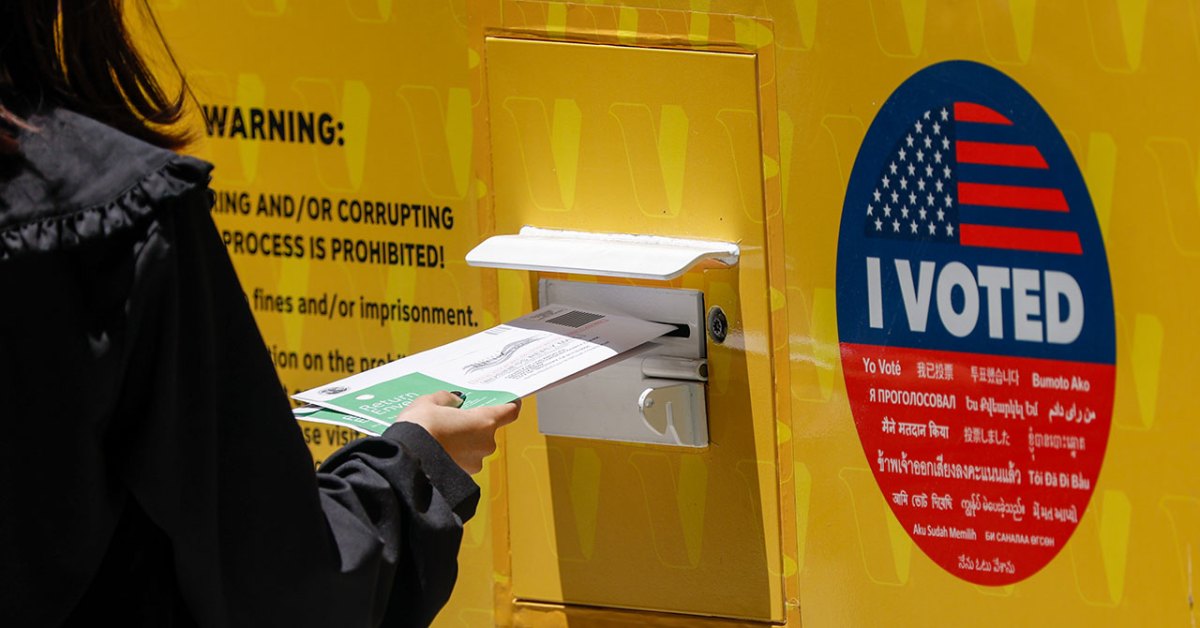
A person drops off a mail-in ballot during early voting outside the Los Angeles County Registrar-Recorder building on June 1, 2026, in Norwalk, California. (Ronaldo Bolaños/Los Angeles Times via Getty Images) A narrow majority of Americans (55%) are confident that this November’s midterm elections will be conducted fairly and accurately – down from 61% ahead of the 2024 elections, 64% in 2022 and 59% in 2020. Confidence in the fairness and accuracy of elections is lower than in past years, but with no partisan gap % who are ___ confident that the elections this November will be conducted fairly and accurately Source: Survey of U.S. adults conducted July 6-12, 2026. PEW RESEARCH CENTER Confidence in the fairness and accuracy of elections is lower than in past years, but with no partisan gap % who are ___ confident that the elections this November will be conducted fairly and accurately GroupSomewhatVeryNETApr ’20Total451459Aug ’22Total392564Jul ’24Total372461Jul ’26Total401555Apr ’20Rep/Lean Rep552075Aug ’22Rep/Lean Rep341246Jul ’24Rep/Lean Rep361147Jul ’26Rep/Lean Rep421355Apr ’20Dem/Lean Dem37946Aug ’22Dem/Lean Dem433781Jul ’24Dem/Lean Dem383977Jul ’26Dem/Lean Dem391858 Source: Survey of U.S. adults conducted July 6-12, 2026. PEW RESEARCH CENTER But in contrast to those earlier years, Americans’ views don’t differ substantially by party today, even as Republicans and Democrats express different concerns about elections. Among Republicans and Republican-leaning independents: 55% now say they have confidence the upcoming midterms will be conducted fairly and accurately. This is up from 47% in the summer of 2024 and 46% in the summer of 2022. Joe Biden was president in both years. But it is lower than in the spring of 2020, during President Donald Trump’s first term (and in the early months of the COVID-19 pandemic). About this research This Pew Research Center analysis looks at Americans’ views about the upcoming midterm elections, including whether they will be conducted fairly and accurately and whether all eligible citizens – and no ineligible voters – will be able to vote if they wish to. Why did we do this? Pew Research Center does research to help the public, media and decision-makers understand important topics. We have studied Americans’ views of voting and elections for decades.Learn more about Pew Research Center and our politics research. How did we do this? Most of the data for this analysis comes from a Center survey of 3,554 U.S. adults conducted July 6-12, 2026. Everyone who took this survey is part of the Center’s American Trends Panel. The survey reflects the views of all U.S. adults. Here are the July survey questions we used for this analysis, the detailed responses and the survey methodology. This analysis also uses data from a Center survey conducted April 20-26, 2026. Here are the April survey questions, along with responses, and the survey methodology. Among Democrats and Democratic leaners: 58% now express confidence in the fairness and accuracy of this year’s elections. Confidence today is substantially lower than in 2024 (77%) and 2022 (81%). Confidence remains higher than in April 2020, when 46% of Democrats expressed confidence the 2020 election would be conducted fairly and accurately. The new Pew Research Center survey of 3,554 adults was conducted July 6-12. The survey also finds that 66% of Americans overall are very or somewhat confident that all citizens who want to vote this November will be able to cast ballots. Republicans have long been more likely than Democrats to express confidence on this question. But the partisan gap was narrower in 2024 and 2022 than it is today: 83% of Republicans now say they are very or somewhat confident that all citizens who want to vote in November will be able to do so. Republicans are far more confident than Democrats that all citizens who want to vote will be able to % who are ___ confident that all citizens who want to vote in the elections this November will be able to Source: Survey of U.S. adults conducted July 6-12, 2026. PEW RESEARCH CENTER Republicans are far more confident than Democrats that all citizens who want to vote will be able to % who are ___ confident that all citizens who want to vote in the elections this November will be able to GroupSomewhatVeryNETApr ’20Total392563 Aug ’22Total403373 Jul ’24Total423376 Jul ’26Total392866 Apr ’20Rep/Lean Rep464187 Aug ’22Rep/Lean Rep384583 Jul ’24Rep/Lean Rep404383 Jul ’26Rep/Lean Rep364783 Apr ’20Dem/Lean Dem321143 Aug ’22Dem/Lean Dem422466 Jul ’24Dem/Lean Dem452571 Jul ’26Dem/Lean Dem411253 Source: Survey of U.S. adults conducted July 6-12, 2026. PEW RESEARCH CENTER Far fewer Democrats (53%) express a similar level of confidence. In 2024 and 2022, during Joe Biden’s presidency, larger majorities of Democrats (71% and 66%, respectively) expressed confidence that every interested citizen would be able to vote. However, the partisan gap was even wider in April 2020 than it is today. At the time, 87% of Republicans and fewer than half of Democrats (43%) expressed confidence. And two-thirds of Americans – including 80% of Democrats – thought it was very or somewhat likely that the COVID-19 pandemic would significantly disrupt Americans’ ability to vote that November. Will all eligible voters – and no ineligible voters – be able to vote? A separate Pew Research Center survey – conducted April 20-26, 2026, among 5,103 U.S. adults – finds that an overwhelming majority of the public (90%) says it is very or somewhat important that “no eligible voters are prevented from voting” in U.S. elections. Nearly as many (85%) say it is important that “no ineligible voters are permitted to vote.” Wide, bipartisan majorities view each of these as at least somewhat important: 89% of Republicans and 92% of Democrats say it is important to ensure that all eligible voters can vote. 92% of Republicans and 79% of Democrats say it is important that no ineligible voters are permitted to vote. But there are substantial partisan differences on whether U.S. elections achieve these goals. Republicans are 16 percentage points more likely than Democrats (77% vs. 61%) to say the following statement describes U.S. elections very or somewhat well: “No eligible voters are prevented from voting.” Wide partisan differences in perceptions of whether any eligible voters are prevented from voting – and whether any ineligible voters are permitted to do so How well does each describe elections in the U.S.? (%) Source: Survey of U.S. adults conducted April 20-26, 2026. PEW RESEARCH CENTER Wide partisan differences in perceptions of whether any eligible voters are prevented from voting – and whether any ineligible voters are permitted to do so How well does each describe elections in the U.S.? (%) QuestionVery wellSomewhat wellNETTotalNo eligible voters are prevented from voting303868Rep/Lean RepNo eligible voters are prevented from voting393877Dem/Lean DemNo eligible voters are prevented from voting233861TotalNo ineligible voters are permitted to vote292958Rep/Lean RepNo ineligible voters are permitted to vote122537Dem/Lean DemNo ineligible voters are permitted to vote463379 Source: Survey of U.S. adults conducted April 20-26, 2026. PEW RESEARCH CENTER The two groups are even further apart when it comes to ineligible voters casting ballots. Democrats are far more likely than Republicans (79% vs. 37%) to say the following statement describes U.S. elections at least somewhat well: “No ineligible voters are permitted to vote.” Fewer than half of Democrats (46%) and just 12% of Republicans say this statement describes elections very well. Public views – including partisan differences – are largely unchanged on these questions since we first asked them in 2018. Note: Here are the July survey questions we used for this analysis, the detailed responses and the survey methodology. And here are the April survey questions, along with responses, and the survey methodology. Additional demographic chart Older Americans, those with college degrees have greater confidence in upcoming midterm elections % who are ___ confident that the elections this November will be conducted fairly and accurately Source: Survey of U.S. adults conducted July 6-12, 2026. PEW RESEARCH CENTER Older Americans, those with college degrees have greater confidence in upcoming midterm elections % who are ___ confident that the elections this November will be conducted fairly and accurately GroupSomewhatVeryNETTotalTotal401555WhiteRace/Ethnicity421557HispanicRace/Ethnicity391554BlackRace/Ethnicity321850Asian*Race/Ethnicity441862Ages 18-29Age35145030-49Age37124950-64Age43165965+Age471966College grad+Education441761No college degreeEducation381452Rep/Lean RepRep/Lean Rep421355ConservRep/Lean Rep411153Mod/LibRep/Lean Rep421659Dem/Lean DemDem/Lean Dem391858Cons/ModDem/Lean Dem412061LiberalDem/Lean Dem371654 Source: Survey of U.S. adults conducted July 6-12, 2026. PEW RESEARCH CENTER Andrew Daniller is a research associate focusing on politics at Pew Research Center.
How confident are Americans in the midterm elections’ fairness and accuracy?
Full Article
Original Source
Read the full article at Pewresearch →KhanList aggregates and links to publicly available news content. We do not host full articles from third-party sources. Always verify important information with original sources.