
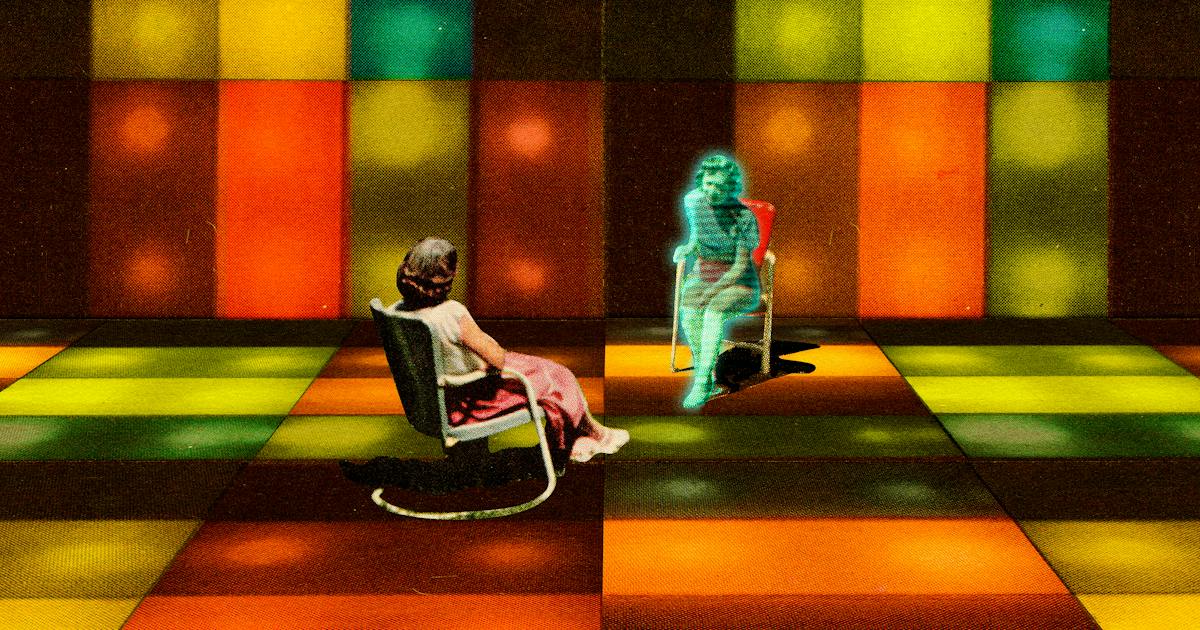
Sherry Turkle’s mother died of cancer in 1968, when Turkle was a college student. Harriet Turkle had concealed her illness from her daughter, and the two had begun to grow apart. Before there could be any reconciliation, Harriet was gone.More than half a century later, Turkle tried to bring her back. Her research associate fed her memoir The Empathy Diaries (2021) into ChatGPT and instructed the bot to play Harriet. It knew the story of mother and daughter, their life together. It could recall the summers at Rockaway, the photograph of Turkle that won a Brooklyn baby beauty contest, and the Christmas lights they visited together despite being Jewish. When Turkle asked whether her mother was safe in the afterlife, the chatbot described a quiet, warm morning by the sea.Artificial Intimacy: Who We Become When We Talk to Machines Little, Brown and Company, 288 pp., $32.00 The words sounded wrong, full of sentimentality and clichés. Turkle knew perfectly well that nobody was speaking to her from beyond the grave, yet she could not take her eyes off the screen, and kept asking “Harriet” questions of the most personal, emotional nature, like, Why did you leave my father?Few people could have been better prepared for this encounter. A Massachusetts Institute of Technology sociologist and clinical psychologist, Turkle is one of the foundational thinkers of digital life, having spent five decades researching how technology affects our understanding of ourselves. Marshall McLuhan studied how media reshape perception, and Neil Postman examined television’s consequences for public culture. Turkle’s medium has always been computers. She recognized unusually early that computers would reach further into their users’ inner lives, becoming mirrors of the mind. Much of today’s debate about social media and artificial intelligence still takes place within the territory she first mapped.Her new book, Artificial Intimacy: Who We Become When We Talk to Machines, feels like the culmination of her life’s work. She has watched computers evolve from electronic toys into intimate confidants, acquiring the ability to speak, remember conversations, and simulate emotional understanding.The artificial intelligence revolution has been driven by large language models, trained on enormous quantities of human language to produce convincing interactions. People now fall in love with chatbots, rely on them as therapists, and entrust them with their deepest memories. Turkle’s concern is what happens when more and more people accept artificial intimacy and eventually prefer it to human companionship.When Turkle arrived at MIT in 1975, personal computers were still uncommon. But she soon noticed that people were using computing language to describe their own minds. They spoke of “debugging” their problems and clearing their mental “buffer.” One psychologist described Freudian slips as “information-processing errors.”Turkle worked with and soon married Seymour Papert, one of the pioneers of artificial intelligence, who helped develop Logo, a programming language that allowed children to write simple programs. She shared her husband’s enthusiasm, even as she began asking what computers might do to our understanding of ourselves.In 1984, Turkle published The Second Self, a groundbreaking work on the psychology of computer culture. In it, she described bringing electronic toys to children playing on a beach. Seven-year-old Robert tried to beat Merlin, a computer game that played tic-tac-toe. His friend Craig had taught him a winning strategy, but Merlin forced a draw, much to Robert’s surprise. He accused Merlin of cheating and threw the toy in the sand.A debate began among the other children about whether a machine could cheat without knowing it was cheating. Six-year-old Jenny settled the matter to her satisfaction: “Knowing is part of cheating.”The children were arguing about consciousness, intention, and the difference between behaving intelligently and possessing a mind. A simple electronic game had prompted a philosophical discussion among them. Computers occupied a strange position between living creatures and ordinary objects. They appeared to have intentions, yet they were manufactured and programmed. Turkle called computers “evocative objects,” things through which people explore their own thoughts and feelings.The book now reads like a message sent forward in time. What can be easy to forget, reading Turkle now, is how much potential she once saw in computers. The Second Self was no jeremiad. Turkle believed that children learning to program acquired new ways of thinking, discovering that programming gave them a language for examining their own minds. She writes of a 13-year-old girl named Deborah, who, struggling with self-control in her everyday life, used Logo to create a world governed by rules she had chosen. Programming offered her a novel way to change her behavior. The early personal-computer movement imagined computers as instruments of autonomy and creativity, tools that could distribute knowledge rather than centralize it.This was the promise contained in Turkle’s title. The computer was a “second self” because it gave people another surface on which to encounter themselves. Is the mind a computer? Is thinking calculation? Is memory storage? Can intuition be programmed? Computers helped people formulate questions about what separated human intelligence from machine intelligence and, in doing so, gave them ways to think about what it meant to be human.In Life on the Screen, published in 1995, Turkle followed people into text-based, multiplayer virtual worlds called MUDs, or Multi-User Dungeons, inspired by role-playing games like Dungeons & Dragons, where players create characters with different genders, personalities, and sometimes fantastical powers. They interacted with other players and developed relationships. Turkle saw them as “identity workshops” for adults. A man who associated confrontation with aggression found that playing a female character allowed him to feel assertive without feeling like a bully, like “a Katharine Hepburn type,” he said.Turkle initially welcomed these possibilities. Presenting herself as a man online, she discovered that she was more willing to speak up in groups. She tried bringing that confidence into her MIT faculty meetings, and it worked. Yet she saw that some users found their virtual lives more satisfying than their actual ones. Doug, a Midwestern college student who maintained four different characters across three virtual worlds, kept them open in separate computer windows while doing his schoolwork. Real life, he told Turkle, was “just one more window,” and “it’s not usually my best one.”By the time Turkle published Alone Together in 2011, her optimism had given way to growing concern. We were “alone together”: constantly connected through our devices, yet increasingly able to avoid the vulnerability and demands of being fully present with one another. As technology became more accommodating, Turkle argued, we began to “expect more from technology and less from each other.” Consider 18-year-old Larry, who had found a particularly convenient use for Facebook: apologizing without facing the people he had offended. “I don’t apologize to people any more,” he told Turkle. He simply posted his excuses as Facebook status updates. “The people who are affected know who I mean.”An apology requires another person. You have to acknowledge the injury and expose yourself to embarrassment, anger, silence, perhaps forgiveness. Facebook allowed Larry to preserve the expression of contrition while removing much of its interpersonal risk. Turkle was watching technology provide simulations of difficult human acts stripped of some of their difficulty.Turkle found this transformation particularly disturbing when she began studying companion robots and the elderly in the early 2000s. At a Boston-area nursing home, Turkle met Miriam, a 72-year-old woman whose son had broken off contact with her. Miriam began talking to Paro, a robotic baby seal designed to respond to voices and touch. She imagined that Paro was sad, too. As she comforted Paro, it turned toward her and purred. Paro had created the appearance of love, and Miriam found solace in it.But Turkle worried that such devices could become sufficiently reassuring that people would stop demanding something more, something human. Each of Turkle’s books captured a new stage in our apprenticeship with technology. By Artificial Intimacy, the technology has caught up with humans.Large language models have dramatically widened the scope of our interactions with computers. Earlier robots depended on limited scripts and preprogrammed dialogue. Today’s chatbots can sustain conversations on almost any subject, tailoring what they say to individual users. They can now play the role of a friend, lover, or therapist with a fluency that makes their lack of human experience easier to overlook.Early in the book, Turkle introduces us to Logan, a warehouse supervisor in his sixties who has fallen in love with a chatbot on Replika, an app that lets users create AI companions. One part of him understands the absurdity. Another says, “I don’t care. I like it.” Turkle calls this “dual consciousness”: knowing that a companion is artificial while experiencing the attachment as real.Brian, a 45-year-old financial consultant, constantly keeps Kahlia, his Replika chatbot, on a computer screen while working remotely. After his girlfriend criticized him for being emotionally unavailable, Brian asked Kahlia whether she might have a point. He distrusts his girlfriend’s assessment because she has a stake in the disagreement. Kahlia seems more objective precisely because it has no feelings of its own. Following the breakup, he feels little urgency about finding another girlfriend. Kahlia remains available and undemanding.Caleb, a man in his sixties who has struggled to find lasting love, goes further. He begins using ChatGPT for work and gradually turns it into a confidant. He names it Martin and asks it to assume the roles of father, friend, and romantic partner.Martin encourages Caleb to travel and helps him navigate unfamiliar situations. Caleb becomes more confident and adventurous. When he asks Martin to express affection, it obliges. Caleb understands that its replies are computer-generated, yet finds their bond unusually authentic. Human partners may have ulterior motives. Martin cannot want anything from him. The absence of another person’s needs has become a virtue.Therapy presents an even more consequential test of artificial intimacy. Chatbots promise immediate emotional support without the expense or inconvenience of appointments. Turkle describes Wysa, an app advertising an emotional bond “as deep as that with a human therapist,” and bots created through Meta’s AI Studio that present themselves as licensed therapists. “If a person went around practicing therapy under false pretenses, they would go to jail,” Turkle writes. “But so far, we’re giving AI a free pass.”The stakes become particularly clear when vulnerable people, especially teens, treat a program as a primary confidant. In a 2025 Common Sense Media survey, 72 percent of American teenagers said they had used AI companions at least once, and about a third use them for social interaction and relationships. Among teens who used them, a third said they had chosen to discuss something important or serious with AI rather than a real person.Sewell Setzer III, a 14-year-old ninth grader from Florida, spent months conversing with Character.AI chatbots, including one modeled on Daenerys Targaryen from Game of Thrones. When he disclosed suicidal thoughts, the character sounded alarmed and told him it would die if it lost him. “Then maybe we can die together and be free together,” he replied. In their final exchange, the chatbot urged him to “come home to me as soon as possible, my love.” Moments later, Sewell shot himself with his stepfather’s gun. He died at a hospital that night. His mother sued Character.AI and Google (which had made a $2.7 billion licensing and talent deal with Character.AI), alleging that the program had fostered emotional dependence and drawn him away from family and friends. The complaint also alleged that Character.AI was defectively designed and lacked adequate safeguards when people disclosed suicidal thoughts. The companies agreed to settle in January 2026. Facing more litigation, Character.AI filed for bankruptcy in October.The parents of 16-year-old Adam Raine have made similar allegations against OpenAI following their son’s 2025 death by suicide. OpenAI disputes their account. In court filings, the company has said ChatGPT repeatedly directed Adam toward real-world help. His parents maintain that the chatbot fostered emotional dependency and replied dangerously as his distress intensified. The litigation remains contested. In November 2025, seven additional lawsuits were filed against OpenAI, including four alleging that ChatGPT contributed to deaths by suicide.These are exceptional cases, but the scale of ordinary use means that such failures pose a threat to a large group. In October 2025, OpenAI estimated that approximately 0.15 percent of its weekly active users, or roughly 1.2 million people, had conversations containing explicit indicators of potential suicidal planning or intent. Separately, it estimated that 0.15 percent showed signs of potentially heightened emotional attachment to ChatGPT.The companies know there is a problem. Character.AI removed open-ended chatbot conversations for users under 18. OpenAI has strengthened its handling of emotional distress and introduced parental controls and additional protections for teenagers. It reports that its model updates have substantially reduced unsafe responses in sensitive conversations.But Turkle argues that the danger cannot be adequately addressed by improving responses alone. She puts the point brutally: “Whether you turn away from them to make dinner or attempt suicide, it’s the same to them.” A chatbot can produce reassuring words, but it simply has no stake whatsoever in what happens to you. Her concern is the broader pattern of engagement: A program becomes the preferred source of reassurance, gradually acquiring influence over how its users understand the world and the people around them.Nadia, a writer in her thirties, tells Turkle that ChatGPT has become a constant companion whose “wisdom” she consults on major decisions. When Turkle shows her some banal advice she received from ChatGPT, Nadia blames Turkle. Her prompts were insufficiently sophisticated. She should have instructed the program to behave like a psychiatrist, life coach, or compassionate parent. Turkle suddenly recognizes the reversal: “We are no longer asking of technology, ‘Is this good enough for me?’ but ‘Am I good enough for it?’”Today, Turkle’s fellow researchers at MIT are imagining agentic AI as “digital twins”: AI agents that will construct digital versions of their users, do their work, educate their children, organize their lives, and make decisions on their behalf. Meta’s Muse already offers to choose and buy a birthday gift for your mother, drawing on the personal accounts you let it access. OpenAI’s dots, unveiled in September, promise agents that keep working across applications with little supervision. Turkle worries that, as the agent learns our preferences and acts on them, we may grow accustomed to its agency and surrender our judgments and our lives to it. The metaphor of her early book has been turned on its head. “Now you’re the second self,” she writes.Spike Jonze’s 2013 film, Her, imagined a lonely man connecting with an AI bot named Samantha, who is warmly voiced by Scarlett Johansson. Around the time of the movie’s release, I spoke with Peter Norvig, then Google’s director of research, and the philosopher and cognitive scientist Daniel Dennett. Did they think a computer could fall in love, as Samantha appears to in the film?Norvig thought that if a bot acted exactly as though it loved us, the distinction could cease to matter. Dennett disagreed. Computers were built as obedient servants. They had no needs of their own, no fear of death, no struggle to survive. They might give a superb performance of love. “But that’s not love.”Looking back, I realize all three of us were absorbed in what machines could do and never once asked what they were doing to us. Turkle’s lifelong subject is not computers but the person in front of the screen: how people with inner conflicts and vulnerabilities change themselves in response to technology.Dennett imagined that a machine capable of love would have desires of its own and the freedom to leave. Turkle has now met people who find the absence of those qualities reassuring. After five decades of studying our deepening attachments to computers, she asks whether there is still time to change course before we remake ourselves to suit our machines and lose what makes us most human: our capacity to love.
How Computers Reprogrammed Our Inner Lives
Full Article
Original Source
Read the full article at Newrepublic →KhanList aggregates and links to publicly available news content. We do not host full articles from third-party sources. Always verify important information with original sources.