
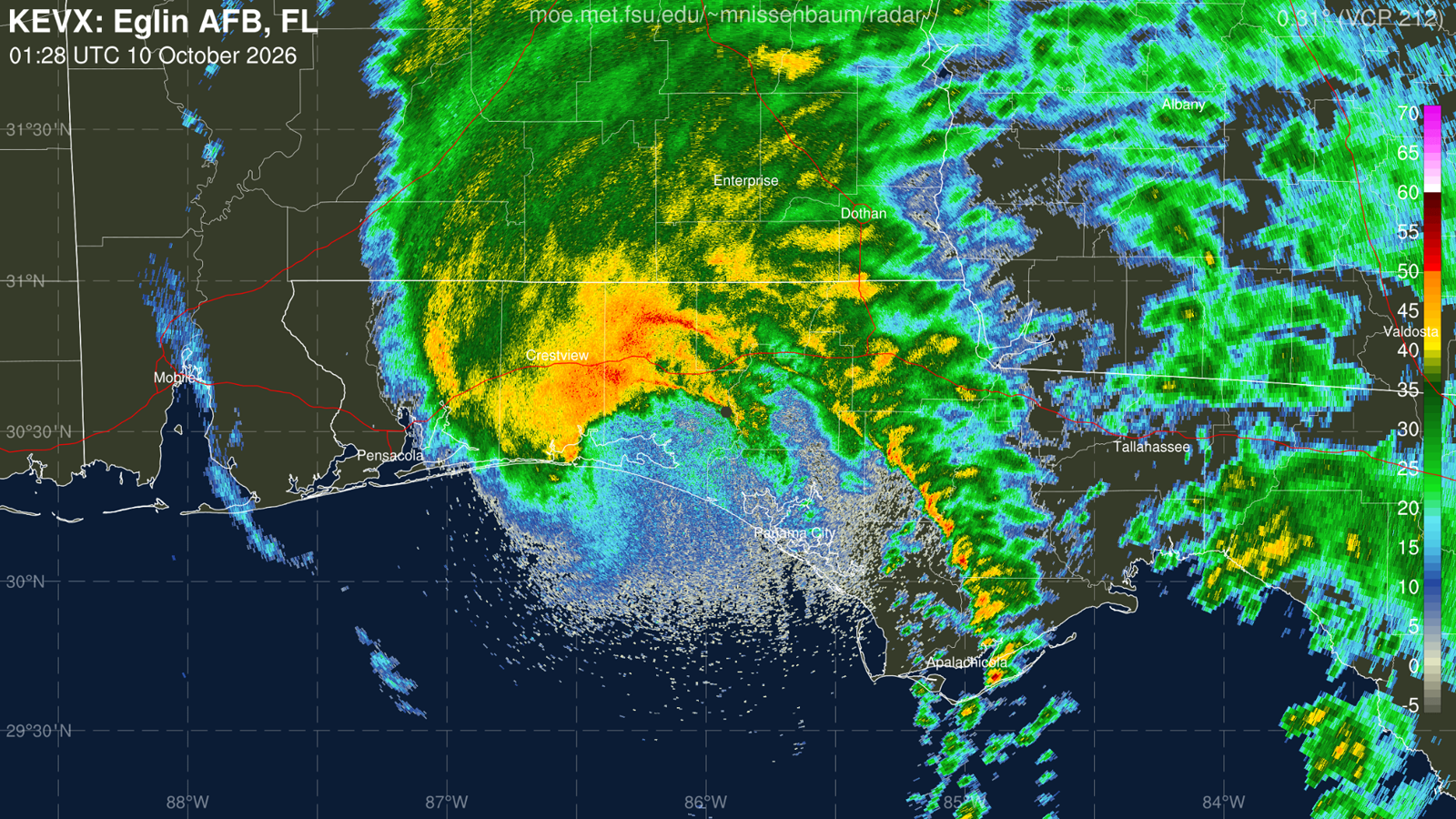
Radar image of Hurricane Isaias at landfall, 9:28 p.m. EDT Oct. 9, 2026. At the time, Isaias was a Cat 2 with 105 mph winds and a central pressure of 971 mb. (Image credit: Florida State University) Hurricane Isaias made landfall around 9:30 p.m. EDT Friday, Oct. 9, near Destin, Florida, at Category 2 strength with top sustained winds of 105 mph (165 km/h) and a central pressure of 971 millibars (28.67 inches). In the final few hours before landfall, high wind shear of 40-60 knots was able to weaken Isaias from its 120-mph peak. Isaias was moving at a fast 18 mph (30 km/h) pace at landfall, and degenerated quickly into a post-tropical cyclone with 35 mph winds at 5 a.m. EDT Saturday, Oct. 10. Most of Isaias’s intense showers and thunderstorms had been focused in the hurricane’s northern half, so conditions improved quickly along the coast after landfall. Ex-Isaias will bring flooding rains, damaging wind gusts, and a few tornadoes to the Southeast today. Isaias had knocked out power to over 900,000 customers across Florida, Alabama, and Georgia as of 9 a.m. EDT Saturday, and is being blamed for one death — from a falling tree in Florida. The price tag for the hurricane will likely be several billion dollars, but it is questionable if Isaias’s impact will be notable enough to gets its name retired. Figure 1. The storm surge from Isaias at the Panama City Beach tide gauge. (Image credit: NOAA) The largest storm surge observed at any NOAA tide gauge from Isaias occurred at Panama City Beach (Fig. 1), which reached 5.59 feet above Mean Higher High Water (MHHW). This is the second-highest water level sine 1995 at the gauge, behind the 6.84 feet observed in Hurricane Opal of 1995. Third through fifth place at the gauge are: 5.43 feet in Hurricane Dennis (2005), 5.08’ feet in Hurricane Ivan (2004), and 3.79 feet in Hurricane Michael (2018). How climate change worsened Hurricane Isaias In a press release on Oct. 9, Dr. Daniel Gilford, Meteorologist and Climate Scientist at Climate Central, said: “The first hurricane of the season clearly shows the fingerprints of climate change. Climate-warmed Gulf waters mean that Isaias is forecast to be 7 mph stronger than it would have been in a world without heat-trapping carbon pollution, increasing the chances of expensive and life-threatening consequences for Gulf coast communities.”A 7 mph increase in winds may not seem like much— that’s about a 6% increase in the Isaias’s winds. But as I explained in my 2026 post, Global warming is making the strongest hurricanes stronger, a 5% increase in hurricane winds yields about a 50% increase in damage: Hurricane damage increases exponentially with an increase in winds (see NOAA’s damage multiplier table). Figure 2. Sea level rise at Pensacola, Florida since their tide gauge was installed in 1923 has been over a foot, with nearly half of that amount attributable to human-caused climate change. (Image credit: Climate Central) Climate Central detailed multiple other ways that climate change made Isaias worse: Isaias underwent rapid intensification over waters that were 1.4 degrees Celsius (2.4°F) warmer on average than they would have been in a world without climate change. These unusually warm Gulf waters, exceeding 31°C (88°F), were made 4 to 600 times more likely due to human-caused climate change, depending upon the exact location in the Gulf being considered. Across the southwest Gulf, where Isaias first organized, the warmth was especially stark, estimated to have been 600-800 times more likely to occur by human-caused climate change, as shown in the Bluesky post embedded above. The Gulf’s warmer oceans supercharge tropical systems’ ability to carry moisture, adding to the ongoing flood concerns, especially across southern Alabama, the Florida Panhandle and Big Bend, and southwest Georgia through the weekend. Human-caused climate change has raised sea levels in the region that experienced Isaias’s greatest storm surge by about 6.5 inches since 1900, allowing storm surges to reach higher levels and increase their potential for destruction. At the Pensacola, Fl, tide gauge, sea level has risen a little over 12 inches since the gauge was installed in 1923. Almost half of that rise can be attributed to human-caused climate change (Fig. 2). Small increases in storm surge can cause huge impacts A 6.5-inch rise in sea levels because of climate change may seem insignificant in comparison to the 6-9 feet of storm surge that Isaias was predicted to bring. But a small amount of sea level rise – even just a few inches – can lead to significant damage during a storm surge event. Why? To use a sports analogy, it’s because the interaction of a storm surge with a city is a deadly game of inches and thresholds. Coastal cities are generally designed so that it takes a 1-in-100-year event (one that has a 1% chance of occurring in a given year) to cause substantial damaging flooding: A storm surge must rise to the base height of the city before it can flood large areas. But once the storm does cross that threshold, every inch of additional rise in water levels can flood large areas. And since just one inch of water in a 2,500-square-foot home can cause $27,000 in damage, and 12 inches can cause $72,000 in damage (according to FEMA), a few extra inches of storm surge can add up to a lot of damage in a hurry. As much as $8.1 billion of the $62.5 billion in damage caused by Hurricane Sandy in 2012 in New York, New Jersey, and Connecticut resulted from the 3.8 inches (9.6 cm) increase in sea levels caused by human-caused climate change, according to a 2021 paper by scientists from Climate Central. (The total sea level rise that occurred from 1900 – 2012 in New York City is much higher, about 12.9 inches, since there are significant natural components caused by land subsidence and natural variations in ocean currents.) JUST IN: Saildrone Explorer SD-1045 passed through the eye of Category 3 Hurricane Isaias, recording wind gusts over 90 knots (103 mph).This is the same USV that filmed inside Hurricane Sam in 2021, setting a Guinness World Record.Watch ↓ @NOAA_AOML @noaapmel pic.twitter.com/4i6BFscUFn— Saildrone (@saildrone) October 9, 2026 Jeff Masters’ climate change/hurricane posts 10 ways climate-change-altered hurricanes may come to bite us (2026) The floods of the future won’t come one at a time (2026) Climate change is supercharging hurricane rainfall, contributing to deadly floods (2026) Climate fiction envisions the future of hurricanes and sea level rise (2026) This swirling gyre spawns storms. How will climate change affect it? (2026) Something startling is happening in the Gulf of Mexico (2026) How strong can a hurricane get in a warming world? (2026) Global warming is making the strongest hurricanes stronger (2026) Will climate change bring more major hurricane landfalls to the U.S.? (2026) The emerging danger of post-hurricane heat waves (2026) The future of Atlantic hurricane tracks (2026) Climate change strengthened Hurricane Melissa, making the storm’s winds stronger and the damage worse (2025) Climate change behind 36% of damage inflicted by Typhoon Ragasa in China (2025) Climate change brings more rapidly intensifying hurricanes; NOAA cuts makes forecasting them harder (2025) Human-caused ocean warming intensified recent hurricanes, including all 11 Atlantic hurricanes in 2024 (2024) Without climate change, Hurricane Milton would have hit as a Cat 2, not a Cat 3 (2024) Four ways climate change likely made Hurricane Helene worse (2024) Does the Saffir-Simpson Scale for hurricanes need a Category 6? (2024) Hotter ocean temperatures from global warming likely increased Idalia’s destructive power by at least 40-50% (2023) How sea level rise contributes to billions in extra damage during hurricanes (2022) Warming climate makes extreme hurricane rains more likely for Puerto Rico (2022) Why are there so many Atlantic named storms? Five possible explanations. (2021) Bob Henson contributed to this post. Republish our articles for free, online or in print, under a Creative Commons license. Jeff Masters, Ph.D., worked as a hurricane scientist with the NOAA Hurricane Hunters from 1986-1990. After a near-fatal flight into category 5 Hurricane Hugo, he left the Hurricane Hunters to pursue a... More by Jeff Masters
How climate change worsened Hurricane Isaias
Full Article
Original Source
Read the full article at Yaleclimateconnections →KhanList aggregates and links to publicly available news content. We do not host full articles from third-party sources. Always verify important information with original sources.