
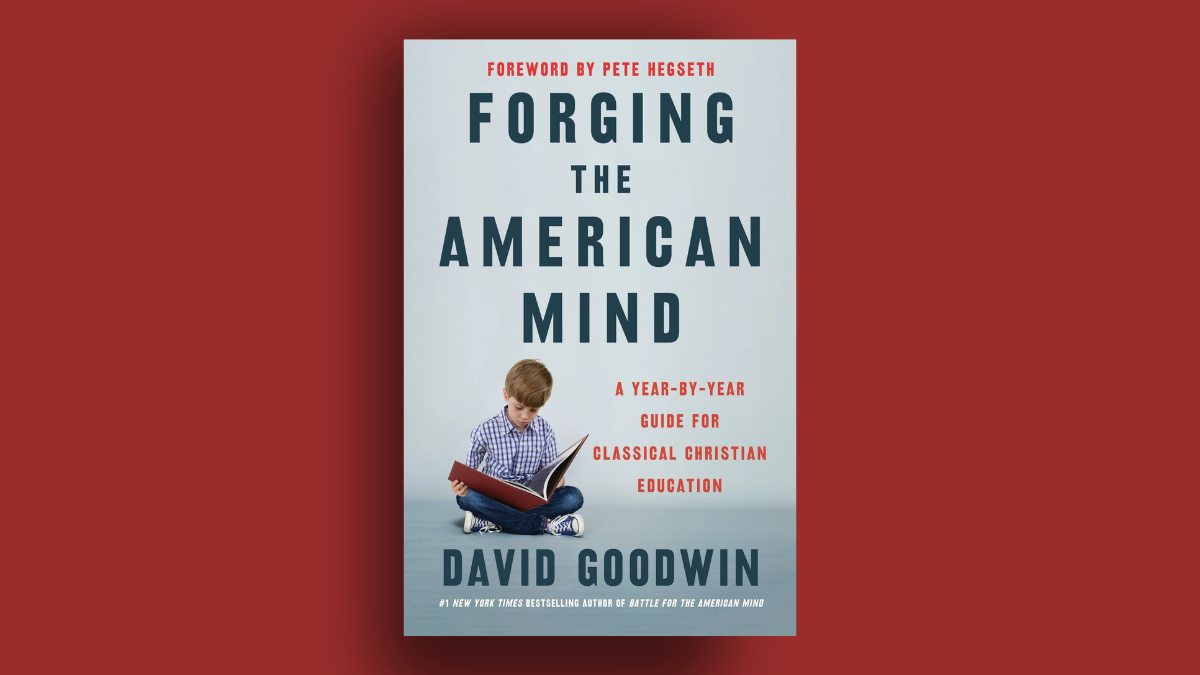
In the summer of 2022, the publishing world was taken by storm when Fox & Friends co-host and soon to be Secretary of War Pete Hegseth released his #1 New York Times Bestseller Battle for the American Mind. With great energy and conviction, Hegseth documented and exposed the incremental takeover of America public schools by progressive educators and policies, a process that began, not in the 1960s, but in the 1860s. Slowly and systematically, the Greco-Roman, Judeo-Christian props of education—which Hegseth identified as reason, virtue, wonder, and beauty—were replaced with a secular ethos grounded in such fashionable pseudo-virtues (or values) as diversity, equity, inclusion, multiculturalism, and environmentalism. The situation Hegseth described in his book was bleak, but he discerned hope in the classical Christian education (CCE) movement that has spent the last four decades recovering a traditional pedagogy grounded in wisdom, virtue, and eloquence. Battle for the American Mind was inspired and co-written by David Goodwin, founder of the classical Christian Ambrose School in Boise, Idaho. After serving as headmaster of Ambrose from 2003-2014, Goodwin became president of the Association of Classical Christian Schools, a position he continues to fill with distinction. Based on his many years of experience, Goodwin has written a much-needed sequel to Battle titled Forging the American Mind: A Year-By-Year Guide for Classical Christian Education. The book defines well the mission and vision of CCE and provides a practical guide for instituting that mission and vision in grades K-12. Borrowing a metaphor from Battle that compared our modern educational system to a capsized cruise ship that we have gotten used to living on, Goodwin argues that classical Christian schools have the wherewithal to “right the ship. We train students in the tools of learning and then we transmit the rich culture of the West. CCE trains a child to synthesize all truth together into a system of knowledge that reflects reality.” A great deal hangs on the phrases “tools of learning,” “transmit the rich culture of the West,” “synthesize all truth together into a system of knowledge” and “reflects reality,” and Goodwin does an excellent job parsing each of them. Forming Virtuous Citizens CCE does far more than teach students discrete facts to prepare them to take standardized exams. It supplies them, via the trivium of grammar, logic (or dialectic), and rhetoric, with the necessary learning tools to “divide truth from falsehood, goodness from evil, and beauty from ugliness. It teaches children to rightly divide the truth themselves rather than simply learn it by being told outright or through mimicry.” While the grammar phase ensures that students possess the foundational information on which to build a holistic understanding of history, ethics, and the philosophy of ideas, and the logic phase equips them with the ability to distinguish logical thinking from logical fallacies, the rhetoric phase gives them the skills and the courage to defend the truth and live lives of virtue. In addition to the trivium, the main tool for forming virtuous, morally self-regulating citizens is to invite students into the Great Conversation that has shaped and defined the best of Western civilization. The role of the CC educator is to preserve and “pass down” (what tradition means in Latin) the Great Books through which that Conversation has been conducted. Goodwin refers often to the multi-volumed Great Books of the Western World, published in 1952, but with a second edition in 1990 that includes more works by the Fathers of the Church. The set, primarily edited by Mortimer J. Adler, who also edited the Encyclopedia Britannica, includes a two-volume Syntopicon that traces 102 key ideas — angel, being, God, good and evil, nature, justice, monarchy, philosophy, time, truth, virtue and vice, war and peace, and so forth — through three millennia of pre-Christian, Christian, and post-Christian writings. Adler and his team, Goodwin explains, called this the Great Conversation because “once an idea first emerges in ancient literature, it is referenced and developed by later thinkers and in later works down through time. This creates a conversation of sorts, but one that is conducted through the greatest thinkers throughout history! The ideas of the Greeks may travel through the Roman Republic and the Empire, the Byzantines, the Anglo-Saxons, the Gauls, the Irish, and so on up until about 1900.” To invite students into this Conversation is to take them behind the scenes to see how the rich culture of the West was fashioned. Such students will not be fooled by political propaganda, isolated by purveyors of identity politics, manipulated by advertisers, or seduced by ideologies that have been tried and failed. The trivium and the Great Books form the backbone of CCE, but the goal is to synthesize all knowledge into a unified, coherent system. Throughout Forging the American Mind, Goodwin asks a simple question: How do we know? The CCE answer is the same as the medieval Christian answer: By combining “human reason with God’s natural and direct divine revelation.” Secular, progressive schools, by throwing out divine revelation and willfully blinding themselves to God’s design in nature, have been left with a desiccated reason that cannot resist the slide into subjectivism and indoctrination. Meanwhile, Islam, which “contributed to the early rise of knowledge in the Middle Ages,” went astray as “conflicts between the Koran, reason, and natural revelation caused Islam to retreat back to a single source of knowledge—the Koran.” Which is not to say that Godwin advocates putting reason and revelation on exactly equal scales. He makes it clear that Christ — the Word (logos) that became flesh (John 1:14) — is the unifying factor that allows for a full synthesis of goodness, truth, and beauty. This is what allowed the Judeo-Christian revelation from Jerusalem to complete and perfect the Greco-Roman legacy from Athens. “The Greeks understood logos to mean a sort of disembodied entity of divine reason, causing the cosmos to be intelligible. What John revealed was that Jesus is logos made flesh. Divine reason took on a body. Reason is more than a matter of the mind. God is more than simply an abstract concept,” Godwin writes. The wisdom and virtue taught at CC schools is grounded in the full self-revelation of God, a historical event (the incarnation) that gives providential shape to all human history, meaning to all human philosophy, and a story pattern to all human literature. And that leads to Goodwin’s fourth phrase: that the unified knowledge instilled in CC students should reflect reality. Goodwin is at his most insightful when he reminds his readers that CCE is not about a series of dos and don’ts but about conforming the human person to the cosmos. The telos (purposeful end) of CCE is to bring students to “the realization that God’s truth just makes sense. And that the only way to be happy and free is to align oneself with the world as God created it.” Those who think that CCE is about retreating from the “real world,” or about looking at life through rose-colored glasses could not be more mistaken. CCE looks reality in the face with all its horror and its joy, its cruelty and its altruism, its sin and its glory. CC students learn to see things as they really are and to discern their place in God’s cosmic plan. Rather than force the world to conform to their own private desires and passions, they learn to conform themselves to the world as God created it. Indeed, as central as classroom instruction is to CCE, atmosphere and ethos play an equally vital role in aligning students with reality. “The concept of solemnity in a medieval sense is important to know. CCE gives students an aspirational vision—a vision for greatness in truth, greatness in virtue, and greatness in beauty,” observes Godwin. At the risk of offending Christian parents and teachers who prefer chorus songs to hymns, pop music to classical music, utilitarian buildings to beautiful architecture, no-frills classrooms to havens decorated with great art, and personal clothing styles to uniforms, Goodwin insists “that God planted a desire for beauty in the human heart, and fulfilling that in our homes and schoolwork spaces is honoring to God.” Thus far, I have referenced only Parts I and II of Forging the American Mind, which make up 25% of the book. They contain the theoretical presuppositions on which Goodwin builds the practical curriculum he lays out in Parts III and IV. Not being a K-12 teacher, I expected to skim this part of the book, but I quickly abandoned that plan. In addition to the incisive, concrete, implementable suggestions Goodwin offers — suggestions that will aid teachers, administrators, and homeschooling parents alike — he loads Parts III and IV with gems of wisdom on the true nature of human beings, history, habits, heroism, and humility. “Progressive schools,” Goodwin argues, “have imbibed the culture’s belief that children at this age [5-6] should self-direct their education. Conformity and compliance have long been the bogeymen of our cultural story. Rather, our modern stories tell us, true freedom is found in rebellion and self-expression.” The pedagogical upshot of such a false understanding of human nature is that students are left without any proper guidance and are encouraged to adopt self-focused, disordered strategies that will destroy them and their societies in the end. Children learn more, and are happier, when they are provided with structure, order, and proper hierarchy. “Instead of prizing authenticity and self-expression,” Goodwin explains, CC schools “prize truthfulness and integrity.” The Vision of a Graduate This dichotomy between progressive and traditional anthropology is also reflected in their differing perspectives of history. “Modern historical methods tend to teach history as the story of forces and trends, as if it were one big sociological soup, flowing passively up its evolutionary chain. . . . Christians teach history differently, embracing a model that is more like storytelling, where characters — that is to say, people — move the plot along,” Godwin notes. Despite the progressive focus on the autonomous individual, its worldview is deterministic; only in CCE are students treated as fully ethical beings with moral agency and a role to play in God’s metanarrative. Uniting CCE’s anthropological focus on proper conformity with its historical focus on proper agency yields a classroom that seeks to instill habits of virtue in its students. “To our modern ears,” Goodwin explains, “habits are equated with words like mindless and bad. We may fail to realize that well-formed and intentional habits actually shape our love for the good. We believe we are creatures driven by reason, but we are not. We’re a complex mix of reason, emotion, and affection.” A teacher’s unspoken assumptions about habits will determine whether he urges his students to break all boundaries and be true only to themselves, or to conform all areas of their mind, heart, and soul to that which is good, true, and beautiful. Schools that do this will be less likely to fall into the progressive trap of heroizing villains and demonizing heroes. In CC schools, students are made “wary of pseudo-heroes who love disrespect and disobedience, and pseudo-villains who love good things like tradition.” The acquisition of knowledge is not enough; students must be molded in accordance with fixed, absolute, transcendent standards. They must learn to love the good and hate the bad, and for that love and hate to become habitual. And they must learn to do so humbly, with a knowledge of their own limits balanced by their faith that they serve a God who is Truth itself (John 14:6). Thus does CCE both mimic the best of the classical world and transcend it through Christ. Like Socrates, CCE students “need to develop the humility that neither they, nor possibly their teacher, are capable of answering the question completely and perfectly. But we should not leave them in despair. This is where Christianity offers hope. There is always an answer, even if we fail to find it.” If this is done properly, Goodwin promises, we will forge students who “are deep and serious people with an ability to engage on any topic.” Students, that is, who live up to the “Vision of a Graduate” that Goodwin helped develop for the Ambrose School: “students with a heartfelt moral compass, sound reason and a sound faith, a masterful command of language, well-rounded competence, and literacy with a broad exposure to books, and who have a well-developed aesthetic, with maturity, virtue, and a love for Christ.” I have met and conversed with many such students over the years, and they have filled me with hope for the future of our nation. If the battle for the American mind is to be won, it is students who possess this combination of faith and virtue who will win it. Louis Markos, professor in English and scholar in residence at Houston Baptist University, holds the Robert H. Ray Chair in Humanities. His books include "Apologetics for the 21st Century," "On the Shoulders of Hobbits," and "Restoring Beauty: The Good, the True, and the Beautiful in the Writings of C. S. Lewis." book reviewBooksChristian educationClassical Christian Educationclassical educationDavid GodwineducationForging the American MindPete Hegseth
How Classical Christian Education Can Save America
Full Article
Original Source
Read the full article at Thefederalist →KhanList aggregates and links to publicly available news content. We do not host full articles from third-party sources. Always verify important information with original sources.