
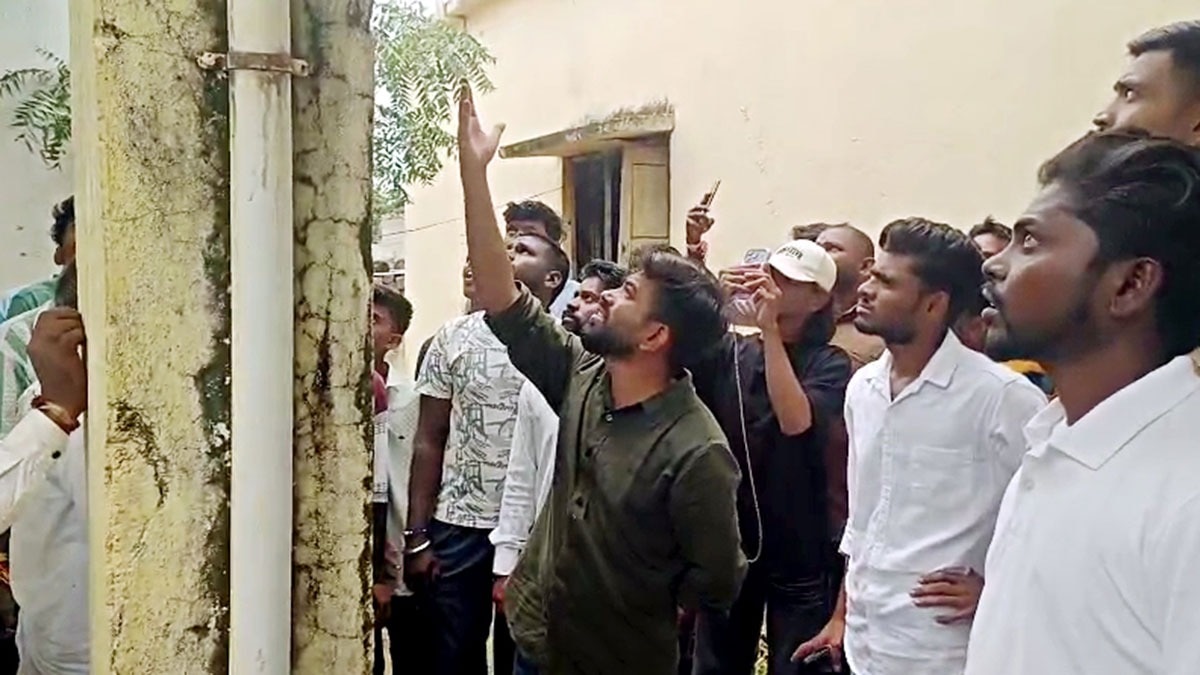
The campaign has put school deficiencies in simple, replicable political terms and called into question the environment in which children are learningAn unlikely topic is seemingly placing itself on the political agenda just months before the next set of state elections, with positioning already evident for the 2027 battle for Uttar Pradesh: the condition of government schools.The ‘School Thik Karo’ campaign of the Cockroach Janta Party (CJP), wherein citizens and volunteers visit government schools to video-record broken toilets, unsafe classrooms, lack of furniture, drinking water and mid-day meal issues, teacher attendance and other problems, is starting to spread beyond the fledgling organisation that started it all with the protest at Delhi’s Jantar Mantar over examination irregularities.Chief minsters and education ministers are reacting. Opposition parties have started to campaign on schools. The schools themselves are making repair calls and at the same time limiting access and filming throughout the campus. Independent examination, by courts and human rights bodies, of the situation and safety of government schools poses uncomfortable questions in themselves.The campaign is just a few weeks old, yet the spread has been quick. According to CJP co-convenor Ashutosh Ranka, 1,200 to 1,500 volunteers have carried out an estimated 1,500 audits of schools, and they’ve been active in Maharashtra, Uttar Pradesh, Rajasthan, Gujarat, Bihar, Uttarakhand, Madhya Pradesh, Tamil Nadu and other states. It’s a simple process: investigate a school, video-record lapses, post them and compel a response. Videos brought up by the campaign have had children complaining about drinking water, toilets, classrooms and more.In Uttar Pradesh, the political reaction has been telling. The Yogi Adityanath administration initially appeared to welcome the scrutiny while pointing to its Operation Kayakalp and improvements in school toilets, drinking water, furniture and smart classrooms. Days later, the response hardened.Officials were directed to register cases against those spreading “misleading videos” about schools and colleges. At the same time, orders were issued for inspection of mid-day meals and toilets, and district magistrates directed to regularly inspect schools. Chief secretary S.P. Goyal subsequently issued directions covering school infrastructure, cleanliness and road connectivity.The political opening was quickly seized upon by the Aam Aadmi Party (AAP). The party’s Rajya Sabha MP Sanjay Singh launched AAP’s own ‘School Theek Karo’ campaign, asking citizens to send videos of dilapidated schools and promising an exhibition to show their condition. Singh claimed there was no evidence of the BJP’s “double engine governance” in UP. AAP’s own account of the campaign says it is collecting videos of dilapidated buildings, toilets, desks, mid-day meals and other deficiencies.The ripples extend beyond Uttar Pradesh. In Rajasthan, the Bhajan Lal Sharma government has announced a school infrastructure revamp programme, with an outlay of around Rs 12,500 crore. The state recently witnessed a face-off over the condition of a government school in Rampura-Kanwarpura village near Jaipur, where locals took on visiting CJP activists. The government has ordered a new building for the school whose students were attending classes in a cattle enclosure as the building had been deemed unsafe.The revamp programme followed an earlier plan of constructing new buildings in 300 dilapidated schools at a cost of Rs 409 crore, which CJP founder Abhijeet Dipke had described as “CJP impact in Rajasthan”. The bigger Rs 12,500 crore roadmap seems to have come in the face of rising political heat over government schools, the CJP’s investigations and criticism by Opposition parties about the ban on making videos in government schools.Those limitations have now become part of the tale. Permission is needed to enter schools in Rajasthan, and for photography and videography purposes, it should be a written consent. Restrictions or resistance to outsiders coming into government schools have also been reported from Maharashtra, Haryana, Telangana and UP. In Maharashtra, Dipke and others were accused of entering a school in Latur district, disturbing official proceedings, video-recording teachers and threatening them. A case was filed.But for the CJP, the overwhelming response from the government only validates its campaign. Aafreen Nawaz, the CJP’s 34-year-old national secretary and a former MNC employee, said she has watched repairs begin almost in real time. “I was checking a video of one of our teammates. He’s got the whole JCB into the school and he’s getting it renovated right at this moment as we speak. I have goosebumps,” Nawaz said.“What the government should have been doing, we are doing it. And this gives me immense pride. It’s not a small thing. Irrespective of political party, you (government) should be doing all of this. That’s the basic need,” she added.More revealing to Nawaz is what happens when officials merely expect the CJP to arrive at a school. “It so happened that a school just got to know that Abhijeet Dipke might visit, and within two days they were all set with everything,” Nawaz said. “So, why would you not do this before?”The CJP is now publicly claiming the government responses as victories for the campaign, insisting that the movement would continue. The courts, meanwhile, have entered the broader argument over condition of schools.The Rajasthan High Court is considering a suo motu PIL on the July 2025 school building collapse in Jhalawar, which claimed the lives of seven children. The court issued a direction to the state that it cannot use dilapidated buildings, and during later hearings said an allocation of Rs 1,000 crore was “a drop in the ocean” compared to the needs.The human rights commissions of Telangana and Haryana have also taken suo motu cognisance of the issue of children being taught in makeshift classrooms—under trees, in open fields and even in cattle sheds. On the other hand, in a PIL before the Supreme Court, restrictions on the entry of outsiders and their filming of government schools in Rajasthan and UP are called into question, citing that the need to protect children doesn’t mean sweeping prohibitions on filming collapsing infrastructure.What the CJP campaign has achieved is to put school deficiencies in simple, replicable political terms: go into your neighbourhood school, point a camera at things that are broken and ask why they haven’t been fixed. Such mobilisations around common grievances are nothing new in Indian politics nor have they all been able to maintain the initial public interest.The most obvious comparison in recent times is that with AAP. It emerged from the anti-corruption movement led by Anna Hazare, entered electoral politics and its school education model became one of its strongest symbols of governance in Delhi. The parallels are compelling: another movement to protest, another effort to turn a public service malfunction into mass action, and again education coming onto the electoral agenda.Nawaz wants none of the comparison. “I feel everyone should get done with the Aam Aadmi Party,” she said. “You see the graph of any political party, whether in its beginning stage or later. I don’t think anyone has made an impact as much as us (CJP),” she said.In the latest India Today Mood of the Nation survey, Dipke has featured ahead of AAP supremo Arvind Kejriwal on a list of leaders people would like to see as the next prime minister of India.“I don’t think comparing us with any other political party gives any weight to us,” added Nawaz. “It gives weight to them.”That confidence will be tested in the coming years. Movements can cause a problem to become unignorable, but it is harder to maintain the attention. For now, however, there’s a change. Chief ministers are standing up for their records. Governments are issuing inspection and repair orders. Courts and human rights groups are calling into question the environment in which children are learning. The issue at stake is a very basic one indeed: what does the government school in your neighbourhood look like?Subscribe to India Today Magazine- EndsPublished By: Shyam BalasubramanianPublished On: Aug 31, 2026 19:54 IST
How CJP's 'School Thik Karo' has everyone scrambling ahead of crucial polls
Full Article
Original Source
Read the full article at Indiatoday →KhanList aggregates and links to publicly available news content. We do not host full articles from third-party sources. Always verify important information with original sources.