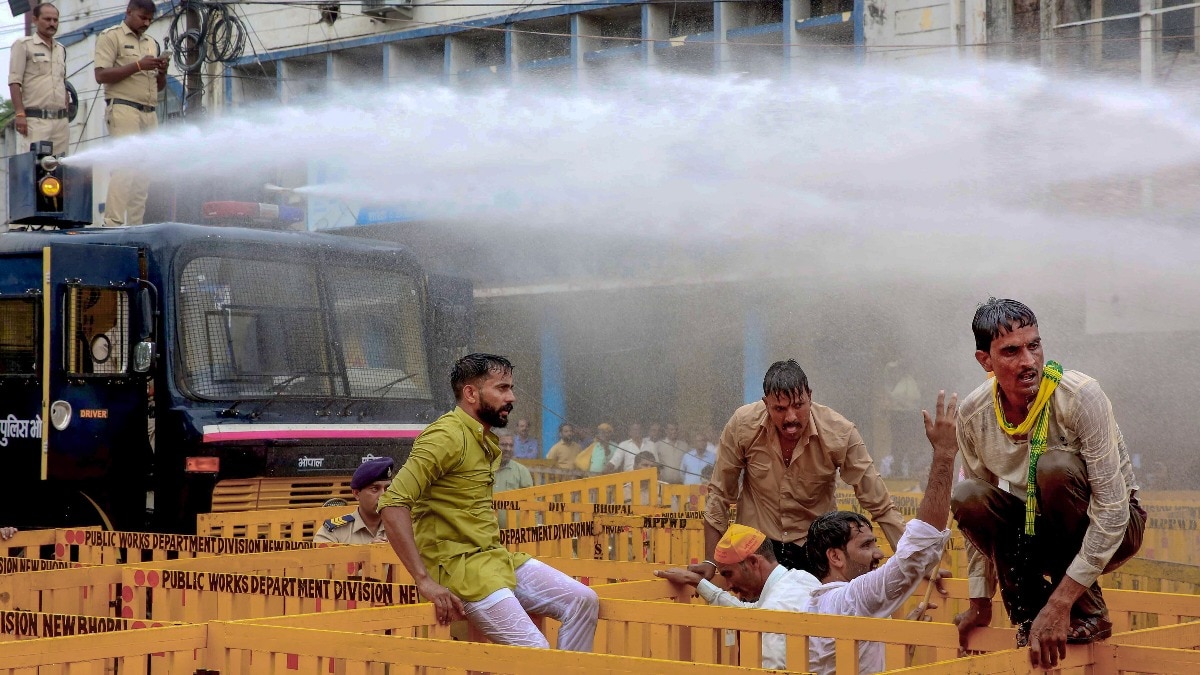
The CJP's protest against paper leaks has birthed and provided a template for an anti-reservation movement. This is why the protests over the NEET-UG paper leak reopened the debate on the quota system, one of India's most politically explosive and socially fissile issues. And this comes just ahead of the election in Uttar Pradesh.The Cockroach Janta Party (CJP) got what it wanted — Education Minister Dharmendra Pradhan's resignation. The month-long agitation over NEET paper leak and alleged irregularities in the examination system has to come to an end. The protests are over. The barricades at New Delhi's Jantar Mantar are gone. But a new storm, a byproduct of the CJP protest itself, might be brewing.The unexpected byproduct of the CJP protest is an anti-reservation campaign, which is gathering pace. It threatens to reopen the politically explosive and socially fissile issue of caste-based reservations in India.Over the past few days, social media has seen an explosion of posts, reels and campaigns, spearheaded by the CJP-styled online platform, the Reservation Hatao Andolan (RHA). The Instagram handle, with its first post from six days ago, now has over 5.8 million followers. As the name suggests, it's demanding an overhaul, or even abolition, of caste-based reservations in India.The timing is tricky and could prove to be troublesome for several political stakeholders. The anti-reservation movement, and a brewing polarising environment, even as the CJP-led protests raged on in New Delhi, months after the UGC equity regulations sparked nationwide unrest, could further polarise public discourse. This must have discomfited the government. That too, with the Uttar Pradesh Assembly election just months away. And, in India's largest state, caste is the king. The anti-reservation debate found a fresh audience during the NEET protests. People claimed that most of the NEET aspirants who died by suicide after the paper leak in May were from the General category. They argued that the reservation system made the exam too difficult for the General-category students.That anti-reservation debate continues in its aftermath. Even as supporters and critics clashed over the CJP agitation, the age-old fault line of caste-based reservations resurfaced. Also, the CJP's successful online mobilisation appears to have offered a template (at least on the internet) for campaigners pushing anti-reservation demands. The RHA's website is uncannily similar to that of the CJP. Similar palette. Plenty of AI-generated stuff. A visual deja vu. To understand what's going on right now and what has been going on for a while, let's go back a few months.UGC ROW SET THE STAGE FOR ANTI-RESERVATION MOMENTUM?Although opposition to the caste-based reservation is almost as old as the reservation system itself, the debate found a place during the CJP protests. Reservation was introduced to address caste-based discrimination. Many in today's anti-reservation camp argue that ending the reservation itself would help end caste discrimination. The debate is as layered, polarising and contentious as ever.This is only the latest flashpoint months after the UGC's Promotion of Equity in Higher Education Institutions Regulations, 2026, introducing Equity Committees, Equity Squads and grievance mechanisms to tackle caste discrimination on campuses, kicked up a storm in several parts of India, including the caste-sensitive Hindi heartland.Reserved castes and classes called the regulations a long-overdue step towards making higher education more inclusive.The nay-sayers, all at once, hit the streets and argued that the rules recognised discrimination primarily against SC, ST and OBC students, and it didn't offer protection to the unreserved. General category students said several provisions were vague, one-sided and open to misuse. In the meantime, protests broke out outside the UGC headquarters in New Delhi and spread to campuses across several states.Responding to the row, Dharmendra Pradhan, who was then the Education Minister, tried to reassure students. "No one will be discriminated against or oppressed by the new UGC rules. Whether it is the UGC, the Centre or the state governments, it will be our responsibility to ensure the law is not misused," he said.The matter eventually reached the Supreme Court. In January, a Bench headed by Chief Justice Surya Kant stayed the regulations. He observed that several provisions appeared "prima facie vague" and capable of misuse. While the regulations never came into force, the controversy ensured the reservation debate remained politically alive and revealed the possibility of potential street action.HOW CJP PROTESTS OVER NEET LEAK AMPLIFIED ANTI-RESERVATION VOICESJust as the uproar over the UGC regulations subsided by February, another issue took over. Following the NEET-UG paper leak in May, the CJP, which began as an online satirical movement, gained momentum and captured the attention of students, young and old nationwide.While the protests' trigger was the paper leak and repeated irregularities in competitive examinations, thousands of students poured onto the streets and social media, voicing frustrations with India's education system. Jantar Mantar became the movement's headquarters, while activist Sonam Wangchuk's prolonged hunger strike added moral weight to the campaign.Along with paper leaks and exam reforms, the debate over the need for caste-based reservation also resurfaced. And, the trigger came from the CJP's unofficial headquarters, Jantar Mantar.Casteist remarks and posts from Jantar Mantar got onto social media, given the CJP's link to Left outfits driven by "Ambedkarism" and Dalit interests. Several right-wing influencers urged "general category" students to stay away from the protest. They portrayed the CJP as anti-merit and pro-reservation.Anti-reservation commentators also linked paper leaks, unemployment and shrinking opportunities with India's quota policy. They argued that repeated examination scandals only intensified competition for general category seats.Meanwhile, a Wall Street Journal opinion piece by Washington DC-based Indian-American writer-journalist Sadanand Dhume drew a contrast between India's reservation system with China's merit-based model. That triggered fresh discussion and debate.ANAND RANGANATHAN, HARSH DUBEY, BRAHMIN GENES KEPT THE RESERVATION DEBATE ALIVEAmong those amplifying the anti-caste-based reservation narrative was author Anand Ranganathan. He argued that reservations should be limited to one generation per family rather than abolished. Explaining his position in an interview with RJ Raunak, he said, "I fully support the reservation... But I believe it should be given only once per family... Because quota seats are finite. Right now, if a wealthy family uses the quota for three generations (grandfather, father, and son), they have three seats. As a result, three truly poor families from that exact same community get absolutely zero.""Limiting it to one generation ensures the benefits stop looping at the top and finally reach the poorest people who actually need them," added Ranganathan.Around the same time, the reservation debate also spilt onto television. During a TV debate on a private channel, NEET aspirant Harsh Dubey passionately questioned India's caste-based reservation system. Emotions spilled over. Standing up from his chair, he gestured and raised his voice while questioning the reservation system. A multiple-time NEET candidate who scored 627 marks but did not secure a government medical seat, Dubey argued that while the country was debating the alleged paper leak, few were speaking about what he described as the challenges faced by general category students.Pointing to differences in cut-offs, state quotas and admission criteria across categories, he asked, "Who will talk about reservation?" The clip went viral and ignited the familiar equity-versus-merit debate around competitive and entrance examinations.Around the same time, caste-based attacks against CJP supporters became increasingly visible on social media.A prominent anti-reservation voice, associated with "BrahminGenes" social media handle, Anuradha Tiwari, joined in the debate on reservations even as the CJP protests continued. Appealing to general category protesters at Jantar Mantar, she said, "My request to all General Category. If you are going to a student protest, please raise the issue of Reservations. Use this opportunity. This is your time."Tiwari also posted banners and said that reservation was a core issue concerning meritorious students.Sharing the much-discussed PM Narendra Modi's first Instagram video, Tiwari said, "You can win back all your goodwill with just one decision. Replace Caste-based Reservations with Economic Reservations. You may lose the next election, but your name will go down in history".QUOTA CRITICS CLAIM RESERVATION POLICY BEHIND NEET SUICIDESDuring the CJP protests, several people claimed that lower cutoffs for reserved categories created unfair competition and despair. As a result, many students in India have died by suicide due to academic pressure and discrimination against them.Indian-American academic Rajeshwari Iyer took to X and said that "21 students died by suicide following the NEET paper leak" of which she said, "19 of them were from the General category". Iyer asked "if reservation was meant to create equal opportunity, why did so many General category students feel they have no second chance?""This is a question that deserves serious discussion," she added.New Delhi-based Chartered Accountant Nitin Kaushik claimed that "15,000 students commit suicide because of reservations, every year".Following the NEET-UG paper leak, outrage also centred on irrational cut-offs on which admissions are based. A similar concern over NEET-PG 2025 counselling was highlighted on X by a person, Anshul Saxena.In a detailed post, he claimed that NEET-PG 2025 counselling saw postgraduate medical seats allotted at strikingly low scores. Citing examples, he claimed that an MS Orthopaedics seat in a Hyderabad medical college was filled at 1 mark out of 800, an Orthopaedics seat at 4 marks out of 800, General Surgery at 47, Obstetrics and Gynaecology at 44, Biochemistry at -8, and Anatomy at 11 marks out of 800. He further claimed that "candidates with scores as low as -40 out of 800 were allowed to participate in PG counselling", adding that "a negative score was considered qualifying".Calling the figures "a serious crisis in academic standards", Saxena argued that "a reasonable minimum qualifying merit must be established to maintain the integrity of medical education and the healthcare system". He also alleged that "neither the Government nor the Opposition has said a word" because the issue did not suit their "political interests".Reacting to the post, Bengaluru-based entrepreneur Mohandas Pai tagged Prime Minister Narendra Modi and wrote, "This is a major source of grievance by students... A GC with 90%+ does not get a seat, but some others in categories with very low marks get in! Needs a solution."IS RESERVATION HATAO ANDOLAN A BIGGER POLITICAL TEST THAN CJP'S NEET PROTESTS?Dharmendra Pradhan's resignation on July 25 revealed the power of sustained online and offline mobilisation. The "political victory" of the CJP also provided a stage and opportunity for different battles to be played out. After the NEET agitation wound down, calls for a "merit-only" system became significantly louder on social media platforms.Then came the next phase. Within days of the protests ending, the Instagram-led Reservation Hatao Andolan (RHA) exploded online. It attracted millions of followers in a matter of days. Calling itself a citizen-led, non-partisan movement (like the CJP), it demanded an end to caste-based reservations, greater reliance on economic criteria, removal of caste identification from official forms, and a "One Nation, One Identity" framework.Although no major street mobilisation has been announced or taken place, the campaign appears to adopt the same digital-first strategy. Viral videos, influencer-driven content and relentless social media engagement of anti-reservation narratives.Simultaneously, supporters of reservations have rejected the arguments against caste-based reservation outright. They maintained that reservations are not poverty-alleviation schemes, but constitutional tools intended to address centuries of caste-based exclusion. Several academics, Dalit organisations and social justice advocates argue that replacing caste with purely economic criteria ignores the historical basis of affirmative action that reservation in India is based on. They also point out that the Supreme Court has repeatedly upheld reservations as instruments of substantive equality.Whatever direction the RHA eventually takes and achieves, its timing makes any development on it politically sensitive. Several states, including Uttar Pradesh and Punjab, are heading to the polls in a few months, and caste is one of the biggest electoral factors. As discussed earlier, the reservation was meant to reduce caste discrimination. Its critics now argue that removing it would do the same. But unlike the CJP's demand for Pradhan's resignation, this is one demand that few parties are likely to openly champion. The caste calculus is simply too high-stakes, and no political party will want to toy with fire.- EndsPublished By: Anand SinghPublished On: Jul 30, 2026 07:30 IST
How CJP's protest became fodder for anti-reservation stir
Full Article
Original Source
Read the full article at Indiatoday →KhanList aggregates and links to publicly available news content. We do not host full articles from third-party sources. Always verify important information with original sources.