
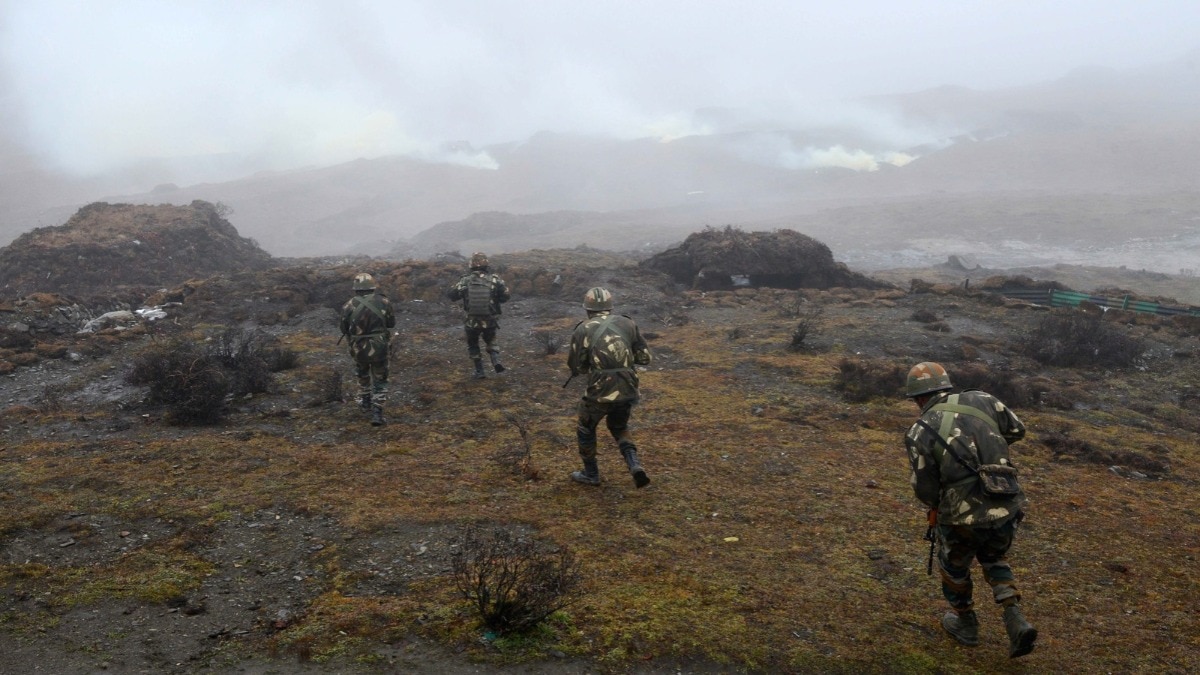
China’s military advantage along the Line of Actual Control (LAC) in Arunachal Pradesh lies not just in troops deployed close to the border but in its ability to rapidly reinforce them, sustain operations and exploit infrastructure spread across the Tibetan plateau.While the current posture does not necessarily point to an imminent large-scale conflict, the People’s Liberation Army (PLA) has built a layered military architecture that allows Beijing to maintain pressure on India, probe its defences and test the limits of existing border-management mechanisms.Arunachal Pradesh is emerging as another area of strategic concern for New Delhi. Reported face-offs and renewed Chinese activity along parts of the frontier underline how fragile the situation remains. Unlike eastern Ladakh, where the 2020 Galwan clash triggered a prolonged military standoff, Arunachal presents its own operational challenges. Rugged mountains, difficult logistics and dispersed border settlements complicate military movement and sustainment. China’s growing military infrastructure across Tibet adds another layer to the security challenge.At the heart of the PLA’s operational structure is the Combined Arms Brigade (CAB), its principal manoeuvre formation. These brigades integrate infantry with artillery, armour, air defence, reconnaissance, engineers, electronic warfare and logistics elements. Organised into light, medium or heavy formations depending on operational requirements, a typical brigade is estimated to comprise around 4,500-5,000 personnel. Their modular structure allows the PLA to tailor forces for different missions and terrain, including high-altitude operations along the Himalayan frontier. China’s deployment along the eastern LAC follows a layered model. Border-defence units maintain a forward presence near the frontier while formations under the Tibet Military District provide operational depth. Additional forces from the Western Theatre Command can be brought in through rotational deployments or during a crisis. This arrangement allows Beijing to sustain pressure without keeping its entire combat strength permanently deployed near the LAC, while retaining the ability to rapidly expand its military presence when required.The 52nd, 53rd and 54th Combined Arms Brigades, associated with the Tibet Military District and reported in the Yadong-Shigatse, Nyingchi-Bayi and Lhasa areas respectively, have featured in assessments of China’s military posture in the eastern sector. Other formations, including elements associated with the 77th Group Army, could provide additional reinforcement options. However, earlier reporting on their locations should not be mistaken for a confirmed picture of current deployments.The Indian Army’s Annual Report 2025-26 offers an important insight into China’s broader military posture. According to the assessment, the PLA reduced its deployments along the northern borders during 2025, maintaining 10 Combined Arms Brigade-sized forces along the LAC and another 10 in traditional training areas. These figures cover the entire India-China frontier and cannot be attributed exclusively to Arunachal Pradesh. The report also described India’s own deployment across the sectors as robust, well poised and prepared to meet emerging contingencies.A reduction in Chinese deployments, however, should not be mistaken for a reduction in military capability. China’s extensive road, railway and air infrastructure across Tibet gives the PLA considerable logistical depth and the ability to reinforce forward positions. The speed with which troops, equipment and supplies can be moved from operational depth to the frontier could prove decisive during a crisis. Actual reinforcement timelines, however, would depend on terrain, weather, location and operational conditions.India, meanwhile, has steadily strengthened its own preparedness through improved border connectivity, forward infrastructure and sustained military deployments. Its established presence, familiarity with local terrain and operational experience remain important advantages. Army formations, backed by the Indian Air Force and improving logistics networks, provide the capacity to respond to localised incidents as well as larger contingencies. The challenge is to ensure that these capabilities translate into sustained operational readiness across difficult terrain.The latest developments in Arunachal also underline the importance of military communication mechanisms in preventing local incidents from spiralling into wider confrontations. The September 2026 Wacha-Damai senior military commander-level flag meetings, held amidst reported tensions in the Taksing area, marked an important step in strengthening direct engagement in the eastern sector. Such mechanisms can help resolve local disputes and prevent miscalculations, but they do little to address the underlying boundary dispute.For India, the larger concern is not simply the number of PLA troops positioned near the LAC at any given time. It is China’s ability to convert infrastructure, force structure and mobilisation capacity into sustained operational pressure. Persistent probing, localised face-offs and attempts to alter the ground situation demand constant vigilance and a credible response from Indian forces.Military observers pointed out that the strategic imperative for New Delhi is clear: strengthen border infrastructure, improve surveillance, ensure operational mobility and logistics resilience, and maintain the ability to respond quickly to emerging contingencies. China’s layered force architecture gives it the capacity to sustain pressure along the eastern frontier. India’s forward presence, improving connectivity and military preparedness remain critical to preserving deterrence.Arunachal Pradesh may not be witnessing another Galwan-style confrontation, but the military competition along its frontier is far from over. For India, the challenge is to ensure that every Chinese attempt to test the LAC encounters a force that is prepared, resilient and capable of responding without losing ground.Adding another dimension to China’s military preparedness is the expansion of air infrastructure at Damxung in Tibet, roughly 300 km from the Arunachal-Tibet frontier. Situated at an altitude of around 4,000-4,300 metres, the facility has a runway approximately 5.2 km long. Such an extended runway reflects the demands of operating aircraft at high altitude, where thinner air affects take-off performance and payload capacity. By comparison, Lhasa Gonggar Airport operates at around 3,500 metres and has a runway approximately 4 km long.The scale of construction at Damxung points to its potential to support substantial military aviation activity. Its precise unit designation and permanent force composition remain unclear, but the infrastructure could accommodate a sizeable PLA Air Force deployment. The possibility of additional air assets, including transport aircraft and airborne forces, cannot be ruled out, although the stationing of a dedicated airborne brigade remains unconfirmed. Its proximity to highways and railway lines around Lhasa further strengthens its strategic value, allowing personnel, equipment and supplies to be moved relatively quickly and deployments to be expanded when required.Damxung is no longer merely a future military infrastructure project. Commercial satellite imagery reported in July 2026 showed four J-20 stealth fighters stationed there in June, indicating that the facility is already being used for military aviation activity. The presence of these aircraft adds significance to China’s expanding network of airbases across Tibet, which is designed to improve operational flexibility, strengthen reinforcement capacity and reduce dependence on a handful of established airfields.Taken together, China’s ground-force architecture, infrastructure across Tibet and expanding military aviation network point to a strategy centred on maintaining operational depth and the ability to reinforce the frontier rapidly. For India, the implications extend beyond individual face-offs in Arunachal Pradesh. The emerging military equation along the eastern LAC will increasingly be shaped by how effectively both sides can mobilise, sustain and deploy combat power in one of the world’s most challenging operational environments.Subscribe to India Today Magazine- Ends
How China's reinforcement muscle keeps Arunachal border on edge
Full Article
Original Source
Read the full article at Indiatoday →KhanList aggregates and links to publicly available news content. We do not host full articles from third-party sources. Always verify important information with original sources.