
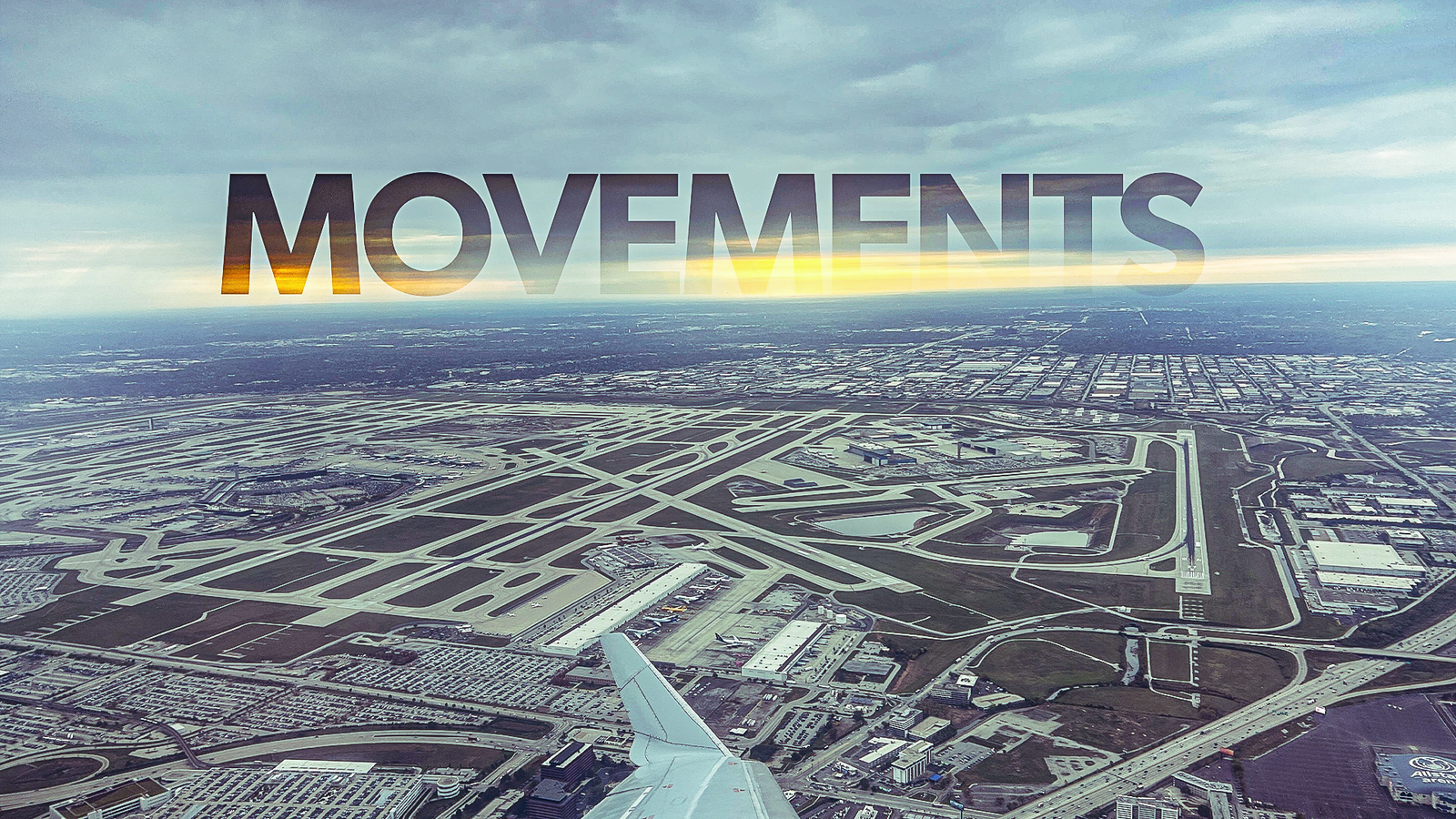
It's well known that the busiest airport in the world is Hartsfield-Jackson Atlanta International Airport (ATL). However, Atlanta is the world's busiest only by number of annual passengers, which is useful when measuring airline operations or evaluating operations in the terminal. Measuring aircraft movements (all aircraft takeoffs and landings), meanwhile, is useful for determining how much traffic the airfield receives. In other words, this shows how many planes are actually operating out of the airport. Chicago O'Hare International Airport (ORD) is the world's busiest airport by aircraft movements, logging well over 2,000 per day, and the airport recorded over 857,000 aircraft movements in total throughout 2025. The airfield handles more aircraft than any other in the world, which means that it needs an efficient taxiway and runway system to accommodate so much traffic. One of ORD's most distinctive features is its runways, as it has eight in total, more than any other airport in the world. The Runway Arrangement At ORD Credit: MKPhoto12 I Shutterstock The eight runways at ORD are oriented in two main directions. In effect, there are six parallel runways running east-west, numbered as 9L/27R, 9C/27C, 9R/27L, 10L/28R, 10C/28C, and 10R/28L. In addition, there are also two parallel runways running from southwest to northeast, numbered 4L/22R and 4R/22L. The longer of the two, Runway 4R/22L, is only 8,075 feet (2,461 meters) long, and these two are only used during exceptionally strong crosswinds or unusual traffic flow. Most of the time, ORD operates like an airport with six parallel runways, which is an exceptionally efficient configuration. Air traffic controllers may run up to four parallel approaches with the airport's current layout, although this is not always done, and controllers often run two parallel departures as well. With the current runway layout, the airport is actually constrained more heavily by departures than arrivals, and Chicago could accommodate more flights than it currently sees. ORD's current runway configuration is relatively new, as construction of the airport's updated runways concluded in 2021. The project ended with the extension of Runway 9R/27R, while Runway 9C/27C is a new addition to the airport. Prior to the ORD improvement project, O'Hare had seven runways configured in a less efficient layout, and the new layout now allows for significantly more flights. This is more important now than ever as the airline's two home airports are rapidly growing. The Hub Operations Located At O'Hare Credit: George Wirt I Shutterstock United Airlines is Chicago's hometown airline, as the airline has long been headquartered in the city and O'Hare is its largest hub. In addition, American Airlines has operated a substantial hub operation out of ORD for decades, standing as a firm number two at the airport. It is one of the most competitive markets in the US, even without Delta Air Lines, and the two airlines' operations at ORD make it one of the busiest airports, with actual traffic figures exceeding Atlanta. United Airlines mainly operates out of Terminal One at ORD, while some of its regional services operate out of Terminal Two. American Airlines' operations are based out of Terminal Three at ORD, while both airlines primarily send their international arrivals to Terminal Five, as this is currently the only terminal at ORD with a Federal Inspection Station (FIS). United Airlines currently holds just over 90 gates at ORD, whereas American Airlines holds over 60 gates at O'Hare after the most recent round of gate allocations. For the summer 2026 schedule, United Airlines was running roughly 650 daily departures at its peak, which was over 100 more than it ran the prior summer. American Airlines operated over 500 daily departures during the 2026 summer season. Both operate a sizable domestic network out of O'Hare, along with some European services, and United even operates nonstop services to Tokyo. Notably, American and United's schedules were meant to be even larger, but they were trimmed after FAA-imposed flight caps at ORD. Runway Improvements And Operations At O'Hare Credit: Nathan Klemstein I Shutterstock The recent runway improvement project at ORD significantly revised the layout of the airfield, creating a more efficient configuration that can accommodate more flights. Construction began in 2003 to update the runways, of which there were six at the time, arranged in a 'pinwheel' layout. The runways were set in different directions to accommodate various wind patterns, and most of them intersected with one another, an arrangement that reduced capacity as not all runways could be used at the same time. Across nearly two decades of work, ORD closed two runways, constructed four new ones, and extended two runways. The result is that there are now six parallel runways, with three located north and three located south of the terminal complex. This results in more crosswind departures and arrivals, but makes for significantly more efficient traffic flows. At any given point, controllers typically use three runways for arrivals, while two runways are often used for departures. Located at the north of the airfield, Runway 9L/27R can take arrivals from the north, while Runway 9C/27C takes some arrivals from the south and heavy aircraft. Runways 9R/27L and 10L/28R are the closest runways to the terminals and are used for departures, while Runway 10L/28R is also the airport's longest runway. In addition, Runway 10C/28C can be used for remaining arrivals from the south. Runway 10R/28L is also used for arrivals from the west, but the 28L side is used less often due to the proximity of Runway 4R/22L. The six parallel runways can operate in the common east-west flows with high capacity, especially because none of these runways intersect with one another. Meanwhile, for strong crosswind conditions, the airport also has Runway 4L/22R and 4R/22L. While Runway 4L/22R does intersect with Runways 9C/27C and 9R/27L, this runway is not used particularly often. Meanwhile, Runway 22L specifically is often used for departures during 'west flows', during which Runway 28L is generally not used. The Renewed Race In Chicago Credit: Adam McCullough I Shutterstock Throughout the years, United has been the number one at ORD, while American has been a solid number two. Post-COVID, however, United has gradually been growing its schedule closer to pre-pandemic levels, while American cut flights in 2022 and 2023. Still, even United wouldn't end up reaching pre-pandemic levels until 2026, when it planned a massive schedule of roughly 750 daily flights on average. This was over 200 more than its daily average in 2025, and significantly more than American's schedule, which was ambitious in itself. United was essentially aiming to dump capacity into the market in an effort to push American out, and given how important the Chicago market is, American responded through significant growth of its own. The two airlines were looking at a bloodbath, which was also partially motivated by Chicago's gate allocation system that assigns gates based on usage. But with United planning up to 750 daily flights and American planning over 500 daily departures, it was starting to look like ORD would be taken beyond its limits. American Airlines Hubs United Airlines Hubs Charlotte New York (JFK) Chicago Newark Chicago New York (LaGuardia) Denver San Francisco DFW Philadelphia Guam Washington (Dulles) Los Angeles Phoenix Houston Miami Washington (National) Los Angeles The FAA instituted a flight cap that cut ORD's capacity to just over 2,700 takeoffs and landings per day, whereas airlines had planned over 3,000 for the 2026 summer season. The cap was instituted due to concerns about delays and congestion, but it hurt United significantly more than American, as the cap was determined based on ORD's 2025 summer schedule. United planned significantly more growth for 2026 than American did, which means that the two airlines are much closer than United had planned for. Remaining Bottlenecks At ORD Credit: MKPhoto12 i Shutterstock While ORD has an efficient runway layout, several taxiways are currently closed due to ongoing construction. As such, the airport frequently faces bottlenecks and delays with departing aircraft, in particular, clogging up taxiways. Pushbacks get delayed, which means that arriving planes don't have a place to park, leading air traffic controllers to send aircraft on extended taxi routes or to put them in the infamous 'penalty box' (technically the de-icing pad now), patiently waiting with the parking brake on until the gate opens up. While ORD's runway projects are complete, the airport is undergoing a much larger modernization project. This includes a new Terminal Two (also known as the Global Terminal), which will accommodate international arrivals (currently, Terminal Five is the only one that can do so), as well as expansions to concourses at the airport's other terminals. In addition, ORD is revising its taxiway layouts for greater efficiency and to accommodate future terminal expansions. While there are elements of ORD's airfield design that are efficient and effective, the airport is also infamous for long taxi times and a lack of gate availability. During peak times, ramp controllers need to use a metering system to control the flow of aircraft entering the taxiways, while some of the runways are located far away from the core terminal area. Through the terminal projects and new taxiways on the horizon, however, ORD should be much more capable of handling even higher flight volumes in the future.
How Chicago O’Hare's 8 Active Runways Handle More Than 2,000 Movements A Day
Full Article
Original Source
Read the full article at Simpleflying →KhanList aggregates and links to publicly available news content. We do not host full articles from third-party sources. Always verify important information with original sources.