
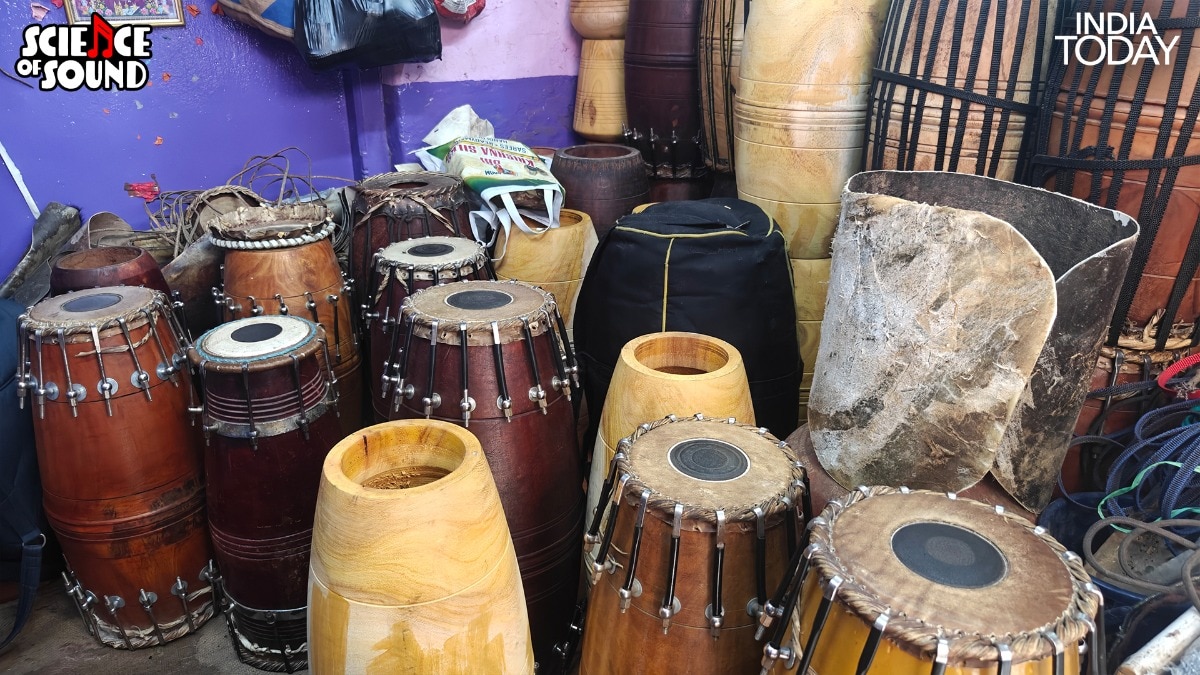
In a Chennai workshop, a mridangam maker showed how the drum's singing tone is built by hand. The process reflects the acoustic principles C.V. Raman explained in 1920.Inside a Chennai mridangam workshop, where craftsmen still build an instrument whose physics once drew a future Nobel laureate's attention. (Photo: Radifah Kabir/India Today)The lane announced itself before I saw it: the smell of wet leather and wood shavings in the air, the particular smell of an instrument still becoming one. I have chased that smell before, in other workshops, in other cities, for the Science of Sound series. I know, by now, roughly what I will find behind the smell and sound. What I did not expect, this time, was to find a smell and sound that explained so completely before a single word passed between us.Somewhere behind a curtain of hanging drum shells, a stone scraped against a stone, unhurried, almost ritual, the sound of someone who has stopped needing to think about what his hands are doing. Then, out of the workshop's dim, a note rose, low and round and startlingly tuneful, nothing like the flat thud an untrained ear expects from a drum. It sang.I already knew why. I have spent this series taking apart the mathematics behind Indian music, note by note, raga by raga, and I knew precisely which century-old paper explained the science of what I was hearing. What I had not reckoned with was the strange vertigo of watching a man who has never read that paper, has perhaps never heard the physicist's name, perform its central discovery with nothing but stone, paste and the certainty of his own hands. Mridangam shells in every stage of making, jackfruit wood turned and waiting, some already strung, crowded into a Chennai workshop. (Photo: Radifah Kabir/India Today) The mridangam, the double-headed drum at the very heart of Carnatic music, carries inside it a real acoustic puzzle, one that has nothing to do with tradition and everything to do with physics. Ordinary drums are inharmonic, meaning the fainter, higher overtones they produce refuse to sit in clean mathematical proportion to the main note, so they clash rather than sing. The mridangam is one of a tiny family of drums anywhere in the world that escapes this fate. Struck correctly, it rings with true harmonic overtones, tones that fall into proper ratio with one another, the same relationship that lets a violin string or a temple bell sound musical rather than merely loud. It does not thud. It sings.WHY DID C.V. RAMAN STUDY A DRUM?The man who finally explained why was C.V. Raman, the physicist the world would later crown with a Nobel Prize for an entirely different discovery, the scattering of light that bears his name. But before the light, there was sound. In 1919, in Calcutta, his curiosity turned towards Indian percussion, a subject he judged worthy of serious, sustained study. In 1920, with Sivakali Kumar, he set down his findings in the journal Nature, under a title as unadorned as its contents were remarkable: musical drums with harmonic overtones. C.V. Raman, whose 1920 study of the mridangam's harmonic overtones came years before his Nobel Prize-winning work on light. Here is what he found. An ordinary circular drumhead, struck, scatters its overtones in every direction, an acoustic mess. The mridangam's drumhead refuses to be left plain, however. It is loaded, weighted with deliberate care at its centre, and that loading performs a small act of discipline on the sound, silencing the unwanted, clashing overtones and leaving behind a clean sequence, roughly five tones standing in orderly harmony with one another.What Raman had truly found was the mathematics behind a solution mridangam makers, working generations before him, had already built with nothing but their hands.HOW DO YOU BUILD A DRUM THAT SINGS?At the workshop, the maker showed me exactly what that loading looks like when it is still becoming, and it begins, unglamorously, with a tree. "This wood I am getting from Panruti," he told me. "This wood is jackfruit." Seasoned jackfruit wood, shaped into the mridangam's barrel body, holds its acoustic character through India's shifting seasons, steady whether the air runs dry or thick with monsoon.Over that body go the drumheads, stretched animal hide rather than any modern substitute. Prof. M. Ramanathan of IIT Madras's Department of Engineering Design, who stood beside me through the afternoon, explained that decades of quiet experimentation have shown natural leather simply outperforms synthetic skins acoustically, however much easier the synthetic version might be to source. The left face takes buffalo and goat skin, tuned towards a deep bass. The right takes cow and goat skin, tuned to carry the very harmonic overtones Raman once studied so closely. The black syahi at the heart of the mridangam's right head is built layer by layer from powdered stone, rice and water. (Photo: Radifah Kabir/India Today) It is on that right face that the transformation happens, in a black paste called syahi or karani. The maker's material comes from a stone he calls kitangal, carried from the region around Tanjore. He grinds it down to a fine powder, works it with saadam, cooked rice, and water, into a paste, and then builds it upward in the thinnest of layers over the drumhead's centre. After each layer, he dries it by rubbing a second, harder stone called kangal against it, the friction raising just enough heat to set what he has laid down before the next layer begins. "This process is similar to additive manufacturing," Prof. Ramanathan said, watching him work, "layer-by-layer manufacturing," the very principle behind a modern 3D printer, discovered by hand, long before anyone had built the machine. The whole black circle takes some five hours to raise, and a full day to dry.It is this loaded mass, weighed and centred with a precision no ruler could improve on, that performs what Raman's mathematics would later describe: it hushes the drumhead's unruly higher overtones and leaves only the clean, singing sequence beneath.WHY DO BOTH SIDES OF THE MRIDANGAM SOUND DIFFERENT?A mridangam, in truth, is two instruments wearing one skin. The syahi-loaded right head, tuned to a fixed pitch, carries the drum's fundamental voice, anchoring it to whichever note a concert is being sung in.The unloaded left head answers with the bass, and it is here that a player performs gumuki, curling the fingers rather than striking flat, bending and sliding the pitch as the moment demands. "You can align frequencies on the left side with the vocalist or instrumentalist," Professor Ramanathan told me, "while the right side stays aligned to a constant fundamental frequency." One hand holds the ground steady. The other goes chasing after the singer. A mridangam accompanies a Carnatic vocal performance, the drum's fixed right head anchored to the singer's pitch. (Photo: Unsplash) Even the hardware has its own small history of tinkering. Older mridangams were bound with buffalo-hide straps, tightened by hand to raise or lower the pitch, later replaced by nylon rope, and now, in most modern instruments, by nuts and bolts a player can turn with an ordinary spanner.With bolts, the two heads become independent of each other, so a musician can carry a single shell and simply swap in whichever head a performance calls for, rather than hauling several complete drums from one concert to the next.WHY IS CHENNAI SUCH A GOOD PLACE TO MAKE A MRIDANGAM?"Chennai has the best weather for mridangam," the maker told me, and he said it the way you state a fact of your trade, not a boast about your city.Roughly from January to August, Chennai's climate sits inside the narrow band that lets the leather and the syahi cure evenly, a window that harsher climates elsewhere in the country make considerably crueller to work within. Mridangams in various stages of readiness, their black syahi heads catching the light in a Chennai workshop. (Photo: Radifah Kabir/India Today) That matters because of what waits at the other end of the year. Carnatic music's concert season, the kacheri season, arrives every December, and by then every performing mridangam must be at the peak of its voice.Makers across the city spend the months before readying instruments for it, and through December itself they keep a different rhythm entirely, mending a worn syahi within a day or two so that an artist playing several concerts in a single day is never once left without a drum that sings.WHOSE PHYSICS WAS IT, REALLY?Near the end of our afternoon, I asked Prof. Ramanathan where the craft ends and the physics begins. He did not draw a line, because there was none to draw.What the maker does with his hands, sensing precisely when a layer of paste has dried enough, precisely how thick the next one should be, precisely where the true centre of a drumhead lies, is the same problem Raman solved with mathematics inside a Calcutta laboratory a century ago.One path ran through generations of ears and fingertips. The other ran through equations. Somehow, they arrived at the very same place.Raman's 1920 paper invented nothing. It explained something that already existed, built by artisans whose names history never thought to keep. Standing in that small room in Chennai, watching a black circle take shape one patient layer at a time, I found myself thinking that the discovery belonged, at least as much, to the long and nameless line of hands that came before Raman ever wrote a word of it down.- EndsPublished By: Radifah KabirPublished On: Sep 13, 2026 12:30 IST
How Chennai's mridangam makers solved a physics puzzle centuries before CV Raman
Full Article
Original Source
Read the full article at Indiatoday →KhanList aggregates and links to publicly available news content. We do not host full articles from third-party sources. Always verify important information with original sources.