
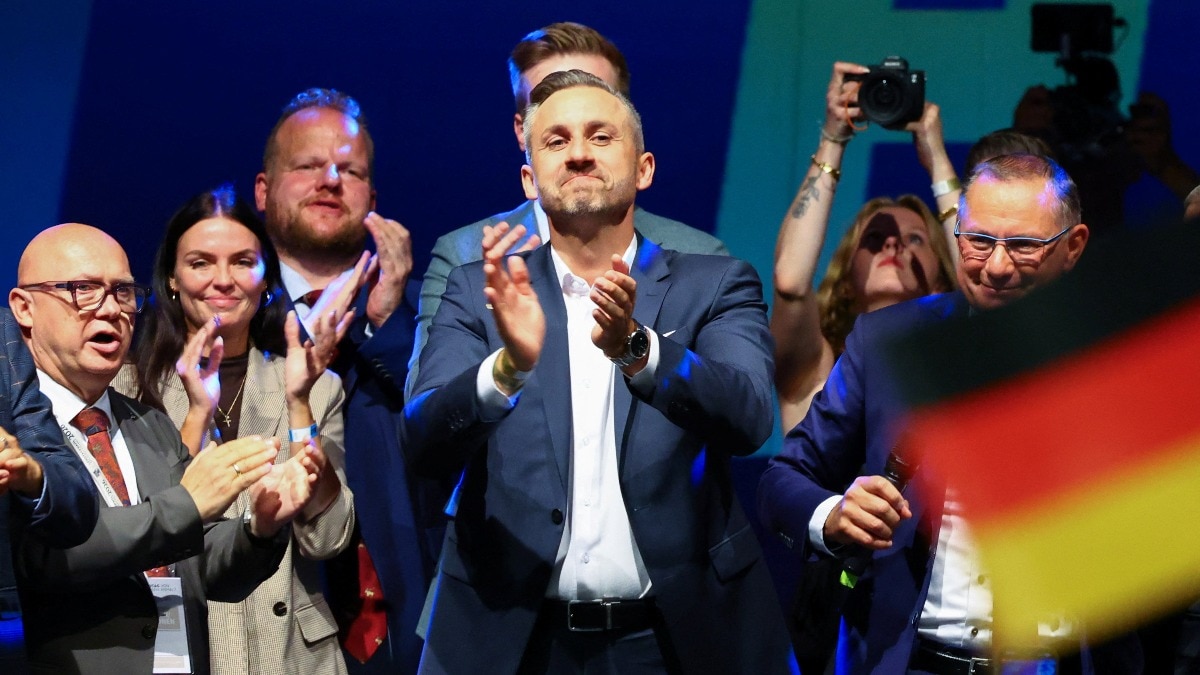
The AfD has secured a sweeping win in Saxony-Anhalt, finishing well ahead of Friedrich Merz's conservatives. The result has sharpened doubts about mainstream parties in Germany and across Europe.Top candidate of the far-right Alternative for Germany (AfD) Ulrich Siegmund applauds onstage at the AfD election party in Magdeburg.Germany's far-right Alternative for Germany (AfD) sweeping victory in Saxony-Anhalt has done far more than shake up politics in one of Berlin's smaller eastern states. It has exposed a much bigger problem confronting Europe: voters are losing patience with mainstream parties that appear unable to deliver economic security, control illegal immigration, improve living costs or restore confidence in the future.With 44 per cent of the vote, the AfD finished comfortably ahead of Chancellor Friedrich Merz's conservatives and came within reach of an outright majority in the state parliament, according to exit polls and near-final results cited by Reuters. The result may not immediately put the party in government because Germany's mainstream parties have ruled out working with it. But politically, the breakthrough is difficult to contain.The breakthrough takes on an altogether different significance in Germany. A country that has spent decades isolating far-right forces because of the Nazism has now watched the AfD become its most successful political force in a state election since the Second World War.Across Europe, the result is likely to raise far more uncomfortable questions. DEFEAT FOR ESTABLISHED POLITICAL ORDERThe election was not simply a victory for the AfD. It was also a devastating rebuke to the government led by Merz.The German chancellor came to power in 2025 promising to revive Europe's largest economy through tougher reforms, higher investment and a major programme of borrowing to rebuild infrastructure and strengthen the military. However, those promises have so far failed to translate into visible improvements for many voters, particularly in eastern Germany. Reuters cited an ARD Infratest dimap survey showing that 87 per cent of voters in Saxony-Anhalt were unhappy with the federal government. Another survey for ZDF found that three-quarters of respondents, including almost half of CDU supporters, believed Merz had damaged his party's performance.Thorsten Frei, the parliamentary leader of Merz's Christian Democrats (CDU), described the result as "a watershed for our country".Merz himself acknowledged the scale of the setback. According to Reuters, he told the CDU's executive board that the result had shaken the party "to its very foundations", while again ruling out cooperation with the AfD.That refusal may preserve the political firewall around the far right for now. But it does not address the underlying reason why so many voters crossed it.As Marcel Fratzscher, president of the German Institute for Economic Research, told Reuters, "This election result is, above all, a vote of no confidence in the federal government."The AfD's success therefore cannot be explained solely by its anti-immigration politics. It has tapped into a much wider sense of frustration -- over prices, jobs, pensions, energy costs, migration and Germany's economic direction.THE ANGER BEHIND FAR-RIGHT SURGESaxony-Anhalt offers a revealing picture of why the AfD's message has found such fertile ground.The state, which was part of communist East Germany, has struggled with the long shadow of reunification. Its industrial base suffered a severe collapse after 1990, while its population has fallen by roughly a quarter since reunification.Even so, the region has also recovered considerably over the past decade and a half. Its unemployment rate, at around 8 per cent, is not dramatically above the national average, while the state has rebuilt parts of its chemicals sector and developed newer industries including logistics and green energy.That recovery, however, has not erased the feeling that economic security remains fragile.Germany's broader industrial troubles have made the situation harder. Volkswagen's announcement of a major restructuring programme, potentially involving 50,000 job cuts worldwide and the closure of major German factories, reinforced the perception of an economy struggling to regain momentum.High energy costs have provided another opening for the AfD. The party has blamed Germany's support for Ukraine and its confrontation with Russia for contributing to higher energy prices, while advocating a restoration of closer ties with Moscow and a reduction in support for Kyiv. Its programme also calls for tougher restrictions on immigration, changes to public broadcasting, greater emphasis on traditional values and a halt to new wind farm construction.THE MESSAGE IS NO LONGER CONFINED TO GERMANYThis is where the Saxony-Anhalt election becomes a European story.Across the continent, mainstream governments are wrestling with similar pressures. Inflation may have eased from its peaks in many countries, but the memory of the cost-of-living crisis remains powerful. Housing pressures, illegal immigration, stagnant wages, ageing populations and doubts about economic competitiveness have created fertile ground for parties promising a sharp break with the established order.The New York Times quoted Mujtaba Rahman, a Europe analyst at Eurasia Group, as saying: "Developed Europe is going through a version of sophisticated state failure.""Governments are unable to address cost-of-living concerns. They are not able to deliver for their voters," he added. That diagnosis helps explain why the German result has been watched so closely in capitals far beyond Berlin.France is perhaps the clearest example. The country will hold its next presidential election next spring, and the far-right National Rally is already in a strong position in polling. Finance Minister Roland Lescure called the German result a "very, very worrying signal", telling RTL radio: "It shows we face a major challenge from a populist wave that is now global."A strong far-right showing in France would carry consequences well beyond French politics. France is one of the European Union's biggest economies, a nuclear power and one of the bloc's founding members. A far-right government in Paris would therefore have the potential to alter the balance of Europe considerably.FRANCE, ITALY, SPAIN AND BRITAIN ARE WATCHINGThe French example is particularly important because the political barrier separating mainstream parties from the far right is already under pressure.Philippe Marliere, a professor of French and European politics at University College London, told The New York Times: "In both countries, the antifascist front that had prevailed since the end of the Second World War seems on the verge of collapse."France is not alone.In Italy, Prime Minister Giorgia Meloni has shown one possible route for populist parties into the mainstream politics. Her government has moderated its tone on some issues, including Ukraine and the European Union, while remaining firmly rooted in a nationalist political tradition. At the same time, competition from figures further to her right has pushed immigration back at the centre of debate.Spain faces a different but related challenge. The far-right Vox party could become an important force in coalition negotiations, with the government of Prime Minister Pedro Sanchez facing pressure over corruption allegations and immigration.BRITAIN'S RIGHT-WING SHIFT?Britain, meanwhile, has seen the rapid rise of Reform UK reshape the right of its political spectrum. Although the British political system is different from Germany's, the underlying discontent -- illegal immigration, dissatisfaction with established parties and concerns over the economy -- are strikingly similar.The NYT reported that Reform's advance had been disrupted by financial scandals involving its leader Nigel Farage, while Rupert Lowe, a former party member, has moved further to the right with his own political group, drawing some support away from Farage.That does not mean the far-right surge is unstoppable. Hungary's Fidesz, led by Viktor Orban, was also defeated after 16 years in power, offering mainstream European parties a reminder that populist movements can lose support when voters become dissatisfied with their economic record and governing performance.EUROPE'S ELECTORAL TESTThe danger for Europe's established parties is not simply that the far right is winning votes. It is that mainstream parties appear increasingly unable to explain why voters should continue to trust them.Merz has promised massive investment, economic reform and a stronger German military. But voters have yet to see enough tangible benefits from those plans. That creates a difficult equation. Governments need time to implement structural reforms, while voters facing immediate economic pressures are rarely patient.The same question now hangs over governments elsewhere in Europe.Can mainstream parties regain credibility before voters decide that the established political order itself is the problem?The answer may lie in the national elections scheduled for 2027 in France, Italy, Poland, Spain, Estonia, Greece, Finland, Malta and Slovenia. Several of these contests could become major tests of the strength of nationalist and far-right parties.France is the most closely watched, with National Rally leader Marine Le Pen in a strong position in the polls. Italy's Giorgia Meloni is seeking to consolidate her position, while Spain's Vox could gain greater influence depending on the balance of the next parliament.- EndsWith inputs from agenciesPublished By: Satyam SinghPublished On: Sep 8, 2026 00:03 IST
How charismatic victory of German far-right party AfD is a warning to Europe
Full Article
Original Source
Read the full article at Indiatoday →KhanList aggregates and links to publicly available news content. We do not host full articles from third-party sources. Always verify important information with original sources.