
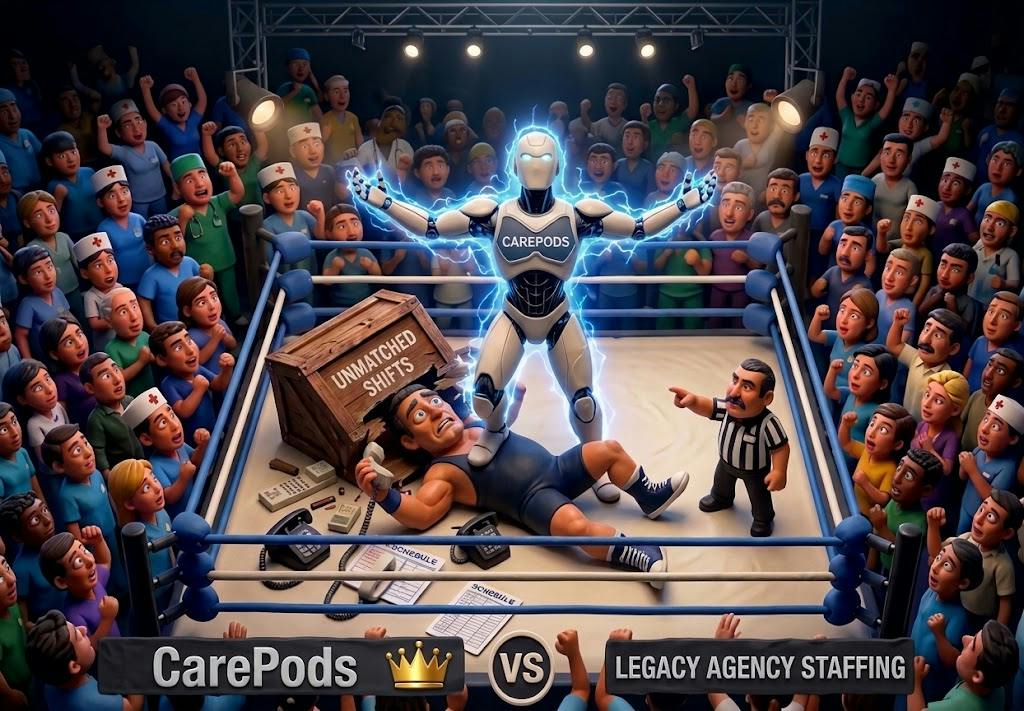
Every year, Michigan healthcare facilities face significant staffing overhead costs that could be streamlined through better technology. Legacy agencies charge substantial markups. Gig platforms have raised concerns about treating nurses fairly. And regional facilities, the ones serving communities outside Detroit and Grand Rapids, have staffing needs shaped by smaller local clinician pools, commuting conditions, and changing demand. CarePods, founded by Taylor Doucet, is building something different: a platform designed around the workers first, with the infrastructure to try to prove it works. The Broken Economics of Healthcare Staffing The problem is not just a shortage of nurses. Getting qualified clinicians into the right facilities remains a challenge, with Michigan hospitals reporting thousands of nursing vacancies. Legacy staffing agencies operate on traditional playbooks, taking cuts and adding markups that can push rates higher while clinicians receive only a portion of what facilities pay. Gig platforms promised on-demand shift booking but faced documented concerns about ratings, shift access, and account restrictions that raised questions about how they treated workers. CarePods is building specialized infrastructure designed specifically for healthcare safety and compliance, with worker protection as a stated priority. Research into gig-based nursing platforms has documented concerns about ratings, shift access, and account restrictions. These practices have raised questions about whether some platforms prioritize operational convenience over worker stability. CarePods watched these approaches and drew a different conclusion: healthcare staffing needs infrastructure built for healthcare, not adapted from the gig economy. The Compliance Layer Nobody Wanted to Build In healthcare, you cannot move fast and break things. Healthcare staffing requires appropriate license validation, background checks where applicable, and credential tracking. Traditionally, this meant coordinators manually cross-referencing databases like LARA, Michigan's licensing authority, and making phone calls to verify references. According to CarePods, the lag time can be measured in weeks, not hours. By the time a facility gets a nurse cleared and onboarded, the crisis may have already passed. CarePods built its compliance layer from day one. According to its Trust & Security documentation, CarePods reviews submitted license details and supporting documents before approving marketplace access. Every nurse who enters the platform must complete the required checks before they can book a shift. No exceptions, no workarounds. This approach is not glamorous. It does not generate headline-grabbing valuations. But it is the kind of unglamorous infrastructure work that could help staffing actually function for regional facilities that cannot afford dedicated compliance teams. Facilities may still have additional credentialing and onboarding requirements. Why Michigan First Makes Sense CarePods argues that national gig platforms often chase Tier-1 hospital networks on the coasts. They build for the enterprise deals, the major health systems, the clients who can afford to negotiate custom contracts. Regional and rural Michigan facilities, including nursing homes in Grand Rapids, assisted living centers near Ann Arbor, and community hospitals outside Detroit, have staffing needs shaped by smaller local clinician pools, commuting conditions, and changing demand. That is the market CarePods chose to own. Michigan presents a specific set of advantages for a platform at this stage. The regulatory environment is consistent across the state. The healthcare corridors are concentrated enough to build density without requiring national scaling. And the facilities serving these communities are precisely the ones getting squeezed by legacy agencies with minimum commitments and regional offices that may deprioritize smaller accounts. By focusing on Michigan, CarePods can build the playbook before trying to export it. Learn where the friction points are in one state, solve for them, then replicate. Protecting the Worker Protects the Facility There is a tension in healthcare staffing that many platforms struggle to address: facilities want reliability, but nurses want stability. Some gig apps have faced criticism for prioritizing facility convenience over worker stability. Legacy agencies build recruitment and administrative costs into what facilities pay. Neither side necessarily gets everything it needs. CarePods' model tries to resolve this differently. Rather than treating nurses as interchangeable gig workers who can be deactivated at the first sign of a dispute, CarePods prioritizes high-retention relationships. Nurses who feel protected by the platform may stay on it longer. Longer tenure could mean facilities get clinicians who know their patients, understand their workflows, and show up more consistently. The economic logic is straightforward. A nursing home that churns through three different nurses in a month because of ongoing disputes is not saving money. Continuity of care matters. Patient outcomes matter. A platform that treats nurses as partners rather than disposable resources could deliver better results for facilities in the long run, although CarePods' effects on retention and facility outcomes still need to be demonstrated. The Numbers Behind the Bet According to CarePods, the company has set concrete targets for its first twelve months: 25,000 completed shift bookings and $2.5 million in transaction volume. These targets establish measurable milestones against which the platform's progress can be assessed. They are not the kinds of numbers that generate unicorn headlines, but they are the kind that could prove a model works in the real world. According to CarePods, Michigan healthcare facilities could save up to $124,800 annually through a more streamlined staffing model. That figure comes from the platform's savings calculator on carepods.co, which models different shift configurations and staffing volume. Actual savings depend on staffing volume and existing costs. That math only works if the platform actually delivers fill rates that meet or exceed what agencies provided, and if the nurses stick around long enough to make the relationship worthwhile. That is the bet. Build infrastructure that treats clinical workers fairly, and the facilities might get better outcomes as a side effect. What Comes Next Healthcare staffing is not a glamorous problem. It does not generate breathless think pieces about AI replacing doctors or blockchain revolutionizing medical records. It is administrative. It is local. It happens in nursing homes and assisted living facilities where the lights are always on and the shifts never fully staff themselves. CarePods is betting that the companies willing to do the unglamorous work, building compliance infrastructure, treating workers fairly, focusing on regional corridors that bigger platforms may ignore, will win in the long run. According to CarePods, the company is finalizing a $750,000 seed round intended to support expansion beyond Michigan. Whether that bet pays off depends on whether the theory holds: that protecting nurses leads to better fill rates, which leads to better outcomes for facilities, which leads to sustainable growth. The next twelve months will test it. And for the Michigan facilities watching, the test starts with a simple question: can a staffing platform built around fairness actually work in an industry facing criticism over how some workers are treated? If CarePods is right, the answer changes how every regional facility thinks about their next staffing partner. If it is wrong, the legacy agencies win another year. Either way, the infrastructure that wins will look nothing like the gig economy playbook. This article was published under HackerNoon's Business Blogging program.
How CarePods Is Approaching Healthcare Staffing in Michigan
Full Article
Original Source
Read the full article at Hackernoon →KhanList aggregates and links to publicly available news content. We do not host full articles from third-party sources. Always verify important information with original sources.