It is conceivable that in one blistering campaign, the People’s Republic of China could invade, occupy, and forcibly annex Taiwan. One question would dominate the post-occupation debate: “What more could have been done?” The obvious answers will be better intelligence, bigger exercises, more weapons. One underexamined answer is a different model for U.S. special operations forces advising.The United States has spent decades using rotational military teams to train foreign partners. This approach is sustainable and useful for specific tactical tasks, but it is poorly suited to the institutional, linguistic, and political work required to help Taiwan prepare for a prolonged campaign against a massively superior force. Military advising for such a complex and consequential situation cannot be treated as a semester abroad.The U.S. advisory model for Taiwan needs an overhaul, starting with the U.S. special operations forces who specialize in foreign partner advising. Long-duration integrated advisory organizations can produce institutional change and strategic effects that rotational advisory models cannot. To successfully deter, Taiwan ought to demonstrate it can fight hard and fight long. At a minimum, a long-dwell advisory cadre would improve Taiwan’s ability to mount a credible defense. At its higher end, such advisory work could help prepare Taiwan for a more ambitious strategic goal: deny a rapid Chinese victory and animate the prospect of a prolonged, costly campaign.Policymakers should seriously consider approving a small, enduring advisory cadre in Taiwan modeled on the organizational principles of Cold War Detachment A in Berlin. Such a model would deepen relationships and integrate successive rotational teams into a coherent long-term effort. The aim is to improve Taiwan’s ability to fight alone, fight with partners, or something in between. I seek here to explain how the nearly forgotten Detachment A mission in Berlin is relevant in constructing a superior U.S. advisory mission tailored for Taiwan.What was Detachment Berlin? Detachment Berlin, officially called Detachment A (or “Det A”), operated in the occupied and divided city of Berlin from 1956 to 1990. The core of Detachment A was less than 100 U.S. Army Special Forces operators on two-year assignments in the city. Berlin was, in many respects, like Taiwan is today — the volatile center of a great power rivalry. Under Allied postwar occupation arrangements, Germany was divided into four occupation zones that later became East and West Germany. The capital, Berlin, was shared occupation space. Berlin itself had four occupation sectors that were controlled by the United States, the United Kingdom, France, and the Soviet Union. The geography and military posture favored the Soviets. West Berlin lay roughly 110 miles inside the Soviet-backed German Democratic Republic. Berlin was calm on the surface, but it remained one of the Cold War’s most contested political spaces.Joseph Stalin attempted to eject Western forces from Berlin in 1948, testing the West’s resolve. The U.S. responded with the 462-day Berlin Airlift, exhibiting a creative determination to sustain the western sectors of Berlin. In 1961, Nikita Khrushchev erected the Berlin Wall.Inside this massive military and nuclear-armed showdown were the plain-clothed and operationally active Detachment A teams. These special operators may seem a footnote in the larger narrative of massive armies facing off on German soil, but their presence — quiet and unacknowledged — was recognized by the Soviets and East German secret police (the Stasi).Detachment A was a type of “stay-behind” force, designed to activate anti-communist sympathizers, cells, or resistance groups to delay Soviet advances. These 12-man operational detachments were not meant to defend Berlin from fixed bunkers, nor to heroically die under the treads of Soviet tanks, which would number in the thousands. Their operational design was to conduct sabotage operations to slow invading Soviet forces, then create chaos in the Soviet rear area with anti-communist partisans.Despite its lack of doctrinal templates, Detachment A was not a free-for-all. These small teams, and the U.S. Special Operations Command that supported them, aligned their effects with the strategies and tactics of the U.S. and allied forces.Detachment A teams operated on a wide spectrum of tasks, including low-level intelligence, liaison, language, advisory, and unconventional warfare. They rehearsed the infiltration of man-portable nuclear devices into what would be Soviet-occupied rear areas. Backpack nukes behind enemy lines may seem like the height of Cold War idiocy, but this is how stay-behind forces operate: asymmetric methods, irregular tactics, unexpected angles of attack. Stay-behind forces seek to inject surprise to confound the well-conceived plans of a military foe. On the less spectacular side, stay-behind forces are throwing sand into the gears of an oncoming war machine. Their military purpose is to delay, disrupt, or degrade invading forces. Their method is to force-multiply horizontally through people, vertically via munitions, or cognitively through information.The Rotational Advisory ProblemU.S. military policy toward Taiwan can be understood as having three components. First, improve Taiwanese self-defense with weapons and munitions packages. Second, lurk on the horizon with menacing U.S. naval and air power and seek to involve regional allies in war plans. Third, provide light footprint train-and-advise packages for the Taiwanese armed forces on the island.The U.S. government is open and public about its arms sales to Taiwan and trumpets its air and naval forces that ostensibly could stymie a Chinese cross-strait invasion. But the hands-on, on-island work of U.S. servicemen is less visible. The U.S. Pacific Command acknowledges defense cooperation with Taiwan but discloses few details about the scale, duration, location, or missions U.S. military personnel support.America’s longstanding policy of strategic ambiguity regarding the defense of Taiwan generates the in-between state of neither committing nor abandoning. The United States has no treaty obligation to defend Taiwan. In practice, any U.S. soldiers, sailors, or marines on the island display an American presence but do so without the superstructure of U.S. bases or U.S. navy ships moored in ports.Special operations forces are designed to deploy to denied, hostile, politically sensitive, and volatile environments. A hallmark of U.S. special operations is operating by, with, and through partners on a spectrum: from professionalized soldiers to village-level irregulars. Special operations forces combine the intelligence and exquisite strike machinery of the U.S. military with indigenous partners to create effects larger than the footprint indicates.This operating template does not guarantee forward progress; it requires expertise, time, and investment from both the United States and the partner. On heel-to-toe rotations to foreign locales, the U.S. military typically operates as an interchangeable parts model. This makes deployments sustainable in the long term, but it inhibits the development of regional expertise. This is, in broad terms, how the U.S. military characterizes its engagement in Taiwan.This posture is intentional. Light footprint forces signal retractability and register low on the escalation scale. For all those benefits, this method relinquishes the development of true expertise and stymies the very “harden Taiwan” objective that it is racing to achieve.In Taiwan now, as in Ukraine prior, this is a poor trade-off. Clusters of advisors can be easily withdrawn, exactly as the United States did in haste prior to the Russian invasion of Ukraine in February 2022. The United States conducted a speedy withdrawal of U.S. special operations forces from Ukraine in the months and weeks prior to the war. The withdrawal reduced the risk of direct U.S.-Russian confrontation but also demonstrated the fragility of an advisory model whose personnel could be removed precisely when their relationships and expertise became most valuable.In Ukraine (2015 to 2022), the U.S. government lacked the imagination – and political will – to prepare its advisors to remain behind. In retrospect, they could and should have done exactly that. As the war progressed, the U.S. assistance to Ukraine grew bigger and bolder. The $195 billion in U.S. aid provided to Ukraine came after the U.S. relinquished the advantage of in-place advisors. Washington’s later intelligence, materiel, and operational support could have benefited from the forward eyes and coordinating hands of special operations forces advisors. This lesson should be captured for Taiwan.The United States may opt out of a direct, high-intensity confrontation with China in the Taiwan Strait. In any scenario, America will consider how to impose costs on China inside and outside active conflict zones. One option that enables all the others is the presence of expertise, on island, that can operate inside Taiwan’s systems and, if called upon, connect to U.S. joint force platforms. Design it to run deep and stay long; decide later if it needs to go.It is too late for “Detachment Ukraine,” but there is still time to introduce “Detachment Taiwan.”Detachment Taiwan?A core cadre of U.S. military advisors as the base advisory enterprise in Taiwan would strengthen deterrence and, if that fails, help Taiwan defeat Chinese Communist Party forces. Some rotational military capability would still occur, but it would orbit around a knowledgeable and integrated collective of long-serving advisors. Special operations would anchor this detachment with related non-special operations efforts adopting a similar model. If the United States wants to credibly support an undermatched Taiwan while refraining from large, provocative, and costly troop rotations, then adopting this model is a logical and smart next step. Little imagination is needed because a similar model already exists.Complicating the Adversary’s Theory of VictoryHow did Detachment A help to deter the Soviets, and how might a related concept deter a willful China from invading Taiwan? The specter of a protracted war is troubling to any political leader or military commander. Detachment A — with its fluency in German, networks of cells and safe houses, and operational methods carried over from the World War II-era Office of Strategic Services — was a form of communication to the Soviets. Of course, Detachment A did not independently deter a Soviet attack, and its precise influence on Soviet calculations is difficult to determine. Its importance lies instead in the problem it represented: even if Soviet forces seized West Berlin, occupation forces would face organized resistance.In Taiwan, the United States possesses no army divisions, nor does it have a secure rear area like western Europe. The timing, scale, and form of a U.S. military response are uncertain. In this geopolitical context, U.S. advisors on Taiwan must carry a larger portion of the work required to create deterrence. An implanted U.S. special operations presence in Taiwan cannot replace massive U.S. military forces, but it is qualified and well-positioned to enable all aspects of Taiwan defense, from repelling a coastal invasion to effecting protracted warfare on the island. They could do so at a sustainable cost. This small detachment could bridge Taiwanese defense improvements with U.S. and allied joint force concepts and capabilities that are under constant revision.The Russo-Ukrainian War has demonstrated how dispersed and technically enabled forces, when integrated with conventional formations and mobilized populations, can disrupt and attrit a larger invading force. The lone advantage that Taiwan has over the defense of Cold War Western Europe is that the People’s Liberation Army must cross roughly one hundred miles of fitful ocean and fight from the beaches to the cities to the mountains. An opposed amphibious landing is one of the most challenging military operations to conduct. Taiwan need not replicate Ukraine’s experience for the comparison to affect Beijing’s calculations. It must credibly demonstrate that an assault would not end with an amphibious lodgment, but could lead to a prolonged campaign, continued resistance, high losses, and uncertain political control.Detachment A, by itself, could not be credibly called a deterrent. But it was not designed to lurk as a lone deterrent. Deterrence should contain a mix of strike-back capabilities that, in sum, present dilemmas and introduce risks for an invading force.In Berlin, the United States concealed an unconventional warfare capability inside of its formidable — yet outnumbered — garrison forces. In Taiwan, the U.S. deterrence scheme rests on a different set of principles. First, aid Taiwan in fighting its own battle in the air, on land, and at sea; second, protect U.S. forces, bases, and treaty allies in Japan, the Philippines, and South Korea; and third, preserve U.S. military power that could strike at a degraded Chinese invasion force reaching culmination. This approach offers political operating space for U.S. leadership but rests on an assumption that Taiwan can impose costs and operate a protracted war strategy. Given the constraints of U.S. policy, Detachment Taiwan is the type of organization required to fulfill such a strategy.Unrealized Benefits Detachment Taiwan offers two unrealized benefits, backed by research.First, on-island advisors require continuity to impact the deeper tissue of strategies, force structure, information operations, and the realization of protracted war plans. Qualified advisors could assist on the difficult topics of distributed command and control, transitioning from urban to rural fighting, weapons employment, and operationalizing undergrounds. The U.S. Army special forces, civil affairs, and psychological operations are selected, educated, and trained for this very purpose. Even then, their honest work will produce modest impacts if they are not woven into the culture, language, and logic of Taiwan.Second, this model incentivizes the host, Taiwan. Instead of hosting new house guests who need introductory instructions every few months, the Taiwanese could invest in enduring relationships with expertly prepared and serious advisors. Together, the Taiwanese and their U.S. advisors would accumulate institutional memory instead of surrendering it every couple of months.Taiwan is building a resilience and whole-of-society defense plan. It is preparing to defend itself without the presumption of external support. Taiwan is exploring how to activate its population to prevent the consolidation of Chinese control in the event of hostile seizure. If U.S. advisors are called upon to support this challenging component of strategy, then this preparation must occur in peace, not under crisis. This scenario would require U.S. advisor support across multiple domains: advising Taiwan partners, fortifying sensor-to-shooter networks, and supporting citizen resilience and resistance structures. Integrating these capabilities and systems would validate the claim that advisory efforts can impact Beijing’s calculations.Research supports this position. The field of advisory work should look to the findings of researchers such as Frank K. Sobchak, Alexandra Chinchilla, Alexander Noyes, Kyle Atwell, and Jahara Matisek. Although they researched different cases and advisory missions, the literature reveals several recurring themes. First, effective advising must occur at the institutional level and not just the tactical level; second, advisory efforts that are right-sized and invested with long-term perspectives produce more enduring impacts; third, treating advisor work as a proper professional domain, not a secondary duty, maximizes the impacts of advisors in any number. In Training for Victory: U.S. Special Forces Advisory Missions from El Salvador to Afghanistan (2024), Frank K. Sobchak states “perhaps one of the clearest conclusions … was that consistency in advisor pairing helps produce combat-effective partners.”Counter Arguments Too Small. Critics might argue that any U.S. advisory effort so small — no matter how it is fashioned — is insufficient to harden Taiwan. The historical record suggests otherwise. When U.S. small-footprint advisory efforts are paired with capable and committed partners, and when aligned with the right host nation forces and institutions, the prospects for lasting success improve. Successful efforts are typically out of the headlines. Philippine special operations forces bear the imprint of decades of cooperation with the United States. In the 2000s, special operations training with new NATO partners such as Latvia, Lithuania, Estonia, Poland, Slovakia, and Romania produced, over time, a multinational special operations capability. More recently, modest investments from advisors in Ukraine from 2015 to 2022 provided a significant return on investment for Ukraine.Force Readiness. Another critic might be the special operations commands that prepare and deploy rotational forces. This speaks to the enduring tension between employing forces and generating forces. The rotational force model provides clear force readiness benefits: predictability, manageable deployment timelines, and the ability to keep units “fit to fight” with intensive home-station combat training. These are important considerations. However, these concerns should not override the qualitative benefits of committing a forward-stationed cadre on the most strategically consequential front line of our time. Detachment Taiwan weighs the effort toward strategic deterrence in theater and at the point of friction rather than general readiness requirements.Too Provocative. Is Detachment Taiwan a provocative act in the eyes of Communist China? Detachment Taiwan is a shift in persistence and continuity, not in scale. For pure optics, less turnover of personnel means less signature. Less signature means lower provocation. This proposal reorganizes an existing model rather than introducing additional combat capability. If China registers this as a provocation, it would be a noteworthy signal to U.S. strategists in ascertaining China’s fears or intentions.Particularism vs. UniversalismThe strategy and practice that won the Cold War against the Soviet Union was a 40-year group project. But it was George F. Kennan, the diplomat, political warfare enthusiast, and Sovietologist, who made the greatest contribution. Kennan argued that mass could not be applied everywhere. Instead, America had to muster and apply its resources where it counted. Kennan argued for custom-built models attuned to regional problems, local conditions, and the minute details that seemed small, but loomed large. U.S. special operations advisory efforts — as part of the mosaic of U.S. deterrence — call for this very particularism. Detachment Taiwan is Kennan’s particularism in practice.Meaningfully integrated and long-dwell advisory organizations would improve the United States’ role in deterring aggression against Taiwan. This proposal changes quality and continuity, not military mass. It respects the lessons on effective advising outcomes and capitalizes on the unique attributes of U.S. special operations forces. Detachment Taiwan offers Washington a military move that hardens Taiwan while respecting political boundaries and escalation apprehensions.Brian Petit is a former U.S. Army officer who served for 10 years in the Army’s 10th Special Forces Group. Brian consults on and teaches special operations, irregular warfare, and resistance for the Joint Special Operations University and the Irregular Warfare Center. The views in this article are those of the author alone and do not represent those of the Joint Special Operations University, the Defense Department, or any part of the U.S. government. Image: Sarah Jane Roberts via U.S. Army
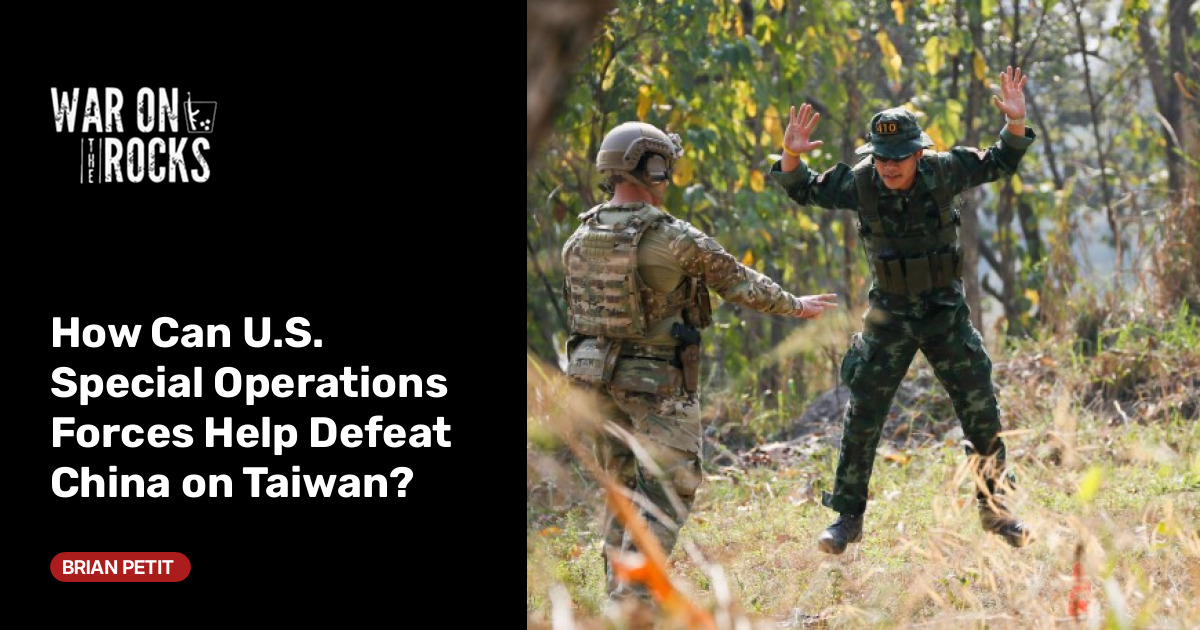
How Can U.S. Special Operations Forces Help Defeat China on Taiwan?
Full Article
Original Source
Read the full article at Warontherocks →KhanList aggregates and links to publicly available news content. We do not host full articles from third-party sources. Always verify important information with original sources.