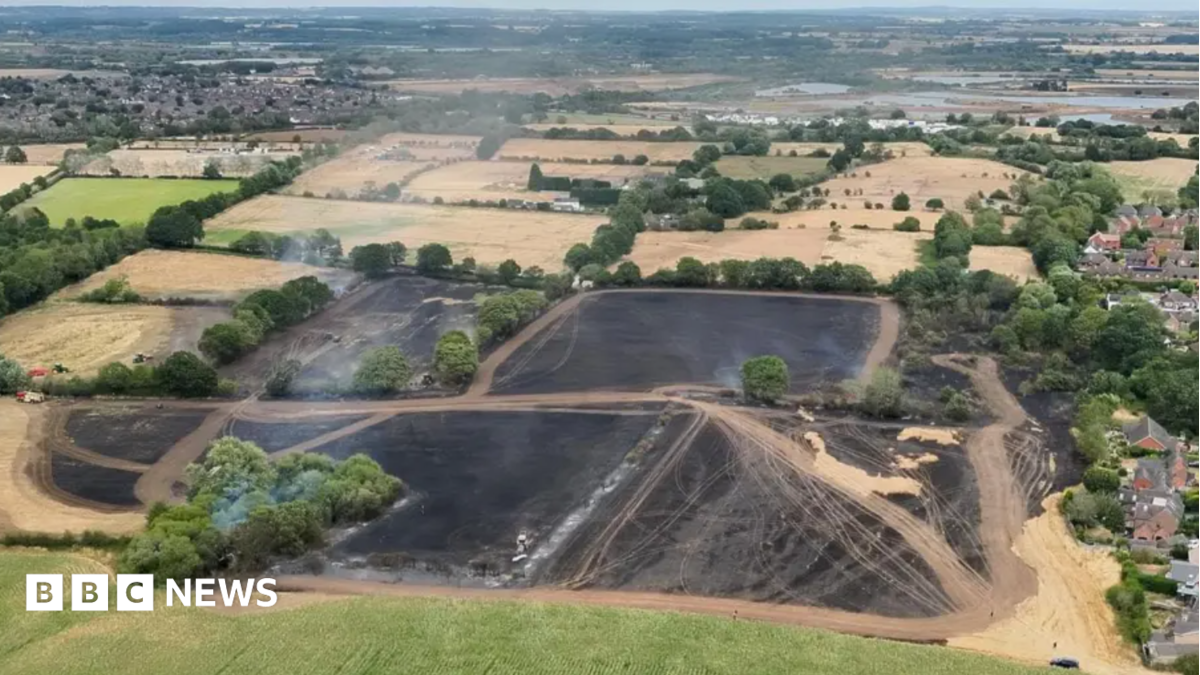
Image source, Staffordshie Fire and Rescue ServiceImage caption, A large fire which started on land off The Moor, Fradley, Staffordshire, two weeks ago was deemed to be deliberateByBridie AdamsWest MidlandsA grassfire can reduce a thriving habitat to blackened ground in a matter of hours - but recovery is a much slower story.Recent fires have torn through nature reserves, beauty spots, farmland and open countryside, leaving conservationists and land managers facing the difficult task of helping to restore habitats and prevent further damage.But can these places bounce back? And what can be done to protect them in a hotter, drier future?Dan Brown, deputy chief executive of Birmingham & Black Country Wildlife Trust, said the loss of habitat was a big problem."When we lose grasses, wildflowers and trees to fire, we lose the food plants that invertebrates rely on, taking away spaces in which butterflies and bees can thrive. That impact cascades upwards to birds and mammals who would normally use invertebrates as a food source," he said.Image caption, Dan Brown said the damage to Portway Hill, pictured behind him, was extensive after flames broke out last weekThirty firefighters tackled a blaze at Portway Hill in Oldbury, West Midlands, last week, an area of land managed by the trust. The site was home to scarce plants including pyramidal and bee orchids, and a rare colony of marbled white butterflies that had relied on common knapweed and red fescue."We've lost these plants now, and it will take years of work to restore the meadow so that marbled white butterflies can return," said Brown.Staffordshire Fire and Rescue Service said it had attended about 600 outdoor fires in July, roughly double the number recorded in the same month last year.Three of them were at Cannock Chase, a protected area of countryside, forest, and lowland heath, where animals including adders and toads were killed.Image source, Staffordshire Fire and Rescue ServiceImage caption, Fifteen fire crews were sent to tackle the largest of three fires at Cannock Chase on WednesdayJeff Sim, head of nature reserves at Staffordshire Wildlife Trust, said the fires had been devastating years of conservation work."Each day we're seeing fires devastate green spaces and my team is incredibly worried," he said. "In an instant we could lose years of careful restoration work. It can take decades for land to recover from fire, even with dedicated intervention and restoration work."Many other parts of the West Midlands have also been affected. Nature reserves have gone up in flames, blazes have ruined farmers' fields and crops, and deliberate fires started in parks and beauty spots have grown out of control. The picture has been similarly bleak nationally.At Dunwich Heath in Suffolk, where a fire that started last week has burned about 371 acres (150 hectares) of lowland heath, conservationists warned the impact on wildlife and the landscape would be felt for years. The National Trust described it as "absolutely devastating".Image source, Suffolk Fire and Rescue ServiceImage caption, A fire burned about 371 acres (150 hectares) of lowland heath in Suffolk, devastating wildlife and its habitatIn Scotland, a fire in the Cairngorms National Park has burned about 10 sq miles (26 sq km) of moorland and forestry. The fire, which started last month, damaged the RSPB's Loch Garten reserve at Abernethy, which is home to thousands of species. Insects, reptiles, trees, lichens and mosses have been killed.Image source, PA MediaImage caption, The wildfire in the Cairngorms is thought to have started about 400m (437 yards) away from Ryvoan Bothy Is restoration possible?Brown said restoration was possible, but slow."We can restore habitat by seeding meadows and planting trees, but this process takes a long time and has to be carefully managed," he said.Some of the trust's conservation projects have made landscapes more resilient to fire.Planting native broadleaf trees creates cooler, shadier woodland that is less likely to ignite, while restoring rivers and wetlands helps hold water in the landscape, keeping surrounding land damp.At The Roaches, a dramatic rocky landscape area in the Peak District, fire broke out in June. Sphagnum moss plants had helped keep some of the ground wet and prevented severe damage.Dr Kate Ashbrook, a conservation ecologist and senior lecturer at the University of Worcester, said the most important thing to do should be to "protect the unburnt habitat"."Any areas that escape the fire will contain the surviving animals or life," she said.Image source, University of WorcesterImage caption, Conservation ecologist Dr Kate Ashbrook said protecting areas of unburnt ground could help restore the rest of the affected landWild Ken Hill, a nature restoration project in Norfolk which was hit by a fire in 2022, provides some hope that scorched areas can recover.Its founder, Dominic Buscall, said: "The wildfire at Wild Ken Hill in 2022 was devastating at the time, but one of the most striking lessons has been how resilient nature can be."Although some impacts take years to recover from, vegetation regenerated quickly and wildlife has steadily recolonised the affected areas. Given the opportunity, natural systems can be remarkably robust."Image source, Andrew Waddison/BBCImage caption, Wild Ken Hill was devastated by fire in 2022, left, but Dominic Buscall said nature had been "remarkably robust" as the land recovers, rightHowever, Ashbrook said true ecological recovery after fires depended on soil fungi returning, plants re-establishing and invertebrate populations recovering, while the loss of mature woodland could take decades to reverse.What about our gardens?For many people, the damage is closer to home. Weeks of hot weather have caused brown lawns, wilted plants and cracked soil.But Josh Cushing, owner of Goldstone Hall Hotel & Gardens in Shropshire, said grass was "remarkably resilient and won't die because of a period of drought".Darren Rudge, a BBC radio broadcaster known as the Laughing Gardener, said lawns were "asleep rather than dead"."The roots are alive. It's totally OK and you do not need to worry about your lawn."What could the future look like?Climate change is creating hotter, drier conditions, more vulnerable to fires.Ashbrook said the frequency of grassfires was of particular concern because "wildlife in the UK is already struggling"."A lot of British wildlife is on its knees anyway, so anything that is going to make it more stressed, whether that's the loss of flowers or a nesting habitat, has a significant impact," she said.Conservationists say by making the countryside more resilient, nature itself can become part of the defence.However, "the biggest factor that will reduce wildfire risk is people's behaviour", according to Brown.He urged people not to light disposable barbecues or campfires in green spaces, avoid dropping lit cigarettes and take litter home."Everyone has a role to play," said Buscall. "Most wildfires are caused by human activity, which means most are preventable."The burnt landscapes may look damaged now, but with time and changes to how we protect our countryside, experts say recovery is possible.Get in touchTell us which stories we should cover in Birmingham and the Black CountryMore on this storyRelated internet links
How can landscape recover after devastating fires?
Full Article
Original Source
Read the full article at Bbc →KhanList aggregates and links to publicly available news content. We do not host full articles from third-party sources. Always verify important information with original sources.