
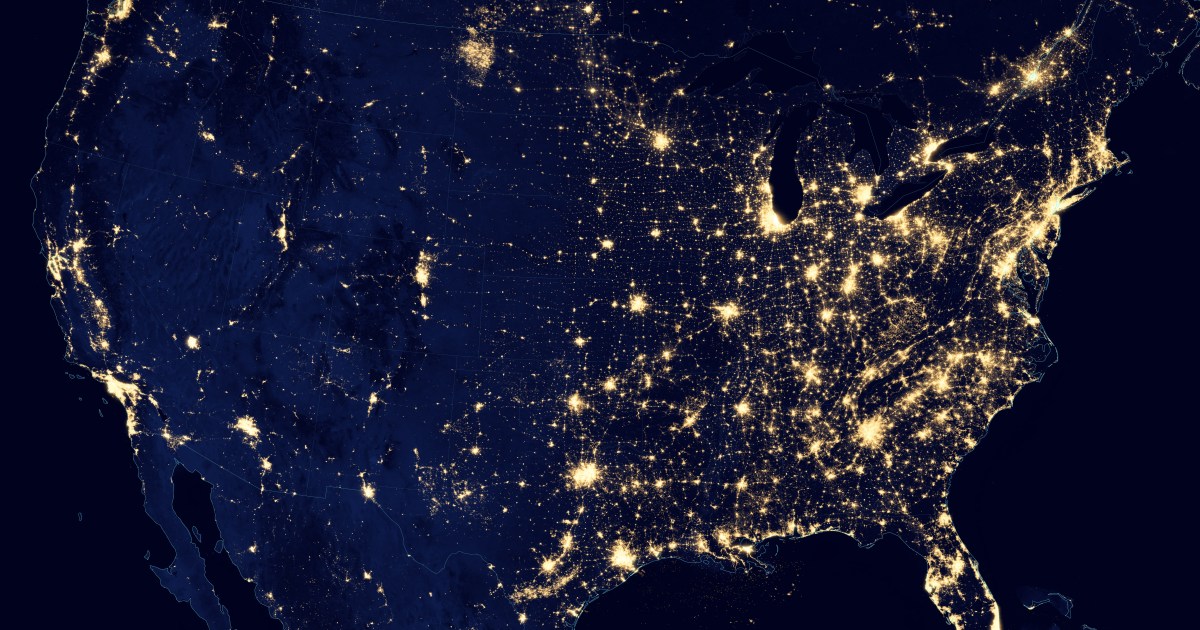
Choosing full cutoff fixtures and the appropriate amount of outdoor lighting is more important than the specific light source you use. | Published: October 2, 2026 Light pollution is not-so-slowly encroaching across the U.S., as exemplified in this 2012 light pollution map. Credit: NASA Earth Observatory images by Robert Simmon and Jesse Allen, using Suomi NPP VIIRS data provided courtesy of Chris Elvidge (NOAA National Geophysical Data Center ). Suomi NPP is the result of a partnership between NASA, NOAA, and the Department of Defense. What type of lighting emits the least amount of light pollution? Peter BladoTacoma, Washington First, use a good lighting fixture, one that is a “full cutoff.” That means there is no direct upgoing light at all. It generally also means there is very little light just below the horizontal, which is the kind of light that causes glare. Too many installations produce a lot of glare, and that compromises safety and security, not to mention the blinding obnoxious light. Essentially all lighting manufacturers make good full cutoff fixtures, and there is no excuse not to use them. Second, use the correct amount of light. Overkill does not help visibility and it can waste a lot of energy. Going from darker areas to overlit areas means the eye does not adapt to the bright areas, and visibility is compromised. Follow the published guidelines of the Illuminating Engineering Society of North America. If you have chosen a good light fixture and used the appropriate amount of light, the choice of the light source is less important. In the vicinity of major observatories, and for those who want the maximum energy savings, one should use low pressure sodium (LPS) lights. These lights are essentially monochromatic, so astronomers can filter their emission out, and the sky remains dark at all other wavelengths. LPS is also the most energy-efficient light source. Many astronomers, however, prefer to use high pressure sodium (a sort of amber light) or metal halide (whitish) sources. HPS is fairly energy efficient, and metal halide is the most energy efficient of the white light sources. Dark skies need our help. Those with additional interest can go to the International Dark-Sky Association (IDA) website (http://www.darksky.org), which has links to other sites, including many in the lighting industry. Or find an interactive FAQ and ways to contact the IDA at https://darksky.org/about/contact/. Dave CrawfordFormer Executive Director, IDA This question and answer were originally published online October 1, 1998. Related: The fight against light pollution
How can I reduce my personal contribution to light pollution?
Full Article
Original Source
Read the full article at Astronomy →KhanList aggregates and links to publicly available news content. We do not host full articles from third-party sources. Always verify important information with original sources.