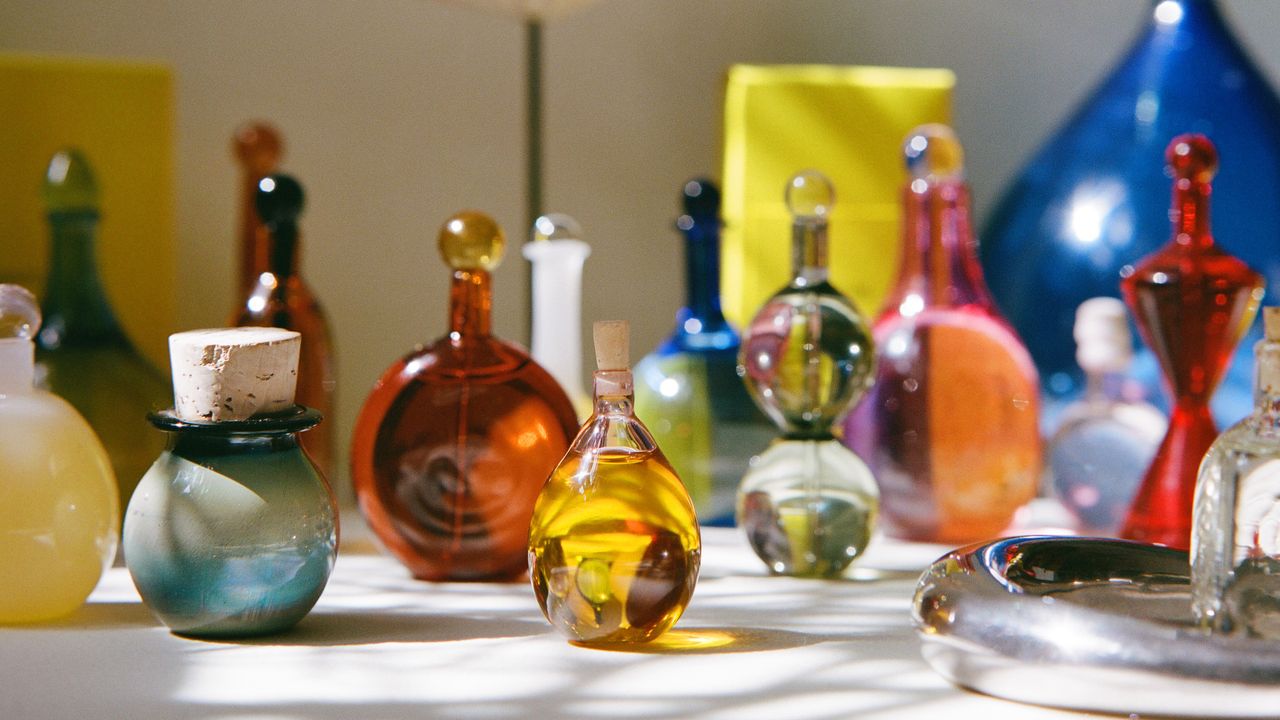
The inspiration for perfume brand Gamine has been a decade in the making. Since moving to Brooklyn's Bedford-Stuyvesant 10 years ago, founder Melanie Dir has absorbed the historic neighborhood's character—its character and community—eventually distilling those influences into a fragrance brand that debuted this April.From the Bed-Stuy brownstone she shares with her artist husband, Frenel Morris, the couple drive their grey Jeep to a cavernous, skylit studio in neighboring Bushwick. There, Morris’s large-scale, high-contrast graphic paintings fill the space alongside the shifting aromas of Dir's latest fragrances. “Brooklyn shaped the brand’s DNA—it’s real, unfiltered, and impossible to manufacture,” she says, alluding to the cinematic quality of street life and the neighborhood’s layered olfactory influences.In spring, she says, jasmine and fresh greenery mingle with barbecue smoke, blunts, and beer. By late summer, humidity draws out Nag Champa incense, OG Kush, hot concrete, and the metallic tang of the elevated subway tracks. “Brooklyn's ability to embrace contradiction became one of the foundational ideas behind Gamine,” she says.Melanie Dir developed the brand Gamine inside her own Bed-Stuy brownstone. GettyGamine is inspired by the juxtaposition of scents like jasmine and spices. UnsplashThat tension carries through the collection. One Gamine fragrance, Heroic Dose, opens with fresh cypress, blue hemp, and salty marine air, but underneath lies an earthy, gritty complexity brought in by cumin and vetiver bourbon. “Beauty isn't about removing the rough edges, it's about elevating them to reveal character and individuality,” she adds. “You also see it in [our bottles]—the durable rubber material, the weighted glass… the industrial design language that runs throughout.”Dir is not the only perfumer to find creative inspiration in the borough, which, for some years now has become home to a community of perfumers, many of them self-taught, who have incubated brands in industrial-spaces-turned-studios or out of their tiny apartments. “Brooklyn in the 2010s was full of artists who took inspiration from the vivid, often overlooked details around them, creating an exciting wave of artisanal, small-batch brands,” explains Tanaïs, an award-winning author and multidisciplinary artist, who started a perfume line 12 years ago now known as Studio Tanaïs.They remember discovering pioneering labels such as D.S. & Durga, MCMC Fragrances, and Joya Studio at local markets and neighborhood shops, inspiring them to begin making perfume in their Williamsburg apartment. They later moved into a studio in East Williamsburg that they still occupy; a raw, industrial space in which they compose fragrances drawn from influences as varied as Bollywood movies, Hawaiian goddesses, and the ceremonial incenses of the Americas—palo santo, wild white sage, and black copal.David Seth Moltz and and Kavi Ahuja Moltz, the co-founders of OG Brooklyn perfume brand D.S. & Durga Martin Scott PowellOf those early OGs that ignited the imaginations of a new generation of perfume makers, none have captured attention—and noses—like David Seth Moltz and Kavi Ahuja Moltz of D.S. & Durga. In 2007, the couple started the transportive fragrance line rooted in music, literature, nature, and design; D.S. & Durga is now sold in over 40 markets. At the time, Seth Moltz was trying to make it as a musician, and the creatives he ran with all tried to “cosplay 1880s living” by urban farming and DIY-ing everything. “That spirit influenced us to first make perfume and then try to make it a business,” he says. “We rubbed elbows with creatives, business owners, and chefs, many of whom are still friends, and it completely shaped our journey.”They started out in Seth Moltz’s Bushwick apartment, later moving into a 500 square-foot space beneath the F/G train in Gowanus. Blond wood shelves held the perfume organ (a specialized workstation used to organize raw materials), while a stereo, stacks of records, and an ink-blue leather Chesterfield sofa gave the space the feel of a listening room as much as a laboratory. Their office at the Brooklyn Navy Yard retains all those familiar touches—only now, there are even more records. D.S. & Durga's commercial success has paved the way for brands like Ellis Brooklyn—founded by beauty journalist Bee Shapiro, a pioneer in the clean fragrance space—that can be found across Sephora stores in North America.Others have taken paths less traveled. For 10 years, Kindred Black’s Alice Kindred Wells and Jennifer Black Francis have disregarded everything marketeers espouse about building a brand by focusing on ethical, low-impact business practices. They share their light-filled Gowanus studio with hundreds of sinuously-shaped tiny phials sourced from artisans around the world. They fill these jewel-toned, hand-blown glass flaçons with small-batch, limited-edition botanical scents. The bottles are unmarked because they didn’t want loud logos distracting buyers.The duo also wanted to take on the responsibility of sustainability rather than pass the onus to users, often making expensive material choices—forgoing plastic and non-biodegradable packaging for recycled boxes and wrapping paper made with post-consumer waste, printed locally with vegetable and soy inks. “People want to be connected to the humanity in craft,” says Wells. “For every product we release, we know the person who's hand-blowing the bottle, the people growing and picking the blossoms, and we're either blending it ourselves or know who's doing it,” she says.They credit the intentionality behind their work to Brooklyn’s artistic openness. “There's such an energy here of people trying to express creativity that you don’t feel afraid to really try something new,” says Francis.Each one of Kindred Black's jewel-toned flaçons are made of hand-blown glass. Kindred BlackKindred Black founders Jennifer Black Francis (left) and Alice Kindred Wells (right) Kindred BlackIt was this cross-pollinating artistic energy that fueled Dir, too. While Dir built Gamine, Morris's art-world friends flowed through the studio—to work, shoot hoops, practice jiu-jitsu, or simply spend time with Beef, the couple's American Bully. Bill Powers, Ryan McGinley, Stanley Whitney, Rashid Johnson, and the late graffiti legend Lance de Los Reyes (Rambo) were among the regulars, and informal sniff tests of Dir's latest fragrances became a fixture of every visit. Artist Sedrick Chisom came by to have each of his dreadlocks personally perfumed by Dir before a date. Dir, in turn, used these folks as a creative cabal to dissect the smell, look, and feel of the brand. “Does it smell like hot steel? Latex? Do you get shamanic incense, but gasoline as well? Too much or not enough?” she recalls asking of them.“Brooklyn has always been a magnet for creatives—designers, makers and aesthetically-minded people gravitate here, and fragrance is just another medium for that same instinct,” says Lindsay Silberman, the founder of Hotel Lobby, a home and personal fragrance line. Silberman has been enamored by hotels for as long as she can remember, and wanted her home to look and feel like one. Every room in her 900 square-foot Williamsburg apartment is designed to mimic an iconic hotel: the office/guest room was inspired by The Beverly Hills Hotel; the living room draws from the Delano Miami Beach.Enfleurage, a traditional method for extracting scents Kindred BlackKindred Black's bottles are blown individually and designed to be refilled and reused. Kindred BlackThe lobby of Williamsburg’s Hoxton Hotel became a sort of second home for Silberman right after the lockdown lifted in 2021. She started Hotel Lobby in homage to her favorite hotels, and much of the brand was built right there in the Hoxton. “Some of my best ideas have come out of there,” she says.Even local flora can contribute to the perfumers’ creative output. “I have studied and copied many plants growing in Brooklyn that have become perfumes or notes in a perfume,” says Seth Moltz. A linden tree on Jefferson and Bedford Avenues in Bed-Stuy became the inspiration for an accord in the perfume and amenity products he created for The Carlyle, A Rosewood Hotel in New York.The concentration of creative minds in the same few zip codes—people boldly forging their own paths across disciplines—has also created the space for first- and second-generation immigrants to build fragrance brands on their own terms, making room for unconventional ideas, identities, and perspectives. Take The New Savant: The six-year-old brand based in Gowanus infuses its candles with whimsy and complexity, crafting scent profiles that push back against the fragrance industry's tendency towards Eurocentrism and heteronormativity. With notes of steamed jasmine rice and roasted sesame, or scents that evoke salty tears or rubber erasers, and product names like Sapphics in the City, founders Ingrid Nilsen and Erica Anderson have made candles feel exciting again.Tanaïs, who is the child of Bangladeshi immigrants, thinks of perfuming as a practice of transmutation: “Our spirituality, ancestors, and homelands are imagined into a material, embodied substance.” Brooklyn gave them the wings to unashamedly pull Bangladeshi scentscapes into their perfumery. They work with traditionally South Asian notes which are alien to noses attuned to mainstream perfumery, such as mitti attar, the smell of wet earth or betel leaf, a familiar scent across the subcontinent but rarely encountered in Western perfumes. They see their efforts to reclaim ingredients by elevating it in perfumery as revolutionary acts.Dir reminds us that long before the rise of independent perfume brands, scent was already part of Brooklyn’s sensory identity, often coming courtesy of a diverse group of immigrants. “African oils, incense vendors, and fragrance dealers have long been part of the streetscape,” she says. “There has always been a unique scent identity that belongs to Brooklyn itself.” The Bangladeshi-owned store Madina on Atlantic Avenue, for instance, is where Tanaïs first started collecting oils for skincare and candles—and it inspired their first novel, Bright Lines, about a Bangladeshi apothecary in early 2000s Brooklyn. “Brooklyn is where the children of immigrants so often become the artists they’ve always been,” they say. “And it’s certainly true for me.”Stéle, a high temple of niche perfumery located in Williamsburg, Brooklyn StéleHow to chart a fragrant trail through BrooklynStéleFree up your schedule before stepping into this high temple of niche perfumery, because once you go down the rabbit hole, extraction is hard. It’s the best place to acquire a unique sillage (the scent trail a perfume leaves behind as it evaporates), and visitors can experience impeccable brands like Gabar, Neanderthal, Kismet Olfactive, Witch and more, often somewhat undiscovered names. One of the founders is a professional stone mason, so the custom fixtures are worth a visit alone.339 Bedford Avenue, WilliamsburgScent BarLuckyscent has had two decades of blessing fragrance fiends with the gift of discovery, so head to the Brooklyn outpost of its retail brand, if you’re dipping your toe in the niche perfume space. They have the heavy hitters like Amouage, BDK Parfums and Creed, as well as an impeccable collection of brands beloved by niche freaks.663 Driggs Avenue, WilliamsburgOlfactory NYCPlay perfumer for an hour by mixing your own custom scent. Pick a core fragrance, each of which is created by one of the world’s top perfumers, choose some unique accords to layer in, and name and label your creation. It’s an incredibly fun, creative experience.101 N 10th St, WilliamsburgApothekeSign up for a candle-pouring class at the dreamy Apotheke studio. Guests get to create their own home scent by picking from over 50 oils, and will get hands-on experience blending and pouring candles that can be taken home an hour later.459 Van Brunt St, #16, Red Hook
How Brooklyn Became an Incubator for Wildly Imaginative Indie Perfume Brands
Full Article
Original Source
Read the full article at Cntraveler →KhanList aggregates and links to publicly available news content. We do not host full articles from third-party sources. Always verify important information with original sources.