
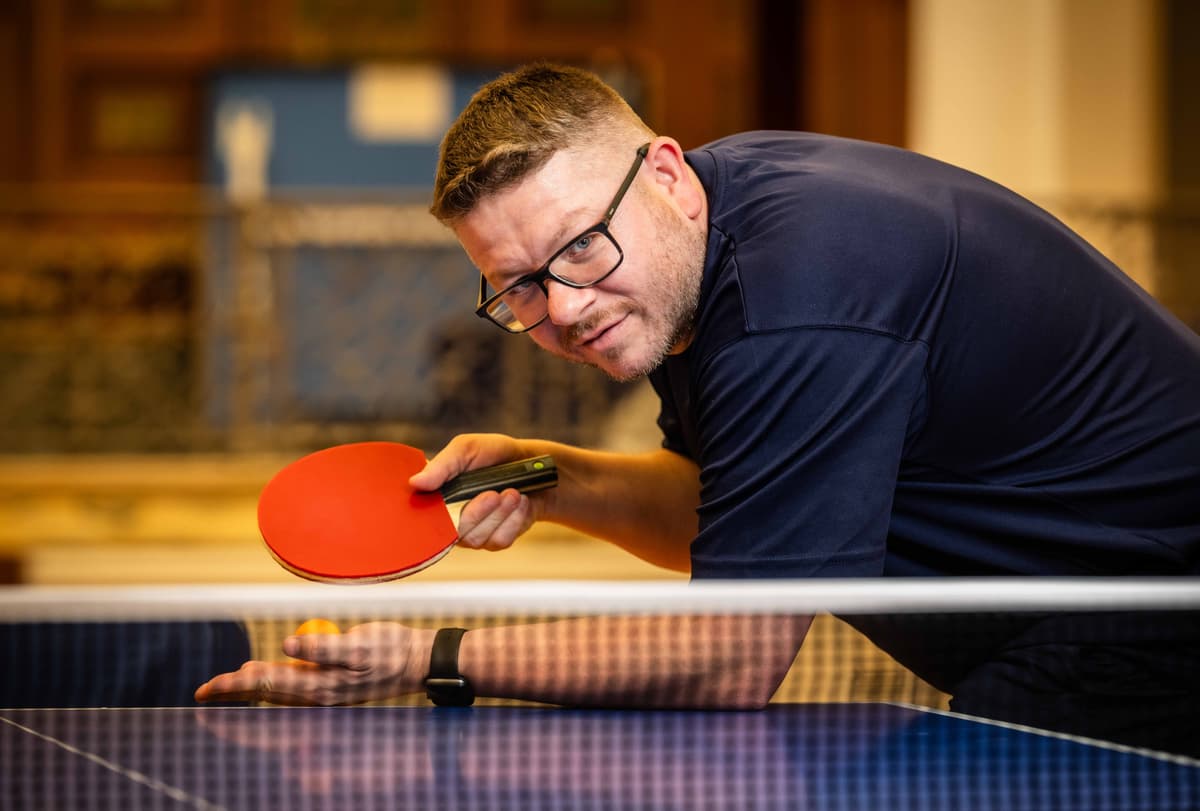
Jason Sugrue had just returned from a summer training camp in China and was about to become the UK’s number one-ranked U15 table tennis player when his mother sat him down to tell him that his father, Buxton, had been shot and killed while he was away. Jason was incredibly close to his father — a warm, charismatic figure who ran a local table tennis club and was much loved in the community — and in that instant, his world collapsed.“I adored my father and spent more time with him than anyone, and from the moment my mother told me, I have a complete blank in my memory,” says Jason. “Apparently, I ran out of the house and got picked up by the police 24 hours later. I have no recollection of those 24 hours.”Angry at the world following his father’s murder and struggling with dyslexia at his secondary school in north-west London, Jason channelled all his energy into table tennis and, at 25, it paid off: he became the 2006 British and Irish Men’s Table Tennis Champion.Jason Sugrue, a former table tennis champion and now Director of Coaching at Greenhouse SportsJohn Nguyen/JNVisualsWinning and competing at the highest level gave Jason focus, but it did not make him happy. It was only when he joined a new charity, Greenhouse — since renamed Greenhouse Sports — that his life began to find its purpose.Yet, even then, the journey took time.“I was employee number four at Greenhouse and its first full-time coach,” recalls Jason. “At first, I was all about training young people to be brilliant players, but I look back now and realise I was a bad coach in those early years. When my young charges did not perform, I would punish them. Performance sport is a dog-eat-dog affair and I was trying to teach them to be winners, but that attitude is now at odds with what Greenhouse and true coaching are about. Today, our emphasis is all about developing the child, not the player, and on the connection and care needed to help them develop as a person.””Our emphasis is all about developing the child, not the player”Today, Jason, 47, is the Director of Coaching at Greenhouse Sports and mentors 60 other coaches. He turned down a prestigious job offer to become performance coach for the British Olympic table tennis team at the 2016 Rio Olympics because he believes that what Greenhouse is doing — improving the life chances of disadvantaged young Londoners through sport mentoring — is more important than winning at the elite level.This month, The Standard has joined forces with Greenhouse Sports to create Sporting Chance, a campaign championing sports coaching and mentoring to help transform the lives of young Londoners growing up in poverty-impacted neighbourhoods. The Evening Standard Dispossessed Fund has pledged £500,000 to the campaign, of which half will fund Greenhouse programmes in five secondary schools in London. The other £250,000 will support four further charities, offering coach-mentoring in football, boxing, martial arts and kayaking. To reach more young people, we are seeking donations from corporations, philanthropists and you, our readers.Jason says that since he joined Greenhouse in his twenties, the charity has reached more than 100,000 children and currently supports 8,000 a year across schools and at its community centre in the deprived Church Street ward of Westminster. The charity offers each school basketball, table tennis, or tennis, and in rare cases volleyball. Schools contribute around one-third of the cost of the programme. Greenhouse also runs holiday camps and employability sessions. Around 45 per cent of participants are female.How did Jason rethink the way he coached — and with it, Greenhouse’s youth development philosophy — and what precipitated the change?“When I first started coaching, I was a performance athlete and I tended to evaluate a child’s worth and my allocation of time by how good they were and how hard they were prepared to practise,” he says. “If they didn’t practise or perform, I wouldn’t engage as much. They had to meet my benchmarks and my targets, not theirs. So, while we were great for people who were good at sport, we were not so great for people who were not.”He adds: “Then, 11 years ago, I became a father and started to rethink my approach. I realised I had the whole thing back to front — that it was all about fostering their journey, not imposing mine. Becoming a father prompted me to reflect on my own traumatic childhood growing up in poverty and to recognise that what I really needed as a 14-year-old was connection and care from trusted adults, not necessarily to win things.“We began to develop a theory of change and I started to change the way I coached based on how I would want a coach to speak to my own daughter. It’s not the sport that kids come back for; it’s the connection and the care with the coach. Sport is the hook, but it’s the relationship with the coach that makes them stay.”How your money can help Greenhouse Sports£15 Could enable a young person to access their programme for a week£65 Could provide 4 weeks of sports coaching and mentoring, helping a young person build confidence, resilience and a sense of belonging£165 Could provide coaching and mentoring during school holidays£800 Could provide a full year of coaching and mentoring, ensuring they stay engaged with school and develop the life skills to fulfil their potentialMore recently Jason enrolled in a masters in Sports Coaching and Human Development. He now sees part of his role as “re-educating” the dozens of Greenhouse Sports coaches who support thousands of disadvantaged children across London.One of those coaches is Zion Boumpoutou, 25, who was “a Greenhouse kid” at 13 and, eight years later became a Greenhouse table tennis coach, most recently at a school in Tower Hamlets.“I grew up in Tooting where there was a lot of gang violence and I was quite vulnerable,” he says. “A lot of my friends got recruited into gangs, but I would go to table tennis after school instead of hanging out on the streets. Sport gave me an excuse not to be on the streets and the strength to resist those friends. Today, one of them is in prison for murder, another two are serving sentences for robbery, and a fourth one died as a result of gang violence.”Zion adds: “I became a top-40 U19 table tennis player, but for me, having a supportive and encouraging Greenhouse coach is what made the real difference. I was introverted and very anti-social, preferring to spend time at home with my PlayStation, but my coach believed in me and I started to come out of myself and to develop as a human being.”Now Zion works hard to ensure the children he supports do not fall prey to local gangs in Tower Hamlets, offering 25 hours of coaching and 15 hours of mentoring a week. “The most dangerous time is after school, but I run sessions from 3.15pm to 5pm and, twice a week, we take the children after school to the Greenhouse Centre in Westminster.”One of his charges is 13-year-old Yasin who proudly tells me he is “the number one player in the whole school”, despite being barely able to play when he started with Greenhouse 18 months ago.Yasin and coach Zion Boumpoutou at a secondary school in Tower HamletsJohn Nguyen/JNVisuals“I didn’t like school that much and I used to get angry, shout and feel overwhelmed, but Greenhouse makes me feel calm and focused,” says Yasin. Last year he received eight detentions and spent half a day in isolation because of his behaviour. This year he has reduced his detentions to just two.Asked what Coach Zion means to him, Yasin says: “He’s like halfway between a friend and a teacher. He makes me laugh. He makes me happy. Being excellent at table tennis has made me want to be excellent at school. I put in a lot more effort.”Coach Zion says: “Yasin has grown in confidence and maturity and has become much more expressive when something is bothering him. He’s learning when it’s the right time to talk in class and when it’s the right time to put his head down and work. He’s become a good listener.”As they knock up, coach Zion says: “The role that I play for Yasin and the other young people is creating an arena for them to express themselves. My goal is not to make great table tennis players. My goal is to make great people. But if they also want to be great at table tennis, I can help.”Sporting ChanceThe Standard
How British table tennis champion Jason Sugrue shapes London's youth
Full Article
Original Source
Read the full article at Standard →KhanList aggregates and links to publicly available news content. We do not host full articles from third-party sources. Always verify important information with original sources.