
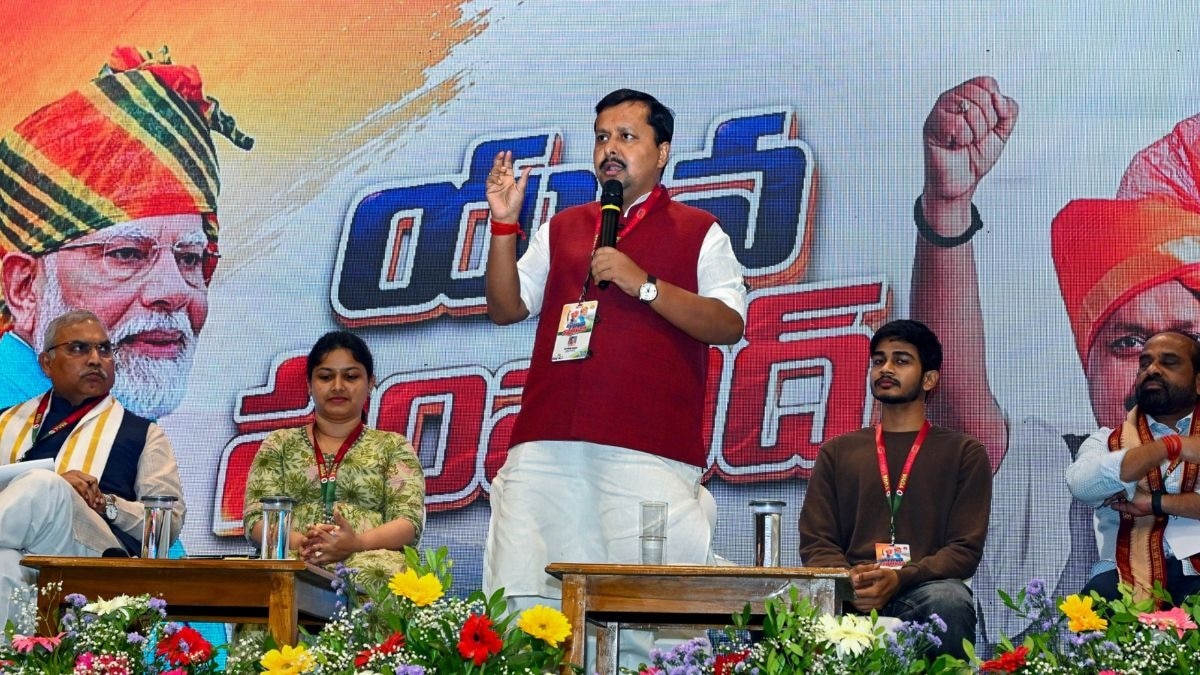
The generation PM Modi is addressing has only ever seen him in office, and may be wanting to know why change has been slowWhen Dharmendra Pradhan resigned as Union education minister on July 25, the expectation in the BJP was that it would take the heat out of the Gen Z agitation at New Delhi’s Jantar Mantar over the demand for examination reforms. Things have not quite worked out that way, and the events that followed suggest that both the BJP and the Rashtriya Swayamsevak Sangh (RSS) have read the protests as something more serious than an examination row.While the agitation was led by the Cockroach Janta Party (CJP), what worried the BJP was who was turning up. Support was not restricted to the Opposition parties, Left-backed university student organisations or constituencies that have traditionally opposed the BJP. A breach was showing up in the BJP’s own social base, in households that have voted for Prime Minister Narendra Modi since 2014.That is a different order of problem. A student at Jantar Mantar can be argued with or ignored. But a student at Jantar Mantar whose parent is a booth-level BJP worker and is asking the same questions at home cannot be. The party’s usual instrument of a quick and loud online response fell to limited use. So, the response after July 25 has been slower and less visible than a campaign.Conversations are being routed through families, small groups, local networks and particular caste and regional constituencies. Two things are being attempted at once. One is to separate the grievances of young Indians—which the BJP has decided not to contest—from the political identity the CJP is trying to build around those issues. The other is to establish that the Modi government can listen and correct its course. That was visible when the BJP quickly brought in a law to tighten penal provisions in cases of exam leaks and also set up a taskforce to implement reforms in the National Testing Agency (NTA). The party also deployed younger parliamentarians, such as Bansuri Swaraj, Tejasvi Surya, Raghav Chadha and ally Saayoni Ghosh, to rebuild connections with the youth. Multi-pronged communication channels to contain political damage is recognisably the Sangh’s method rather than the BJP’s. The RSS has never particularly been interested in winning television debates. Its preference has been for the slower business of shifting opinion in drawing rooms, hostels, mohallas and shakhas, and it has usually had the patience to wait.The BJP has now begun a Gen Z outreach across states through small programmes addressed by local leaders. Modi started it himself with Instagram reels. This is now being taken forward by BJP and RSS foot soldiers—and many among them belong to the same Generation Z they are seeking to address. A harder track runs alongside. Sections of the BJP-Sangh ecosystem have begun describing the CJP as not a spontaneous students’ movement but a political project whose funding and linkages deserve examination. Allegations of foreign involvement and of attempts to destabilise the country have been made. Yet no evidence has been placed in the public domain. The party’s position, in effect, is that the grievance was real but the ownership of it is contested.RSS chief Mohan Bhagwat has done two outreach events within a short duration. The first one was in Mumbai on August 6, before roughly 2,000 young participants. It wasn’t a Sangh affiliate platform but the 15th anniversary conference of India’s International Movement to Unite Nations (IIMUN). Bhagwat said Gen Z’s concerns were genuine and that protest was a legitimate democratic expression when people felt unheard. Young protesters, he emphasised, should not be labelled as anti-national.Then in Nagpur on August 15, at a programme organised by the Lokmat group, Bhagwat returned to the theme in a more cautionary register. He said the young were a demographic dividend, but a generation mishandled could become a burden on society later. Protest and public movements were legitimate, he added, provided the larger national interest was kept in view.Read one way, the Mumbai intervention was the most significant thing to happen since Pradhan’s resignation. Read another way, the two events together are an attempt to absorb a movement the Sangh does not control, validating the anger while attaching conditions to how it may be expressed, and offering its participants a place in the mainstream provided they leave the CJP outside it. Both readings are probably correct. Either way, the situation Bhagwat is addressing has no clear precedent.The 2011 Anna Hazare movement against corruption is the comparison that gets made, and it is only partly useful. That agitation channelled a generation’s anger over corruption towards a government that appeared not to be listening. It produced the Aam Aadmi Party (AAP) and a political alternative in Delhi. But nationally, the anger had somewhere else to go. The BJP was already the alternative and Modi could offer himself as the answer. The BJP’s 2014 pitch was not only Hindutva and nationalism but also clean government, decisive administration, jobs and growth.Gen Z does not have that option because the government it is angry with is the one it grew up under. A good number of this cycle’s first-time voters were in primary school in 2014. There is a further element to it. This cohort may not be hostile to Hindutva or nationalism, but it does not appear to treat either as a sufficient answer to the narrower and more immediate questions it is asking. Will exams be fair? Will jobs be created? Can the family afford entrance exam coaching? What happens to a career when AI comes for entry-level work? And so on.Having grown up in an India that is wealthier, more connected and more sure of itself, Gen Z expects more, and sooner. That assessment, more than anything else, appears to be driving what the BJP has done since. At IIT Delhi on August 8, Modi spoke to students about curiosity, about continuing to learn, about questioning what is handed down, about adapting to rapid technological change. The vocabulary was noticeably different from that of the previous fortnight.Not everywhere, though. Two days later, an out-of-office Pradhan remarked that Gen Z had been misled during the protests. The two statements sat awkwardly together. Until August 15 brought both tracks together. In his Independence Day speech, Modi announced free online coaching for competitive examinations and AI training for 10 million young people, mapping neatly onto the two anxieties that drove the agitation.In Nagpur the same day, Bhagwat made the case for taking the young seriously. The BJP will present the sequence as responsiveness. The Opposition has the obvious counter that it took a central minister’s exit and weeks of protest to produce the announcements, and that a scheme unveiled from the Red Fort is not the same thing as an examination system that works.The BJP followed with organisational changes. On August 17, Amit Malviya, its social media head for 11 years, was replaced by Deepak Mhaskey. Most political observers in New Delhi linked the change to the youth protests. Malviya’s model—hold the narrative, hit back harder—had been built for a different fight, and the Jantar Mantar agitation exposed what it could not do.Mhaskey brings organisational and electoral data experience and has run social media operations for the BJP in several states. His early emphasis has been on Instagram and reels, on communicating differently on different platforms, and on accuracy and countering misinformation. BJP president Nitin Nabin’s new team and Hemang Joshi’s elevation as youth wing chief point the same way: younger faces, less hierarchy in the room.Whether any of it registers with the people it is aimed at is a separate question. The part of this that may matter most is also the part hardest to observe. The Sangh’s traditional strength is unglamorous work: the small meeting, the house visit, the conversation that runs for months. That is where the Gen Z question is now being taken. A father perhaps asking his daughter whether the government actually responded. A group in a colony arguing about whether CJP is a students’ movement or something else. A karyakarta explaining why Pradhan had to go. None of this, though, shows up in the engagement metrics. Nor is it guaranteed to work.The larger vulnerability is that messaging cannot necessarily repair what is broken upstream. The youth grievances did not originate on Instagram; they originated in examination halls, coaching centres, recruitment boards and household budgets. If another examination paper leaks, if the recruitment calendar slips again, if the jobs do not arrive, no amount of tonal correction or coordination will hold.The BJP’s calculation appears to be that it does not need this generation’s agreement so much as its belief that complaint produces results—that a question raised in a hostel can travel up through the organisation and return as policy. That is a modest claim, and a more durable one than asking for loyalty. It is also, so far, unproven. The BJP and Sangh leaders understand that the difference will be settled not in meetings or social media debates but at the next examination, and the one after that. In 2014, Modi asked a generation to give him a chance to change India. The generation he is addressing now has only ever seen him in office, and wants to know why the change has been this slow.Subscribe to India Today Magazine- EndsPublished By: Akshita JollyPublished On: Aug 25, 2026 18:58 IST
How BJP plans to become Gen Z's voice, stop CJP stride
Full Article
Original Source
Read the full article at Indiatoday →KhanList aggregates and links to publicly available news content. We do not host full articles from third-party sources. Always verify important information with original sources.