
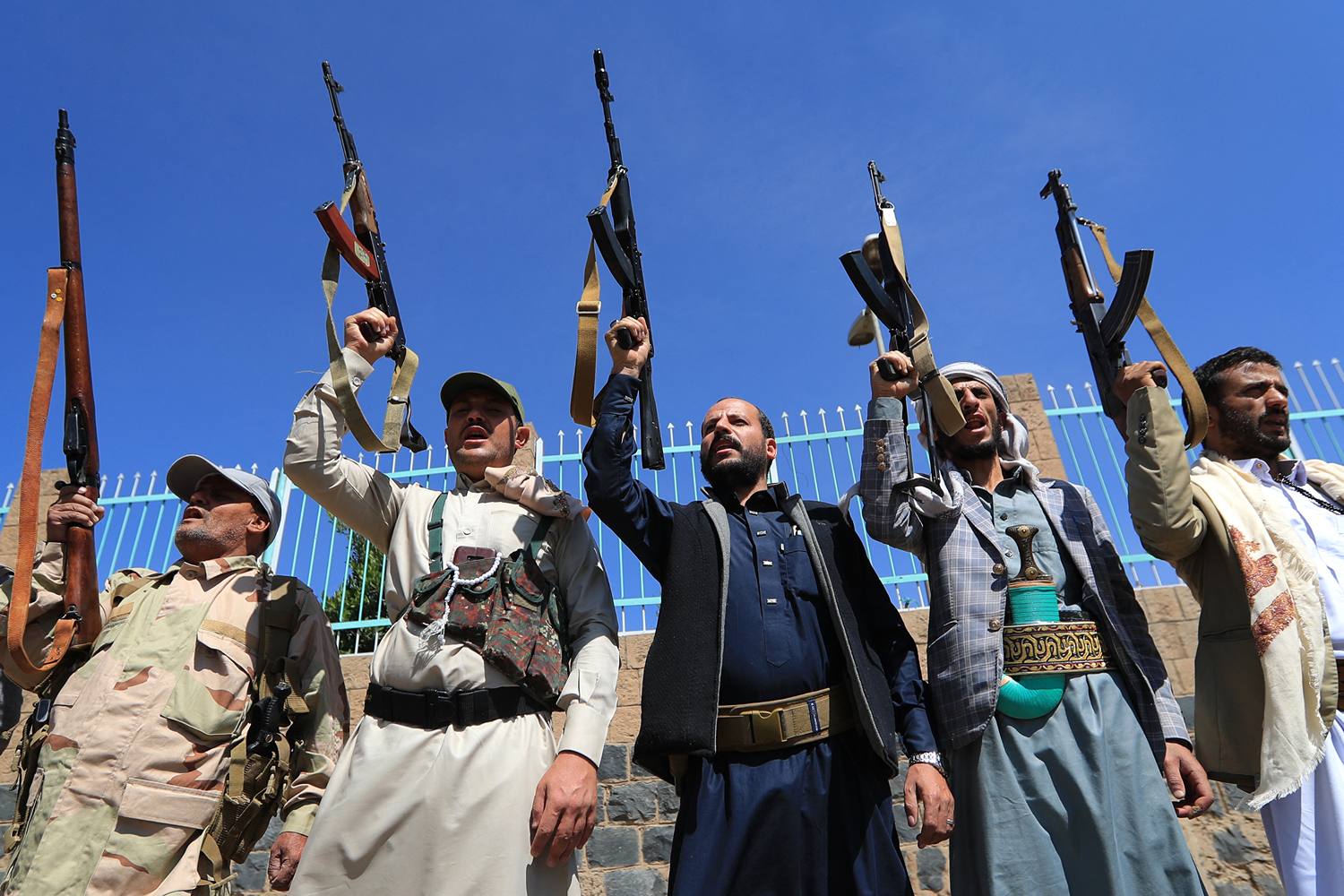
Welcome back to Foreign Policy’s Situation Report. John is once again flying solo for this edition, but Rishi will be back in action next week! Alright, here’s what’s on tap for the day: Saudi Arabia compares the Houthis to the Islamic State, Riyadh considers UAE reconciliation amid the Yemen war, and U.S. Defense Secretary Pete Hegseth’s post-midterms impeachment risk. Welcome back to Foreign Policy’s Situation Report. John is once again flying solo for this edition, but Rishi will be back in action next week! Alright, here’s what’s on tap for the day: Saudi Arabia compares the Houthis to the Islamic State, Riyadh considers UAE reconciliation amid the Yemen war, and U.S. Defense Secretary Pete Hegseth’s post-midterms impeachment risk. The Houthis are causing major problems for Saudi Arabia. The Iran-backed militants made significant territorial gains along Yemen’s Red Sea coastline in September, and the Saudi-backed Yemeni government is struggling to push the Houthis back. Meanwhile, the group has launched deadly strikes in Saudi Arabia that have disrupted air travel and damaged key energy infrastructure. Riyadh is pushing for more international support as the conflict escalates. In a New York Times op-ed this week, the Saudi ambassador to the United States, Reema Bandar al-Saud, compared the Houthis to the Islamic State, saying that the Yemeni group is “underestimated” in the same way that the Islamic State was before it declared a caliphate. She urged the international community to “set a clear goal to end the Houthis as an armed terrorist force,” arguing that the Islamic State “was defeated by local forces backed by a coalition of more than 80 nations. The Houthis can be defeated the same way.” Defining the threat. Unlike the Islamic State, the Houthis do not seek to establish a global Islamic caliphate. Their objectives are less ambitious and are centered on conquering Yemen and removing Saudi influence from the country. But there’s no doubt that the Houthis pose a significant regional threat. Their asymmetrical tactics, including the use of low-cost drones, have proved to be a serious challenge even for a wealthy country with a sophisticated military like Saudi Arabia. And with Israel having severely degraded the capabilities of Hamas and Hezbollah over the last several years, the Houthis are now one of the most powerful Iranian proxies in the Middle East. In addition to attacking Saudi Arabia, the Houthis have also targeted Israel with strikes, including this year, and in 2022 attacked Abu Dhabi. The problems the Houthis cause also have global implications—particularly their attacks on shipping in the Red Sea. Their recent territorial gains have given them more control over the Bab el-Mandeb Strait and have led to a dual-chokepoint crisis as the Iran war has simultaneously impacted traffic in the Strait of Hormuz. There’s also evidence of Houthi collaboration with other terrorist groups in the region, including al-Shabab, an al Qaeda affiliate in Somalia. “The Houthi threat is not only to Yemenis. We have seen that it’s a threat to Yemen, of course, but also to the region and to the international community,” said Ambassador Marwan Ali Noman, political advisor to Yemeni Foreign Minister Afrah al-Zouba. “This is not a local threat. It’s a threat for everyone.” International involvement. Though some countries have offered Riyadh increased defensive assistance—such as the United Kingdom, Egypt, Pakistan, and Turkey—there’s been a general reluctance to get directly involved on the ground. Most critically, the United States, which has conducted strikes on the Houthis in the past (including last year), has so far avoided directly intervening this time around. The internationally recognized Yemeni government is also calling for increased international involvement, but not necessarily intervention in Yemen itself. “We’re not asking for any boots on the ground,” Noman said. “We’re not asking for people to come to fight on our behalf.” This is “our fight,” and “we have the forces,” Noman said. What is needed from the international community is humanitarian assistance, Noman said (read more on the humanitarian crisis in Yemen here). Riyadh and the Yemeni government are also pushing more countries to follow Washington’s example and designate the Houthis as a terrorist group to help isolate the group financially. The Yemeni government has also asked the United States for training and intelligence support. “We’re fighting on behalf of others as well” due to the broader threat posed by the Houthis, Noman added. “That’s why we need the support from our friends and allies.” U.S. Defense Secretary Pete Hegseth has axed yet another top military official, adding to a long list of firings since he became Pentagon chief. Army Lt. Gen. Brett Sylvia has been removed from his role as director of strategy, plans, and policy on the Joint Chiefs of Staff. Sylvia was removed for allegedly leaking classified information to the press, a Pentagon official told ABC News. What should be high on your radar, if it isn’t already. The missing link in Yemen? Riyadh and Abu Dhabi reconciling could be a game-changer in the fight against the Houthis, a top expert on Yemen told John this week. Read more here to find out why the United Arab Emirates could help turn the tide. Impeaching Hegseth. Hegseth could face impeachment if Democrats win big in next week’s midterm elections. FP’s Rachel Oswald interviewed Democratic Rep. Mike Levin about his support for impeaching the Pentagon chief, and the legal and political considerations. Read it here. Netanyahu stands in front of a blue digital backdrop featuring Hebrew writing while he wears a grim expression on his face. Israeli Prime Minister Benjamin Netanyahu speaks to supporters at the Likud party election night event at the International Convention Center in Jerusalem on Oct. 28.Alexi J. Rosenfeld/Getty Images Friday, Oct. 30: U.S. Secretary of State Marco Rubio is poised to host the G-20 foreign ministers’ meeting in Atlanta, Georgia. Tuesday, Nov. 3: The United States is set to hold midterm elections. $47.1 billion: The estimated cost of the Iran war to U.S. taxpayers, per a new assessment from U.S. Central Command. “He’s got the White House looking like Saddam Hussein opened a Cheesecake Factory.” —Former U.S. President Barack Obama, criticizing President Donald Trump’s decorating style. 5 Foreign-Policy Priorities for Democrats After the Midterms by FP Staff NATO 3.0 Is a Dangerous Gamble by Rebecca Lissner and Turner Ruggi Why Putin’s Defenders Are Increasingly American by Adrian Karatnycky
How Big of a Threat Are the Houthis?
Full Article
Original Source
Read the full article at Foreignpolicy →KhanList aggregates and links to publicly available news content. We do not host full articles from third-party sources. Always verify important information with original sources.