
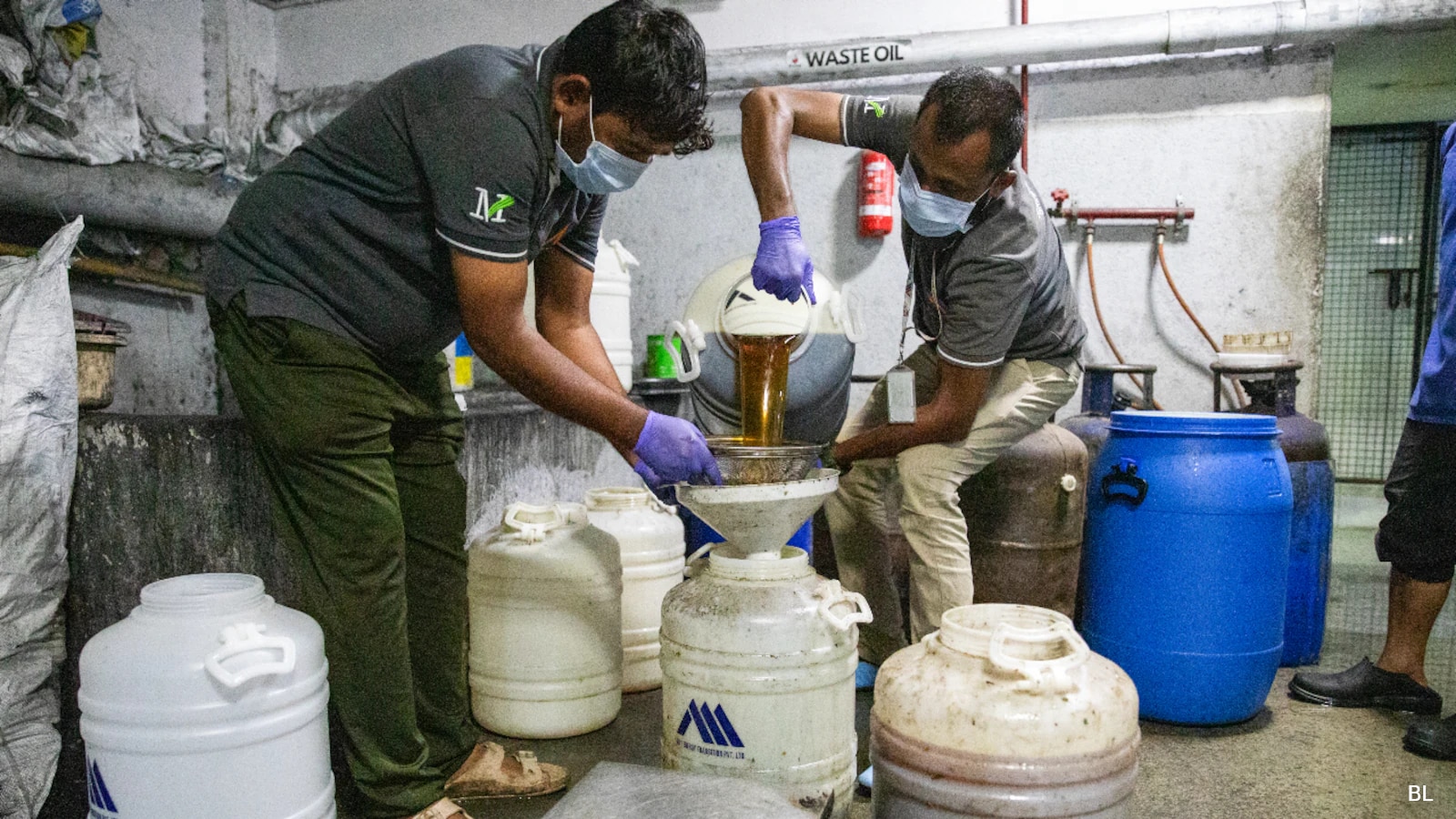
In a grubby restaurant basement in Bengaluru, two men crouch over a sticky plastic tub of something a kitchen no longer wants and the oil industry increasingly does.The men are grease hunters: collectors who spend their days traversing the megacity's clogged roads and narrow back alleys on motorized rickshaws, going from kitchen to kitchen to gather gallons of used cooking oil. Their cargo carries the odor of yesterday's fried chicken and fish fritters. To a growing roster of refiners, it smells like an opportunity to convert cheap waste into valuable biofuel.Already powering some buses and trucks, India's push to fuel more road vehicles and aircraft with homegrown ingredients is bringing bigger buyers into an inefficient and fragmented supply chain. Together, Indian Oil Corp., Hindustan Petroleum Corp. and Bharat Petroleum Corp. want tens of thousands of tons of used food oil. Delivering it means assembling industrial quantities from thousands of scattered eateries, one tub at a time."The market is way, way bigger than all of us can provide for," said Mannan Khan, chief executive officer of M11 Energy Transition Pvt., one of about a dozen licensed aggregators of the waste material in India. In 2022, his company had one person collecting used food oil in jerry cans. This year, he has 300 collectors in 24 cities, gathering about 1,000 tons a month.Photo Credit: BloombergBehind those purchases is a vulnerability that India has found increasingly hard to ignore. The country imports about 90% of its crude and has spent a record $125 billion on those imports so far this year, raising concerns about its foreign exchange reserves. Then came the war between the US and Iran, which disrupted shipments through the Strait of Hormuz and sent oil prices surging, sharpening the case for finding more fuel at home. "Hormuz triggered the alarm," said Sanjay Sah, Deloitte South Asia's lead for energy and resources, adding that the government has had to move fast to reduce imports.Prime Minister Narendra Modi's government is promoting energy made from urban, industrial and agricultural waste to help meet growing demand and cut reliance on imports. From January, international flights leaving India will need to use fuel containing 1% sustainable aviation fuel. That will rise to 5% by 2030 alongside a 5% biodiesel target for road transport.Photo Credit: BloombergIndia is joining a broader Asian push into biofuels, including sustainable aviation fuel. Singapore and South Korea also plan to introduce requirements from 2027. Collection networks are expanding in Malaysia, Vietnam and Indonesia, while China is already a major supplier of used cooking oil to the US, Europe and Singapore. Global demand for sustainable aviation fuel, or SAF, is expected to soar 600% over a decade to 14 million tons by 2035, according to Argus Biofuels Analytics. Asia will be a major driver of that growth, said Jonty Richardson, the agency's principal biofuels consultant. India's demand alone will reach 250,000 tons by the end of the decade, according to S&P Global.Supply, meanwhile, is tight, a complication that's helped to dampen demand. SAF accounted for just 0.6% of total jet fuel used last year, according to the International Air Transport Association, which expects only gradual growth. That makes squeezing fuel out of kitchen waste all the more urgent.Used cooking oil offers the cheapest route to a fuel that meets global emissions standards, but making sure it really is used can be a challenge. Waste oil can sometimes be worth more than fresh oil, creating room for fraud. Another difficulty is getting hold of it. India is the world's biggest consumer of edible oils and produces about 3 million tons of used oil a year, but with no centralized collection system, it sits in restaurant basements, hotel kitchens and food factories, waiting for someone to come take it away.Only about 5% of UCO - the industry shorthand for used cooking oil - is collected, according to India's SAF Association. An estimated 60% finds its way back into the food chain to be used again, a practice that's both illegal and bad for people eating it.Photo Credit: BloombergM11's Khan, who sells biodiesel mostly to customers in Europe and the US, expects India to become an increasingly important buyer. He plans to double his depots to 50 by the end of this year and add households, food manufacturers and industrial kitchens to his collection routes. He's not the only one gearing up for more demand. Munzer Bioindustrie GmbH, an Austrian biodiesel producer, began exporting used cooking oil from India a decade ago and found a haphazard market fraught with challenges. It now sees the market maturing, and has received proposals from refiners to co-produce biofuels."It is not easy to be an organized player in a highly unorganized market," said Jatin Udwadia, head of trading at Munzer Bharat, which collects about 900 tons of UCO a month across more than 20 Indian cities. "India's SAF mandate is an ambitious move and all the more reason for organized players to step in and help India fulfill its mandate."Photo Credit: BloombergBack in the Bengaluru basement, one of the men pours a bucket of amber-brown cooking oil through a metal strainer held by the other. They repeat this until three or four 20-liter containers are full, then weigh the oil, photograph it and record the collection in an app before loading the containers onto their auto-rickshaws. The oil enters a chain of documentation intended to establish something that seems fairly obvious in a restaurant basement but can grow hazier by the time it reaches the refinery: the oil really is used.Photo Credit: BloombergThat distinction can be worth money. In the run-up to the European Union's own SAF mandate last year, used cooking oil sometimes fetched more than virgin oil, an odd inversion. European biodiesel industry groups questioned whether some shipments from Asian producers contained fresh vegetable oil passed off as kitchen leftovers. Asian producers disputed the allegations while calling for more stringent traceability standards.In India's fragmented market, tracing the oil is difficult without coordinated action by government and industry, Deloitte's Sah said.Photo Credit: BloombergFor now, collectors document what they can while more buyers compete for what they gather. State majors Hindustan Petroleum and Bharat Petroleum sought a combined 83,000 tons of used cooking oil in tenders that close this month, adding to a smaller UCO tender from Indian Oil earlier in the year, according to documents posted by the government. Benchmark prices of seaborne used cooking oil from Asia have risen about 10% this year after hitting a record in May, according to data from Argus Media, which expects "a steady incline over the next decade." By evening in Bengaluru, the two men's rickshaw is heaving with about 20 containers of oil. They head for the M11 depot, which receives about four tons a day.Later, the oil will be treated and refined. Some will travel to Germany by way of Rotterdam; some to ports in Texas and California. Increasingly, more of the feedstock will head to Padubidri on India's west coast and Paradip on the east, before eventually reaching aircraft departing Delhi, Mumbai and other major hubs.Photo Credit: BloombergBack at the depot, the grease hunters compare their tally with the month's target on the whiteboard. Tomorrow, there will be more gallons to gather, and more buyers to satisfy. (Except for the headline, this story has not been edited by NDTV staff and is published from a syndicated feed.)
How Bengaluru's Grease Hunters Are Turning Waste Cooking Oil Into Jet Fuel
Full Article
Original Source
Read the full article at Ndtv →KhanList aggregates and links to publicly available news content. We do not host full articles from third-party sources. Always verify important information with original sources.