
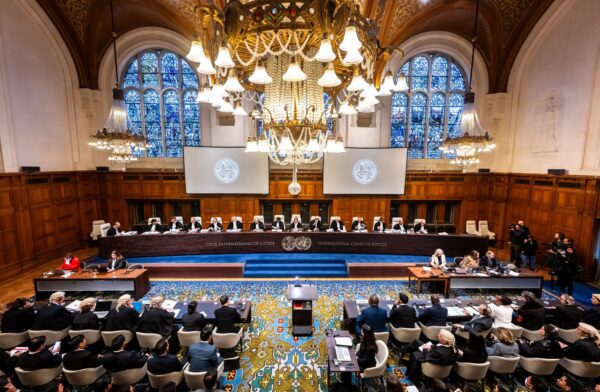
Last week’s landmark ruling by the International Court of Justice (ICJ) is likely to have unpredictable political and diplomatic ramifications for the architecture of international criminal justice in general and Myanmar in particular. By a vote of nine to six, the ICJ ruled that Myanmar committed genocide against Rohingya Muslims during a military “clearance operation” in northern Rakhine State in 2017. During the operation, it found that Myanmar’s security forces “killed thousands of Rohingya civilians, perpetrated widespread acts of sexual violence as well as acts of extreme violence against children and attacked fleeing Rohingya as they sought to flee in large numbers to Bangladesh.” The court ordered Myanmar to provide reparations to victims and allow the “safe and dignified return to their place of residence and the reunification of families for the Rohingya displaced as a result of Myanmar’s wrongful acts.” Judges also said it should take measures to prevent further violations of the Genocide Convention. Enforcing the judgment on Myanmar, which has since rejected the ICJ’s determination as “unfair” and a “great disappointment,” is likely to be challenging, and will depend on whether foreign governments can muster the political will. Many Western governments have expressed their support for the ruling, the most outspoken of which has been the United Kingdom. Foreign Secretary David Miliband said in a statement that the U.K. “reaffirms our full support for the Court and the international legal order, and condemns the horrific treatment of the Rohingya people by the Myanmar military regime.” Stating that it was “determined to act and ensure accountability for these appalling crimes,” Miliband said that his government had ordered the expulsion of the Myanmar defense attaché from the U.K. and called “urgently” for a U.N. Security Council session to discuss the judgment. Other Western powers such as Australia, Norway, and the European Union have issued similar statements, as has the United States, albeit in a more restrained key. In comparison, the response from Southeast Asia has been decidedly muted. As of press time, only two ASEAN governments – the Philippines and Malaysia – had issued official statements about the ruling, and only one other – Thailand – had addressed it at length. Brunei, Cambodia, Vietnam, Laos, Timor-Leste, Vietnam, and Indonesia have so far not responded to the judgment. The most supportive statement came from Malaysia, whose Foreign Ministry said yesterday that it “respects” the ICJ’s ruling, and that it would engage with the United Nations, ASEAN, and the Organization of Islamic Cooperation, on whose behalf The Gambia brought the case against Myanmar in 2019, “on matters arising from the judgment.” “Malaysia reaffirms its commitment to upholding international law, including its responsibilities as a State Party to the Genocide Convention,” the Ministry said. It added that Malaysia would “continue to advocate for a comprehensive and durable resolution to this protracted crisis.” There are a number of possible reasons for Malaysia’s supportive position. Kuala Lumpur has been perhaps the ASEAN member state most critical of Myanmar since the military coup of 2021. However, it has recently begun to moderate its position, and last month, Prime Minister Anwar Ibrahim hosted coup leader-turned-president Min Aung Hlaing with full state honors. The ostensible reason for this was to facilitate the return of refugees and asylum seekers to Myanmar, amid a recent rise in hate speech and anti-Rohingya sentiment that has put political pressure on Anwar’s government. Malaysia’s relatively supportive position on the ICJ ruling may also have something to do with the possible application of the precedent of the Myanmar case to Israel. In 2024, South Africa brought a case against Israel, accusing it of committing genocide against the Palestinians of Gaza, and much of the international response to The Gambia vs. Myanmar judgment has concerned its possible implications for this case. Prime Minister Anwar is a long-time critic of Israel and has been the most outspoken ASEAN leader on Israel’s actions in Gaza since October 2023, an issue that also reflects a strong domestic political consensus in Malaysia. It is plausible that Malaysia’s supportive stance is less a reflection of its attitude toward Myanmar and more an indication of how the ICJ may soon rule on the Israel-Palestine issue. The Philippines’ reaction to the ICJ ruling was slightly more ambiguous. The country’s Department of Foreign Affairs (DFA) stated that it “acknowledges” the judgment and “reaffirms its support for the peaceful settlement of disputes and full adherence to international law, including the obligations of States under the Genocide Convention.” It added, “The Philippines likewise underscores the importance of respecting the decisions of the International Court of Justice as the principal judicial organ of the United Nations.” The DFA also reiterated its “deep concern” about the humanitarian consequences of conflict, particularly for civilians and other vulnerable populations. Thailand did not issue an official statement, but Prime Minister Anutin Charnvirakul said over the weekend that it will maintain relations with Myanmar despite the ICJ ruling. Anutin’s administration has been a strong advocate of a policy of “calibrated engagement” with Myanmar since a quasi-civilian administration took office in April, a position that ASEAN as a whole adopted at this month’s summit. Foreign Minister Sihasak Phuangketkeow on Friday described the ICJ judgment as a legal matter between Myanmar and the ICJ that would not derail Bangkok’s engagement with Naypyidaw, which he said was consistent with ASEAN’s consensus. “Re-engaging with Myanmar is constructive, because what we are asking through this process is a reduction and ultimate cessation of violence, reconciliation among all parties, and open space for humanitarian assistance,” Sihasak said. Prime Minister Anutin said subsequently that Thailand would “take the position that best serves the country.” Beyond these three nations, there has been little official regional comment on the ICJ ruling. This muted response should come as no surprise. As Suwita Hani Randhawa noted in 2022, Southeast Asian governments were also “resoundingly muted” in their response to the Rohingya genocide as it was taking place. This can be explained both by the prevailing regional norms – non-interference and mutual respect for sovereignty are both important tenets of the “ASEAN way” – and by the region’s ambivalence about mechanisms of international justice. Four ASEAN member states have not signed the U.N. Genocide Convention: Brunei, Indonesia, Thailand, and Timor-Leste. While the remainder (Myanmar among them) have signed or acceded to the Convention, Suwita noted that many have “issued political reservations that limit the treaty’s application upon them.” Meanwhile, just two ASEAN member states – Cambodia and Timor-Leste – are states parties to the Rome Statute that created the International Criminal Court. Only Cambodia is a signatory of both treaties. Instead of processes of retributive justice, ASEAN and its member states have principally focused on conflict management and resolution, via the Five-Point Consensus framework established in April 2021, two months after the military coup in Myanmar. All of this suggests that while the ICJ’s genocide ruling will taint Myanmar in the eyes of some members of the global community, it is unlikely to have a lasting impact in Southeast Asia. Will it undermine Myanmar’s relationship with ASEAN as an organization? The bloc has excluded Myanmar from its summits and foreign ministers’ meetings since late 2021 for its failure to implement the Five-Point Consensus – a policy that it reaffirmed at this month’s ASEAN Summit. However, since taking office as president in April, Min Aung Hlaing has made normalization with the Southeast Asian bloc a priority, and has made some progress toward this goal. Five ASEAN member states – Laos, Thailand, Cambodia, and Vietnam, in addition to Malaysia – have been supportive enough to welcome him on official state visits during that time. Richard Horsey of the International Crisis Group told the AFP news agency that it was unlikely that the genocide verdict was unlikely to reverse ASEAN’s slow move toward recognition of Min Aung Hlaing’s administration. “Governments willing to host [Min Aung Hlaing] are unlikely to change course over a ruling addressed to the Myanmar state, which places no legal restriction on him personally,” he said. “It may make some members more cautious about being seen to move quickly, but I doubt it will stop the drift towards normalization.”
How ASEAN Responded to the ICJ’s Myanmar Genocide Ruling
Full Article
Original Source
Read the full article at Thediplomat →KhanList aggregates and links to publicly available news content. We do not host full articles from third-party sources. Always verify important information with original sources.