
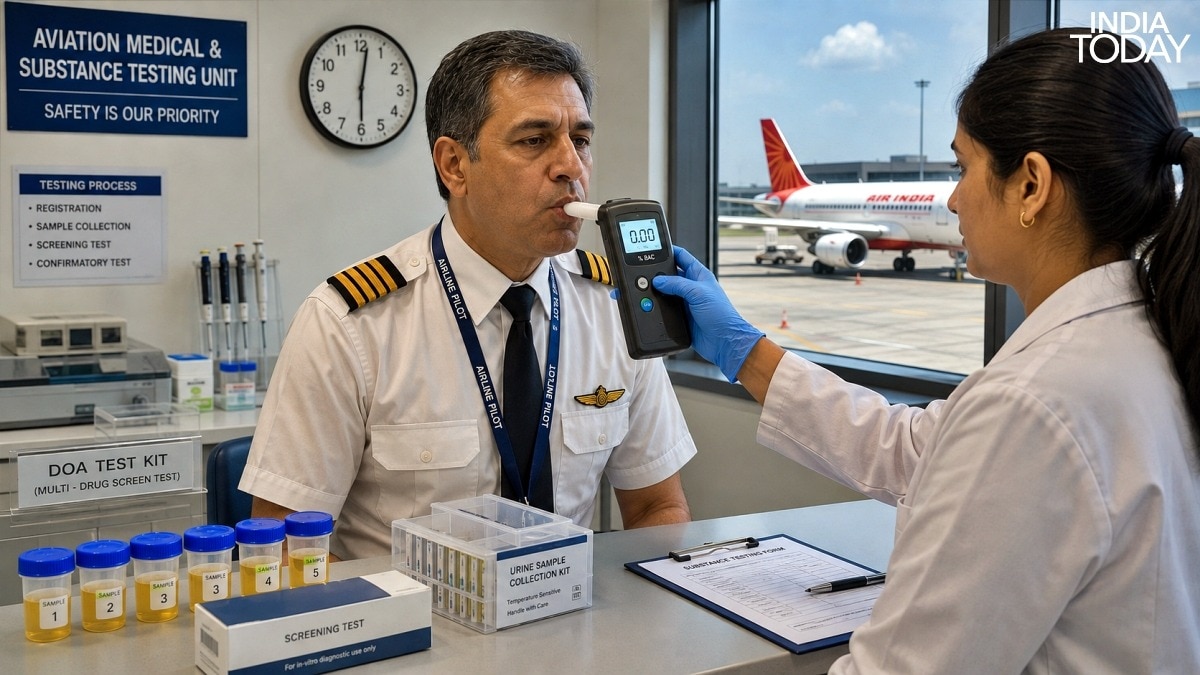
The Air India Phuket-Delhi incident has drawn attention to how pilots in India are tested for drugs and alcohol. The case underlines why regulators enforce random checks and a zero-tolerance safety regime.In India, the Directorate General of Civil Aviation (DGCA) mandates testing for psychoactive substances among flight crew. (Photo: Generative AI by India Today)The recent Air India Phuket-Delhi flight incident has put a spotlight on a little-discussed but critical aspect of aviation safety: dope testing of pilots.The scrutiny intensified after the pilot-in-command of the Air India flight tested positive for marijuana in a confirmatory drug test following the incident, where the aircraft experienced a sudden altitude variation of about 300 feet during cruise.Initial findings by Airbus have revealed that the aircraft with 137 passengers lost control for about four seconds.SHOCKING | Several passengers injured after Air India Phuket–Delhi flight suddenly dropped around 300 ft; the pilot was high on marijuana pic.twitter.com/fCsLB6fevs— The Tatva (@thetatvaindia) August 12, 2026The latest incident has prompted Air India to launch substance screening for all its pilots. But how exactly are pilots tested, and what can these tests reveal? WHY ARE PILOTS TESTED?In India, the Directorate General of Civil Aviation (DGCA) mandates testing for psychoactive substances among flight crew.Airlines are required to randomly test a portion of their pilots every year, while additional testing may be conducted after specific incidents, accidents, or when there is reasonable suspicion. The goal is simple: ensure that no pilot is operating an aircraft under the influence of substances that could impair judgment, reaction time, coordination, or decision-making.In India, pilots are tested for alcohol consumption before every flight. The pilot's urine sample is sent to an accredited laboratory for a confirmatory analysis. (Photo: Air India) HOW IS THE TEST CONDUCTED?The dope test process typically begins with an initial screening using urine samples. The sample is collected under strict chain-of-custody procedures to prevent tampering."The airline calls you to the office after you've operated a flight. You can't refuse," said Varun Sharma, First Officer witn an international airline. Pilots are taken to a designated room where they complete paperwork before providing a urine sample. The sample is collected under controlled conditions to ensure it has not been tampered with.Varun explained that the testing process is conducted entirely in the pilot's presence. Once the urine sample is collected, officials open a sealed testing kit and add the testing reagent to the sample. The results are indicated through a colour-coded system that can detect the presence of prohibited substances."Everything is done in front of you," he said, adding that the procedure is generally carried out by an external third-party company rather than the airline itself.If the screening returns a "non-negative" result, the sample is sent to an accredited laboratory for a confirmatory analysis using highly sensitive techniques such as Gas Chromatography-Mass Spectrometry (GC-MS) or Liquid Chromatography-Mass Spectrometry (LC-MS).These advanced tests can precisely identify specific compounds and significantly reduce the risk of false positives.Meanwhile, pre-flight breathalyser tests are a standard requirement in India and are among the most stringent safety checks imposed on flight crew.WHAT SUBSTANCES ARE DETECTED?Dope tests are designed to identify psychoactive substances, including marijuana (cannabis), cocaine, amphetamines, opioids, and certain sedatives.They may also flag prescription medications that are prohibited for pilots because of their impact on alertness or cognitive performance.Contrary to popular belief, a dope test does not determine whether a pilot was impaired at the exact moment of flying. Instead, it reveals whether prohibited substances or their metabolites are present in the body.Some drugs can remain detectable for days or even weeks after use, depending on the substance, dosage, and an individual's metabolism. Pilots are taken to a designated room where they complete paperwork before providing a urine sample. (Photo: PTI) THE SCIENCE BEHIND THE TESTSWhen a drug enters the body, it is broken down into chemical by-products known as metabolites. These metabolites are excreted through urine, blood, saliva, sweat, or hair. Drug tests detect either the original substance or these metabolites.For example, tetrahydrocannabinol (THC), the psychoactive compound in marijuana, is metabolised into compounds that can remain detectable long after the intoxicating effects have worn off.WHY THE DOPE TEST MATTERSThe Phuket-Delhi incident is still under investigation, and no direct link has been established between the pilot's positive drug test and the aircraft's in-flight problems. Preliminary assessments indicate the aircraft suffered a technical malfunction involving hydraulic systems.However, the case points to why aviation regulators treat substance use as a zero-tolerance issue.In an industry where decisions are measured in seconds, and safety margins are razor-thin, ensuring pilots are medically and mentally fit remains one of the most important safeguards in modern aviation.- EndsPublished By: Sibu Kumar TripathiPublished On: Aug 14, 2026 15:08 IST
How are pilots in India tested for drugs? Science behind dope tests
Full Article
Original Source
Read the full article at Indiatoday →KhanList aggregates and links to publicly available news content. We do not host full articles from third-party sources. Always verify important information with original sources.