
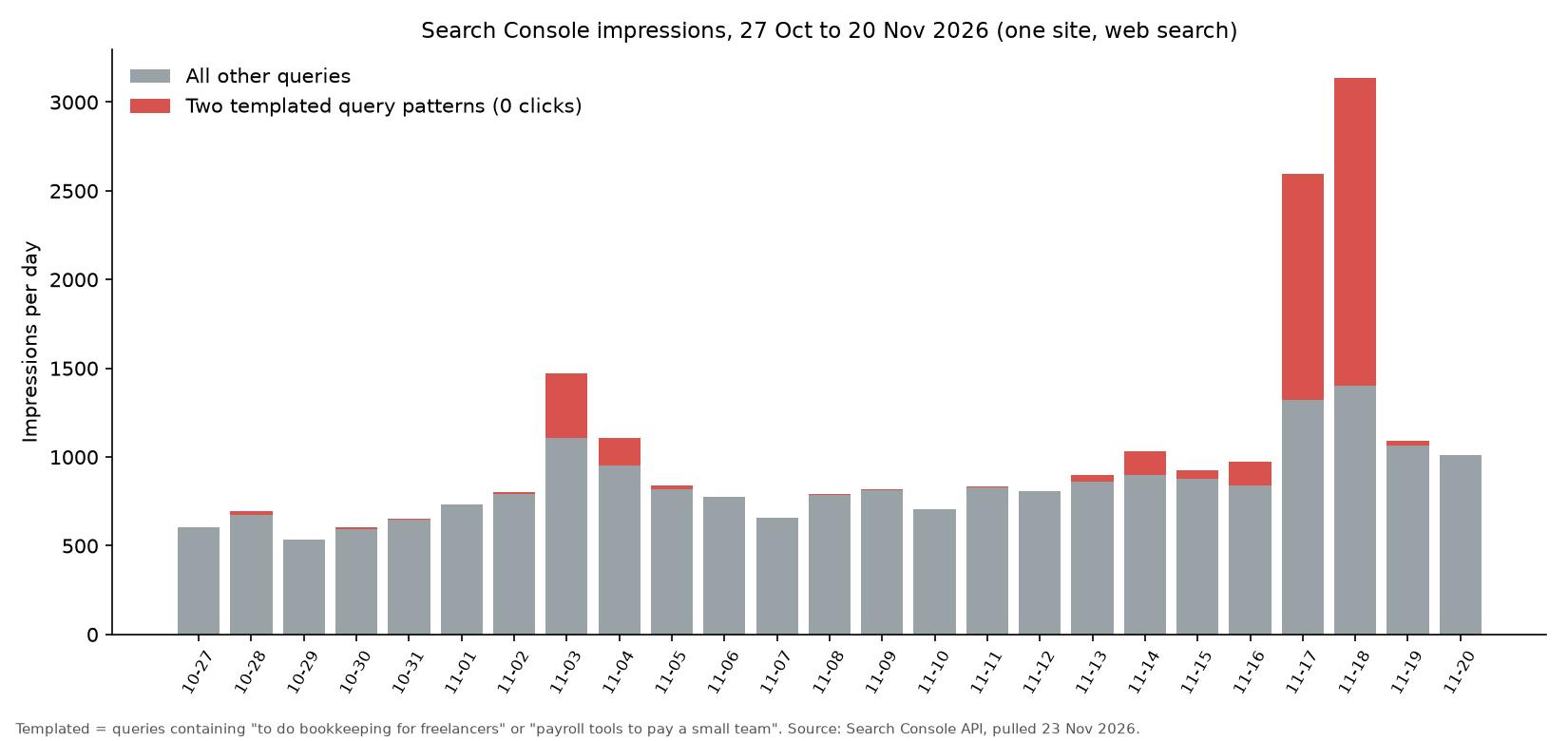
On 3 November, my site's Search Console graph did something it had never done. Impressions jumped to 1,470 in a single day, against an average of 661 a day the week before. Two weeks later it happened again, bigger: 2,594 on 17 November and 3,138 on the 18th. I run a small publication of guides for people running a business alone. It is six months old. A spike like that, on a site that size, looks like the moment Google finally noticed you. I want to be careful here, because the first version of this story jumped to conclusions. Search Console tells you which queries showed your page and how often. It does not tell you who, or what, did the searching. So for each pattern below I have split what the data actually shows from what I think it means. Layer 1: searches that read like a template What the data shows. Most of both spikes landed on two pages: a guide to bookkeeping software for freelancers and one on payroll software. The queries behind them follow a fixed sentence with words swapped in and out: accounting software to do bookkeeping for freelancers for students pricing best accounting tools to do bookkeeping for freelancers for mac best payroll tools to pay a small team on a budget 2026 Daily impressions for queries containing "to do bookkeeping for freelancers" or "payroll tools to pay a small team", against the whole site: 27 Oct to 2 Nov (7 days): 56 templated of 4,628 site impressions in total, 0 clicks 3 Nov: 364 templated of 1,470 site impressions, 0 clicks 4 Nov: 156 templated of 1,109 site impressions, 0 clicks 5 Nov: 20 templated of 839 site impressions, 0 clicks 17 Nov: 1,274 templated of 2,594 site impressions, 0 clicks 18 Nov: 1,735 templated of 3,138 site impressions, 0 clicks 19 Nov: 28 templated of 1,091 site impressions, 0 clicks Over 17 and 18 November, those two patterns made up 3,009 of the site's 5,732 impressions, 52%, and none of them were clicked. Most sat at positions 2 to 6. Each burst was over within three days. The grey part of the chart also rose on the 17th and 18th, so other queries contributed too; I have not traced those. What I think, but can't prove. People rarely search in a fixed sentence with one phrase rotated. Something generating query variations does: a rank-tracking or SEO tool, a scraper, or an AI system expanding one question into many searches. Search Console cannot tell me which, and I have no server-side evidence that would. What I can say is that these impressions came from no one who clicked, so they are not demand I should write for. Layer 2: long questions at position 1 to 5, no clicks What the data shows. Pages averaging positions 7 to 11 also showed long, conversational queries at positions 1 to 5. One, "how do bootstrapped founders build their first product?", had 62 impressions at an average position of 5.4 and no clicks in the 28 days to 5 November. What I think, but can't prove. One possible explanation is Google's AI Mode. Search Console counts AI Mode in the performance report, each follow-up question counts as a new query, and most AI Mode queries are anonymised, according to Search Engine Land's reporting on the change. Long questions ranking high with no clicks would fit a page being shown as a source inside a conversation. But nothing in my data labels a row as AI Mode, and the same pattern could come from the tools in Layer 1. I treat it as unexplained. The practical effect is real either way: a page's average position is pulled up by queries it is not really winning. Layer 3: searches for the site's own name, no clicks What the data shows. In the 28 days to 5 November, the domain name was searched 227 times and clicked zero times. The impressions were spread across more than a dozen pages, not just the homepage. What I think, but can't prove. A person who types a site's name and sees it first usually clicks it. Zero from 227 makes me doubt these were people, but I have no way to confirm what produced them. If you measure "branded search lift" from your own data, count branded searches that end in a click, not branded impressions. Layer 4: most of the queries are hidden anyway What the data shows. Search Console only names some of the queries behind a page. For the pages I checked, named queries covered between 14% and 80% of each page's impressions. My best-performing page earned 20 clicks in 28 days, and every one of them came from queries Search Console did not name. When I filtered out the templated patterns with a "query does not contain" filter, that page's 20 clicks dropped to zero, because a query filter also removes the anonymised rows. What this means. This one is not inference; it is how the filter behaves: if you clean data with query filters, check page totals before and after, or you will delete real traffic along with the noise. What it nearly cost me What the data shows. The page-level view said three articles sat on page one with weak click-through rates. At query level, two of them had almost no named demand behind that position, and the third ranked 11th for its main term. What I decided. A title rewrite would have changed nothing, so I did not do one. My own click data since launch, 120 clicks, shows why position matters more than titles at this size: positions 1 to 3 earned 2.15% of impressions as clicks, 4 to 10 earned 0.65%, 11 to 20 earned 0.22%, and 21 to 50 earned 0.19%. That is a small sample from one site, so I read it as a direction, not a rule. I added internal links to the two pages with the most named searches close to page one instead. Five checks before you trust a Search Console number Read a spike at query level. If the extra impressions come from one sentence with words swapped and none of them click, set them aside, whatever produced them. Compare impressions with clicks per query, not per page. Rank 1 with zero clicks is something to investigate, not a win. Check how much of a page's traffic is named. If named queries cover 20% of impressions, the page average is mostly rows you cannot see. Never clean data with query filters alone. They drop anonymised rows, and those can hold all of your clicks. Ignore the last two days. Search Console's newest data is incomplete; my 6 November first showed 36 impressions before it filled in. The spikes were the least important thing in the data. The useful part was what they forced me to separate: what Search Console records, and what I was tempted to read into it.
How Anonymized Queries and Unusual Search Patterns Distort Google Search Console Analysis
Full Article
Original Source
Read the full article at Hackernoon →KhanList aggregates and links to publicly available news content. We do not host full articles from third-party sources. Always verify important information with original sources.