
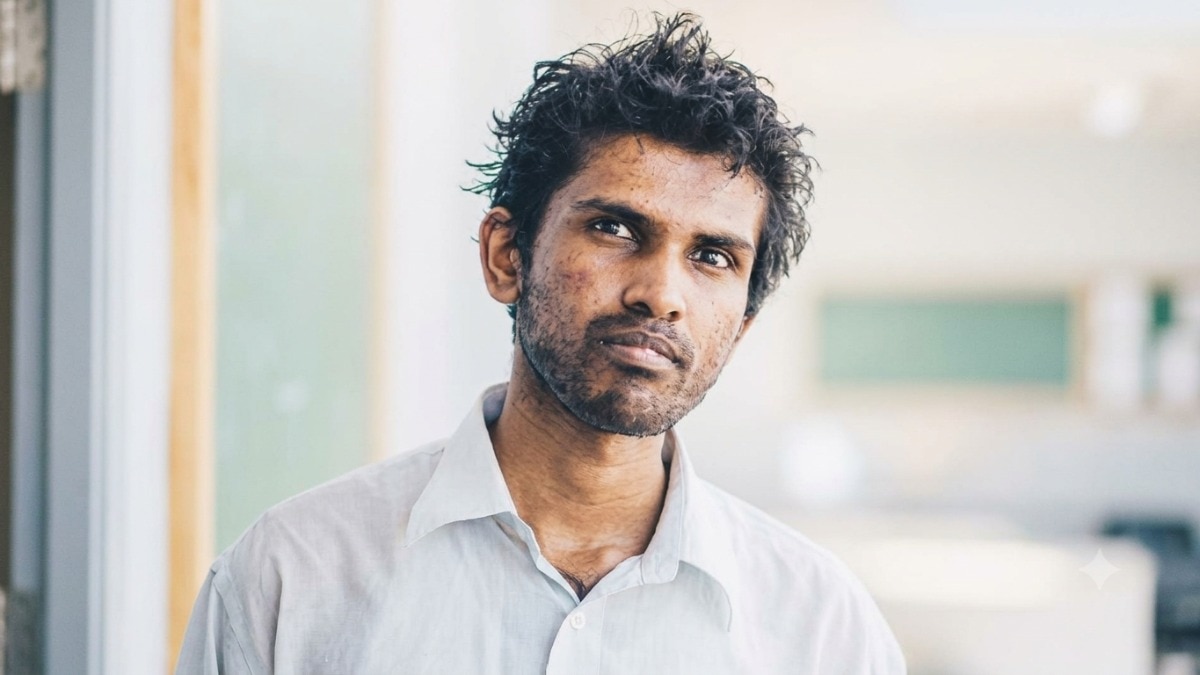
From ISI Kolkata to the University of California, Berkeley and Tata Institute of Fundamental Research (TIFR), mathematician Riddhipratim Basu has built a career solving complex problems in probability theory. His work on the decades-old slow-bond problem, random growth and statistical physics has earned him the Infosys Prize 2026 in Mathematical Sciences.From ISI Kolkata to the University of California, Berkeley and Tata Institute of Fundamental Research (TIFR), mathematician Riddhipratim Basu has built a career solving complex problems in probability theory. (Photo: infosysprize.org | AI-upscaled)New Delhi,Nov 21, 2026 12:37 ISTImagine a line of particles moving forward, each waiting for the space ahead to become free. Now introduce a tiny obstruction at just one point. Would it make any difference to the movement of the entire line?For decades, mathematicians and physicists debated this seemingly simple question. Riddhipratim Basu, an Indian mathematician based in Bengaluru, helped solve it, proving that even a slight obstruction at a single point can slow down the flow across the entire system.The breakthrough, known as the slow-bond problem, is among the contributions recognised by the Infosys Prize 2026 in Mathematical Sciences, awarded to Basu for his work in probability theory and statistical physics.THE PUZZLE THAT REMAINED UNSOLVED FOR DECADESThe slow-bond problem comes from the study of interacting particle systems, where particles move according to certain rules and influence one another. Imagine vehicles moving along a single-lane road, with each vehicle able to advance only when the space ahead is vacant. If one section of the road has a slightly lower speed limit, does it reduce the overall traffic flow?Basu, working with mathematicians Vladas Sidoravicius and Allan Sly, proved that the answer is yes, even if the obstruction is very small. The result settled a longstanding mathematical question. In subsequent work with Sourav Sarkar and Allan Sly, Basu also established Liggett's conjectural description of particle densities on either side of the obstruction.His research extends to random growth models, percolation theory and the study of rare events, including situations where systems behave very differently from their usual patterns.FROM ISI KOLKATA TO BERKELEY AND STANFORDBasu's academic journey began at the Indian Statistical Institute (ISI), Kolkata, where he completed his Bachelor of Statistics in 2009 and Master of Statistics in 2011.He then moved to the University of California, Berkeley, where he earned his PhD in Statistics in 2015 under the supervision of Allan Sly.He spent the next two years at Stanford University as a Szego Assistant Professor before returning to India. He joined the International Centre for Theoretical Sciences (ICTS), part of the Tata Institute of Fundamental Research (TIFR), in Bengaluru in 2017.He is now an associate professor at ICTS, where his research focuses on probability theory and statistical physics.RESEARCH THAT GOES BEYOND ONE MATHEMATICAL PUZZLEThe slow-bond problem is only one part of Basu's work.In collaboration with Shirshendu Ganguly and Allan Sly, he established an important large deviations result for certain first-passage percolation models that cannot be solved using exact formulas.He has also settled conjectures about fluctuations and the geometry of optimal paths in last-passage percolation, helping researchers understand how random systems grow and evolve.His contributions have earned him several honours, including the Ramanujan Fellowship in 2017, the INSA Medal for Young Scientists in 2020 and the NASI Young Scientist Platinum Jubilee Award in 2021. He was elected a Fellow of the Indian Academy of Sciences in 2025.The Infosys Prize jury recognised his work for advancing probability theory and statistical physics, particularly through methods that help explain random growth, rare events and complex systems. Based in India for much of his research career, Basu has also contributed to mentoring younger mathematicians and strengthening the country's research community.- Ends
How an Indian mathematician solved a decades-old puzzle, bagged the Infosys Prize
Full Article
Original Source
Read the full article at Indiatoday →KhanList aggregates and links to publicly available news content. We do not host full articles from third-party sources. Always verify important information with original sources.