
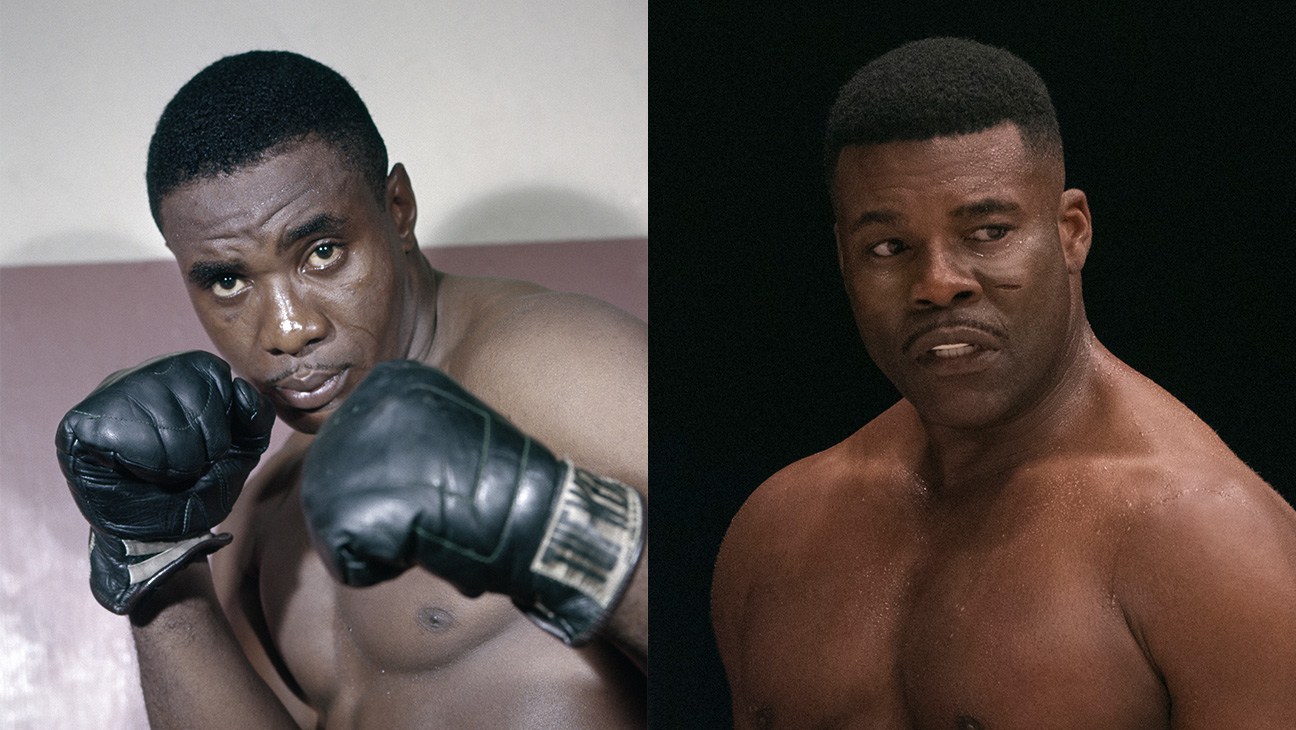
Logo text Sonny Liston stood 6’1″ and, in his prime, weighed in at 218 pounds. For Prime Video‘s The Greatest, actor Amin Joseph (Snowfall) added the requisite 23 pounds to his 6’1 (and ½”!) frame to perfectly match that of the former champ. Joseph proved to be a solid facsimile of Liston in other ways, too. For one, he can really throw hands. “I grew up fighting,” Joseph told The Hollywood Reporter. “My dad got me into boxing when I was probably around 8 or 9.” It was probably no coincidence that the formal lessons began shortly after the family moved to Harlem. Either way, it stuck, and Joseph would box on and off into his college years studying theatre at Howard University. The natural southpaw (not that he told production before landing the role — Liston was a righty) says he had a “knack” for the violent sport, but ultimately was unwilling or unable to “slave [his] mind over” to a coach. “If he says, ‘Run through a wall.’ If he says, ‘Eat sheetrock’ — you need to slave your mind over to that process,” Joseph said. “[My coach] saw that I already had self-confidence and that I was already shaped as a young man in a certain way, and it was just not worth the investment (for him).” Boxing is a sport built on length, speed, power, mental fortitude, and in many cases, having an absent (or at least shitty) father. With a present dad at home, Joseph was not looking for what so many younger fighters subconsciously seek. His training had logical limits. “If [a trainer says], ‘Run at 3 in the morning when it’s raining,’ you don’t need someone going, ‘Well, wait a minute — is that the smartest thing?'” Joseph explained. “You need someone that goes, ‘I’m running.’ Because it could be life or death if you’re in the ring and [a coach] says, ‘I need you to throw this combo.'” The coach needs the fighter to throw that combo and never question his corner. Joseph, who describes himself as “a thespian through and through,” always saw past the ring. Liston, for better or worse, was a boxing coach’s dream. Born into a poor sharecropping family, Liston was uneducated and basically tortured by his father. As a young teenager, he ran away from their Arkansas plantation and toward the streets of St. Louis, Missouri. By his early 20s (Liston never really knew his age), Liston was incarcerated. Not that he minded much: inmates get three meals a day, every single day. Liston “wanted to be accepted” like “a child” does, Joseph said. So he did as he was told. It was not a lifetime of great advice. It was in the Missouri State Penitentiary that Liston found boxing. Or really, it was boxing that found Liston. Once more, that would be for better (he’d become World Heavyweight Champion in 1962) and for worse (Liston died under suspicious circumstances in 1970). Throughout his career, Liston was surrounded by unsavory characters. Before reading Ben Watkins’ scripts, Joseph didn’t know more about Liston than your average… Joseph. He was tangentially aware of the man from the below-pictured infamous KO, which lived on as a mural on the wall of Joseph’s boxing gym (and surely hundreds of others). Muhammad Ali stands over Sonny Liston and taunts him to get up during their second title fight. Getty Images Joseph got the education needed from those scripts. He also gained the confidence that he’d have the appropriate screen time to show Liston’s “thought process,” as well as his “humility” and “humbleness.” It is Joseph’s quietest moments in the series that speak the loudest to viewers — not an easy task when playing opposite the loudest and most relentless talker in boxing history. (Cassius Clay/Muhammad Ali was portrayed with trademark bravado by Jaalen Best. Yes, “Best” was “The Greatest” in what THR TV critic Daniel Fienberg called “a star-making performance.” Fienberg said Joseph “makes Liston into a flawed but tragic figure, ferocious in the ring but eager to find acceptance outside of it,” and calls Liston/Joseph’s talk show-appearance scene “one of the series’ highlights.”) As heavy as Joseph’s new (pure muscle) weight was, what weighed most on the real Liston was “the shame” of being illiterate throughout adulthood, Joseph said. For Joseph, the greatest selling point of The Greatest is that Watkins doesn’t portray Liston as “a dimwit,” as the media of the time certainly did. “Literacy isn’t a direct correlation to your intelligence,” Joseph said. “[Liston] is a man that moves in the silence, but when he does talk, it’s so poignant.” All episodes of The Greatest are currently available on Amazon Prime Video.
How Amin Joseph Brought “Humanity” to Sonny Liston in ‘The Greatest’
Full Article
Original Source
Read the full article at Hollywoodreporter →KhanList aggregates and links to publicly available news content. We do not host full articles from third-party sources. Always verify important information with original sources.