
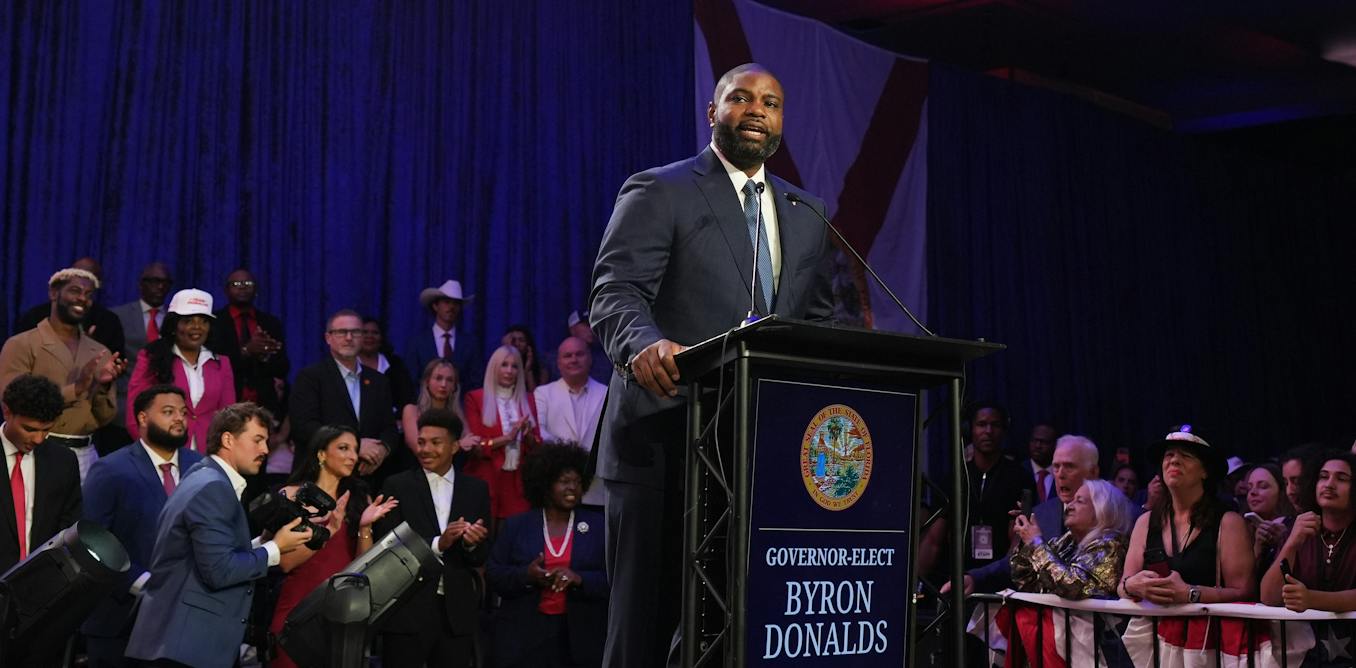
In the midst of what pundits are calling a blue tsunami nationwide, Florida remained resolutely red, electing Republican Byron Donalds as its first Black governor and sending Republican Ashley Moody back to the U.S. Senate. Donalds ran on a promise to continue the legacy of his predecessor, Gov. Ron DeSantis. His victory was not as easily won as polls had predicted. In the week leading up to the election, polls put him at 4 points over his opponent, Democrat David Jolly. In the end, Donalds won by 1.3 points – about 107,000 votes. I’m a political scientist who has lived in Florida for almost two decades and seen the powers of the governor’s office grow. We can see based on Donalds’ campaign promises the direction in which he plans to lead the state. If Gov.-elect Byron Donalds reappoints Dr. Joseph Ladapo as Florida’s surgeon general, childhood vaccine requirements for Florida schools may change soon. Joe Raedle/Getty Images News Amendment 3 shakes things up Donalds’ term as governor will start with a major change: On Nov. 3, Floridians voted to pass Amendment 3 to the state constitution. This will cause a shift in the state’s long-standing commitment to home rule, the principle that local governments, such as cities and counties, should be able to set policy on local issues. The amendment limits local government spending from tax revenue to core categories such as public safety, schools and natural resources. With a lower tax base, some local governments in rural areas may not be able to maintain basic services and might need help from the state. DeSantis has called for a special session to address Amendment 3 before Donalds takes office. DeSantis has said he plans to restrict home rule by stopping local governments from trying to raise revenue through additional taxation at the local level. Donalds supported the amendment, and it will give him and the Legislature the opportunity to redistribute tax funding throughout the state. This election has changed the makeup of the state Legislature, though, with the GOP losing its supermajority in the Florida House of Representatives, which requires holding 80 out of the 120 seats. This change in the Legislature could make it more difficult for Donalds to control the agenda in Tallahassee the way DeSantis did during his second term, when he had a supermajority in both houses of the Legislature. Donalds has affirmed that he supports the big steps DeSantis has taken to limit home rule – such as limiting local control over land development and removing local elected officials from office – and plans to take executive authority further, scheduling more DOGE audits of local government and removing more elected officials as he sees fit. When it comes to data centers, on the other hand, Donalds has said he favors local communities deciding whether to allow them to be built nearby. The GOP still holds the majority in both houses of the Legislature, but Democrats managed to flip enough seats to end its supermajority. The Washington Post via Getty News Florida health policy on vaccine mandates One of the first choices awaiting Donalds will be whom to appoint as Florida surgeon general, a position created in 2007. The position comes with the power to declare public health emergencies, forcibly quarantine people and set vaccine mandates for illnesses such as chickenpox that fall outside the state Legislature’s framework of seven childhood vaccine mandates. As part of his conservative remake of Florida policies, DeSantis appointed the current surgeon general, Dr. Joseph Ladapo, to the position in 2021. During the COVID-19 pandemic, Ladapo emerged as a leading medical freedom advocate and vaccine skeptic. Ladapo opposes all vaccine mandates. He also proposed new Florida health rules in October 2026 to drop mandates for four vaccines required for school attendance, including chickenpox and hepatitis B. Currently, the state allows exemptions only for approved religious or medical reasons. The Florida Chapter of the American Academy of Pediatrics opposes the rule change on public health grounds. Donalds has long opposed vaccine mandates and says that he did not personally receive a COVID-19 vaccine. He supports Ladapo’s proposed rule change to reduce school vaccination mandates and said during his campaign that he is open to reappointing Ladapo as surgeon general. The Florida Legislature, however, will limit how far Donalds can push vaccine policy. The Legislature has mandated measles and polio vaccines for all K-12 public school students, so getting rid of that requirement would require a change in the law. Universal school vouchers One of the biggest developments in Florida K-12 education in recent years has been the creation of a system of universal vouchers by DeSantis and the Legislature in 2023. This program allows parents of any income level to use US$8,000 in state money on average, based on county of residence, for their children’s private or homeschooling education. The universal voucher program has created intense pressure on the state budget. It cost an estimated $4.5 billion in fiscal year 2026. State auditors have identified accountability problems in tracking funds through the system. Public schools have faced declining enrollment, with fewer resources to serve the neediest students they cannot turn away. Donalds strongly supports the universal voucher program. He has expressed an interest in making Florida “the model state for school choice” by allowing parents to choose among private educational providers competing in the marketplace. His wife, Erika Donalds, is a former Collier County school board member who operates a network of for-profit charter schools and advocates nationally for school choice. Whether the Donaldses will divest from the charter school business during the governor-elect’s term remains to be seen. Already, the governor-elect has indicated that he might work with the Legislature to change the way the Florida Education Finance Program funds K-12 schools, allowing districts to spend funds with more flexibility. During his campaign he also proposed a universal scorecard for the voucher program so that parents can compare educational data on student performance across different types of schools. Currently, only public schools must provide this data. Donalds can also influence state education policy by appointing the seven members of the Board of Education and then recommending a candidate for commissioner of education for that board to elect. The commissioner and state board oversee the Florida Department of Education and programs from kindergarten through postsecondary education. They board could also implement new eligibility rules for private school vouchers, as the DeSantis administration has done in the past. The way forward During his campaign, Donalds attempted to distance himself from President Donald Trump, whose policies have proven unpopular even in red states such as Florida. But in his victory speech on the evening of Nov. 3, Donalds proudly announced that he had received a congratulatory call from the president. “Mr. President,” he said to a cheering crowd, “I want you to hear from Florida that we are still red.” This story is an update of a story published on Oct. 28, 2026. Read more of our stories about Florida.
How Amendment 3, vaccine mandates and school vouchers will shape Florida under the leadership of Byron Donalds
Full Article
Original Source
Read the full article at Theconversation →KhanList aggregates and links to publicly available news content. We do not host full articles from third-party sources. Always verify important information with original sources.