
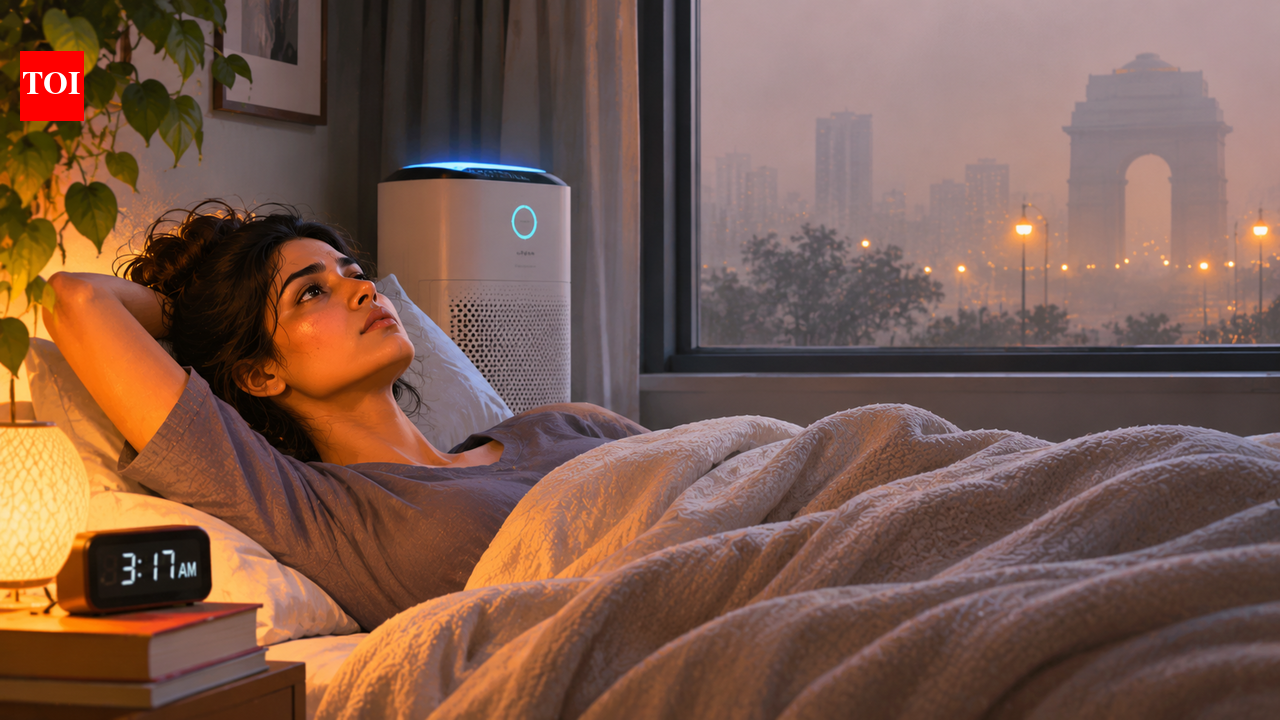
Toxic air is making it hard for you to sleepSo here’s a fun fact. Roughly around one third of our lives is spent sleeping. That is how crucial sleep is for the human body. It is the time when our bodies reboot and repair themselves. But that story is a bit last century. Today, we live in a sleep-deprived world – one where everything from gadgets to 24x7 working lives to our overburdened minds has not just disrupted our sleep patterns but half the world, insomniacs. Add rising AQI, and things get worse.Sample this. On a smoggy November night in Delhi-NCR, you shut the bedroom windows. It’s common sense. The haze stays outside, the traffic fades to a hum, and you settle in for seven or eight hours of sleep. Yet the morning arrives with a familiar heaviness: dry throat, dull headache, brain fog, and the nagging sense that you barely slept at all.Your body isn't imagining things. Closing the windows does little to keep pollution out. In September 2026, researchers presented a study at the BMJ Research Forum South Asia, measuring air quality inside and outside 90 naturally ventilated homes in Delhi. Despite almost all households using clean gas for cooking instead of wood or coal, the median indoor PM2.5 level was 258.7 micrograms per cubic metre. That's nearly 17 times the World Health Organization's recommended 24-hour limit.Even more alarming, indoor pollution levels were almost identical to those outdoors. The indoor-to-outdoor pollution ratio was 0.996, showing that the toxic air outside was finding its way into bedrooms and living spaces almost unhindered.That invisible haze does more than irritate lungs. A growing body of global research shows that dirty air acts like a nightly thief, quietly stealing the deepest, most restorative stages of human sleep. And in cities like Delhi—where November 2026 citizen polling found 22% of respondents struggling to sleep during post-Diwali smog—bad air is colliding with a population that is already chronically sleep-deprived.Says Dr. Shradha Maheshwari, neurosurgeon, SL Raheja Fortis Hospital, “Particles like PM 2.5, PM10, Ozone Nitrogen dioxide and other particulate matters irritate the airways. At night when our body is naturally slowed down, this irritation makes it harder to breathe. This leads to shallow breathing, snoring and poor quality of sleep. In short term, this may cause irritation, memory disturbance, insomnia, daytime sleepiness and mood changes. But longterm, this increases risk for respiratory problems, cardiovascular health, cognitive decline and neurodegenerative disorders.”Adds Dr Maheshwari that due to increased oxidative stress and impaired repair mechanism, pollution causes overall reduced immunity. In an immunodeficient world post Covid, the health risks are too high.It is estimated that 91% of the world’s population lives in regions which are polluted.Piling onto a world already running on emptyAir pollution is affecting people who are already struggling to get enough sleep. Worldwide, people sleep an average of just 6.8 hours a night, down from nearly nine hours a century ago, according to research cited in Sleep Medicine: X.The problem goes beyond occasional sleepless nights. A 2025 analysis in Sleep Medicine Reviews estimates that more than 850 million adults worldwide suffer from insomnia. Another major concern is obstructive sleep apnea (OSA), a condition in which the airway repeatedly narrows or collapses during sleep, interrupting breathing. A 2019 study in The Lancet Respiratory Medicine estimated that 936 million adults worldwide suffer from some form of sleep apnea, with more than 85% of cases going undiagnosed.India is particularly affected, ranking fourth globally in the number of adults with sleep apnea. Research by the All India Institute of Medical Sciences (AIIMS) estimates that 11% of Indian adults have the condition, including 13% of men and 5% of women. An earlier AIIMS study in semi-urban Delhi found an even higher prevalence of 13.74%. Newer research from AIIMS Bhopal also suggests that sleep apnea may be more widespread than previously thought, with strong links to diabetes, high blood pressure and metabolic syndrome.Everyday sleep deprivation is equally worrying. A March 2025 LocalCircles survey of over 43,000 Indians found that 59% get fewer than six hours of uninterrupted sleep each night. Poor sleep is affecting working lives too. ResMed's 2025 Global Sleep Survey found that 94% of working Indians had called in sick at least once because of inadequate sleep.This means millions are already exhausted before pollution adds to the problem. Chronic sleep deprivation affects concentration, slows reaction times and increases the risk of cardiovascular disease. When the body is already running on too little rest, polluted air only adds to the strain.Dr. Manoj Kutteri, medical director & VP, Atmantan Wellness Centre, has seen sleep-related ailments amplify in the last decade like never experienced before. He says. What we don’t realize is that sleep is not always about the number of hours we spend on bed. Many of us toss and turn during sleep and still think our sleep was okay. Because we count the time from when we get to bed and when we wake up. That is not enough for restorative sleep.”Poor quality of air, especially the fine particles in the air can irritate the mucus membrane of our respiratory system, causing allergies, nasal congestion, cough, breathing issues and repeated awakening. Even though we may not be conscious of these, sleep can still get fragmented and does not yield a restorative sleep, adds Dr Kutteri. “Similarly, noise pollution can cause stress induced responses, including increased heart rate, activate the body’s response to stress and cause arousal from sleep, even if it doesn’t make one get up fully.”Changing daytime habits also help us sleep better at nightBut we have become so accustomed to disturbed sleep that we do not pay attention to it.Hence we don’t realize that short term sleep deprivation has resulted in daytime sleep, fatigue, our ability to focus and affected our concentration issues. It has also led to mood changes, inability to execute daily functions, irritability and poor decision-making skills. “When these issues become more of a recurring one, one can end up having chronic sleep deprivation which can be a reason for many of the chronic diseases such as cardiovascular issues, digestive problems, metabolic issues, weakened immune system and also can result in other psychological problems not limited to anxiety and depression,” says Dr Kutteri.How to protect your sleep in a polluted environmentWhile we may have little control over air and noise pollution, experts say there are practical steps we can take to reduce exposure and protect sleep. The first is to make indoor spaces as clean and comfortable as possible.Dr Maheshwari recommends using air purifiers at home and at the workplace. While these may not remove all gaseous pollutants, they can reduce particulate matter and improve the quality of the air we breathe. Checking the Air Quality Index (AQI) before planning outdoor activities, wearing a well-fitted mask when stepping out and ventilating the house when outdoor air quality improves can also help.Indoor sources of pollution need attention too. Smoking, burning incense sticks and using mosquito coils can worsen indoor air quality and should be avoided. During periods of high pollution, keeping windows closed and using air purifiers can help limit exposure.Make the bedroom sleep-friendlyNoise pollution is another often overlooked cause of disturbed sleep. Dr Maheshwari suggests creating a quieter sleeping environment by using insulated windows and earplugs. Keeping the bedroom comfortable, reducing outside noise and limiting exposure to pollution can help the body settle into a restful sleep.Dr Kutteri also stresses the importance of maintaining a regular sleep routine. Going to bed and waking up at the same time every day helps regulate the body's circadian rhythm. A cool, quiet bedroom, adequate sleep and avoiding screens and stimulants before bedtime can further improve sleep quality.“One should also be trained not to carry stress into the bedroom,” he says, recommending journalling as a way to unwind and reflect before going to sleep.Build healthier daytime habitsWhat we do during the day also influences how well we sleep at night. Dr Kutteri recommends getting some morning sunlight to regulate the body clock, staying physically active, eating well and staying hydrated. Avoiding caffeine after 2 pm can also help prevent sleep disturbances.Relaxation practices such as slow breathing, alternate nostril breathing, meditation, yoga and gentle stretching can help reduce stress and prepare the body for sleep. Dr Maheshwari similarly recommends regular physical activity, including walking and stretching, to improve mood and support healthy sleep.
How air pollution is leaving us sleepless in an already-sleep-deprived world
Full Article
Original Source
Read the full article at Timesofindia →KhanList aggregates and links to publicly available news content. We do not host full articles from third-party sources. Always verify important information with original sources.