
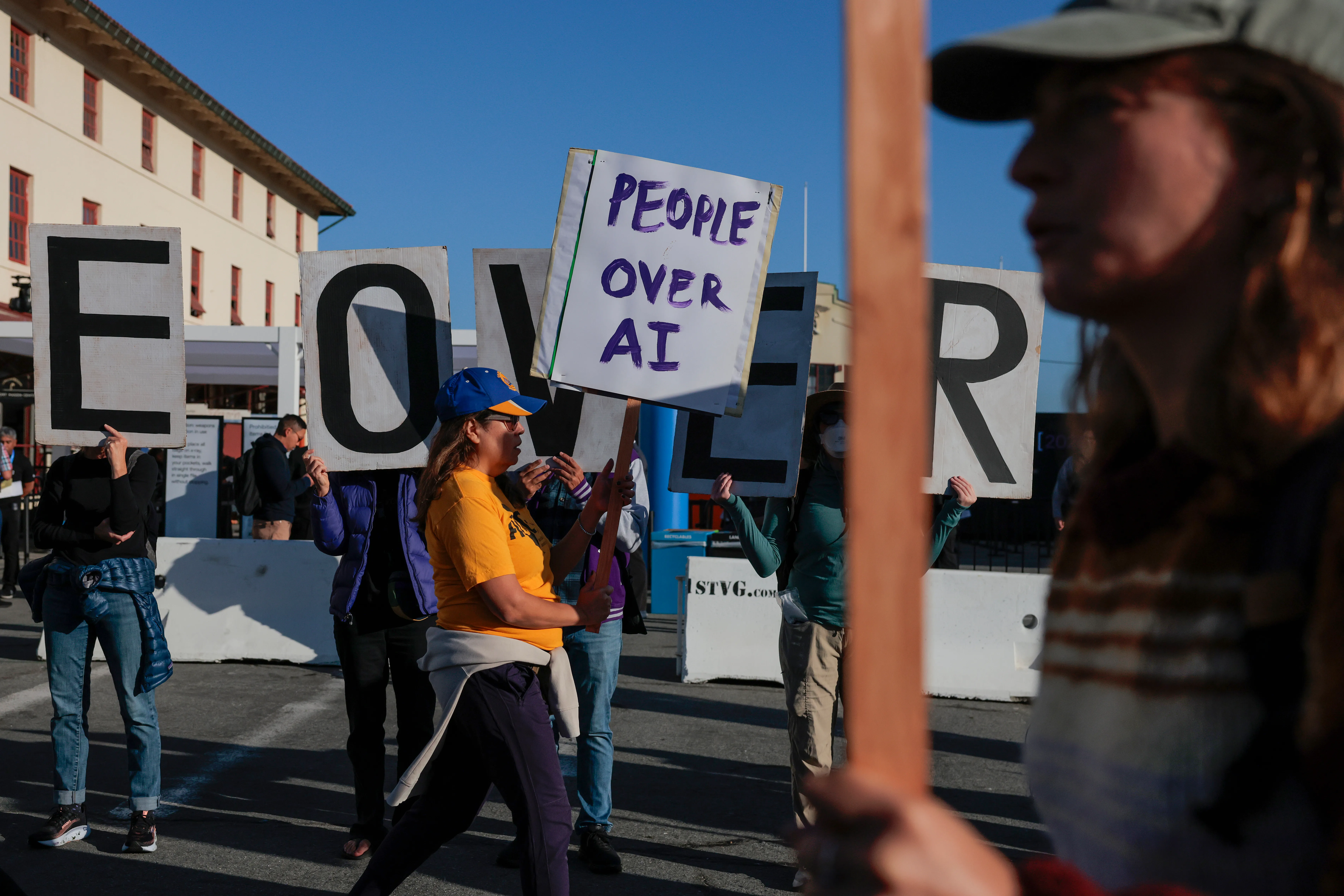
The last few weeks have launched concerns about an AI extinction event into the mainstream. When Anthropic researcher Jacob Coxon announced his resignation from the company on Sept. 8, he wrote that the “people building AI earnestly believe that it could kill us all by the end of the decade.” Tech CEOs such as OpenAI’s Sam Altman, Anthropic’s Dario Amodei, and SpaceXAI’s Elon Musk didn’t disagree. Instead, they called for frontier AI companies to slow the pace at which they improve model capabilities. The spread of artificial intelligence has generated myriad other concerns, too: the ecological impact of data centers, privacy violations and surveillance, machine takeovers of creative endeavors. Fueled by these concerns, a broader pattern of emerging violence motivated by anti-AI sentiment is generating new grievances and forms of target selection that do not always neatly map onto familiar terrorist ideologies. The last few weeks have launched concerns about an AI extinction event into the mainstream. When Anthropic researcher Jacob Coxon announced his resignation from the company on Sept. 8, he wrote that the “people building AI earnestly believe that it could kill us all by the end of the decade.” Tech CEOs such as OpenAI’s Sam Altman, Anthropic’s Dario Amodei, and SpaceXAI’s Elon Musk didn’t disagree. Instead, they called for frontier AI companies to slow the pace at which they improve model capabilities. The spread of artificial intelligence has generated myriad other concerns, too: the ecological impact of data centers, privacy violations and surveillance, machine takeovers of creative endeavors. Fueled by these concerns, a broader pattern of emerging violence motivated by anti-AI sentiment is generating new grievances and forms of target selection that do not always neatly map onto familiar terrorist ideologies. On April 10, a 20-year-old man allegedly threw a Molotov cocktail at Altman’s San Francisco home. Four days earlier, Indianapolis city councilman Ron Gibson, who had backed a data center rezoning measure in his district, awoke to find that 13 rounds had been fired into his home, accompanied by a note under his doormat reading “No Data Centers.” These instances demonstrate a broader AI grievance that can motivate violence. Such grievance is amorphous and can be incorporated into the narratives of disparate extremist movements such as anarchism, environmentalism, or party radicalism, but it can also motivate individuals with little connection to an established movement. Targets are similarly diffuse and can include technology executives and researchers, local officials, and physical infrastructure. Rather than a shared ideological framework, a shared perception of AI as a source of harm connects instances of AI-motivated violence. Yet while the underlying anxiety motivating such extremist behavior is felt globally, that behavior itself is not evenly distributed. This is because anxiety alone does not act as a conveyor belt toward violent action; rather, it can be either exacerbated or calmed by the political environment where it exists. Despite shared anxieties, stark differences exist in perceptions of AI in the United States and China—the global superpowers driving the race for AI dominance. In a global Ipsos survey this year, 85 percent of Chinese respondents said AI offered more benefits than drawbacks, compared with 38 percent of American respondents. There are no publicly reported cases of AI-driven extremism in China (although the Chinese information environment makes the absence difficult to interpret). Amid heightened AI existentialism, how can governments help prevent widespread AI anxiety from being channeled toward violence? The comparison between China and the United States suggests that the answer lies partly in what grievance encounters after it emerges. Even if it doesn’t kill us all, AI is widely understood as having the potential to reorder work and society itself. Three-quarters of Americans believe that AI will harm their job security and 66 percent of European Union citizens fear that AI will destroy more jobs than it creates, while China’s comparatively high rates of AI optimism exist alongside fears of economic displacement. Dystopian forecasts anticipate a permanent underclass excluded from many of the economic opportunities created by an AI-driven economy. Governments cannot prevent technological change from generating opposition, but they can shape the political environment through which that opposition is expressed and addressed. Fear of change is turned into political grievance when people believe the disruption is unfair. Anger is driven by the moral economy: the belief that powerful actors, whether governments, corporations, or individuals, have broken the social contract by privatizing gains while those exposed to disruption are offered no meaningful influence over the transition. The task for the state is therefore to ensure that those experiencing AI anxiety see political institutions as credible avenues through which their concerns can be heard and acted on. On this measure, an emerging contrast between China and the United States is noticeable. Beijing is aggressively pushing AI and automation. Despite a booming technology sector, China’s labor market is under intense strain, with rising youth unemployment and a rapidly expanding gig workforce. After a spate of violence in 2024 in China driven by economic hardship and perceived injustice, AI integration risks further disrupting an already fragile relationship between citizens and the labor market. However, China’s political response has shifted accordingly. Policymakers moved AI-driven employment displacement rapidly up the hierarchy of concerns between 2024 and 2026. China’s latest national employment strategy makes avoiding large-scale unemployment a bottom line, calls for early-warning systems around AI-related employment risks, and allows local governments to establish employment-risk reserve funds. Courts and local authorities have also begun placing some of the costs of automation back onto firms, with recent labor cases ruling it illegal to use AI automation alone as grounds for dismissal. Restrictions on political mobilization and public information make it difficult to interpret the absence of publicly visible anti-AI violence in China as evidence that Beijing’s approach has prevented it. What is clear, however, is that China continues to record comparatively high levels of public optimism toward AI, viewing it in a distinctly non-apocalyptic farming despite significant concern about its effects on the labor market. Beijing seems to be acutely attuned to the question of social stability and has approached this concern through a policy framework, demonstrating how anxiety can be managed as well as the value of treating the social consequences of technological disruption as the state’s political responsibility rather than an inevitable misfortune. Washington approaches the issue from a different angle. Like China, the United States sees AI leadership as central to economic and geopolitical competition. U.S. President Donald Trump remains unmoved by recent conversations around AI’s risks to humanity, labeling such concerns a “hoax” and proponents of a slowdown “treasonists.” Based on the organizing principle of acceleration, a January 2025 executive order made U.S. “global AI dominance” official policy; six months later, the AI Action Plan outlined steps to make that dominance a reality. Subsequent policies have constrained state-level regulations considered inconsistent with national innovation priorities. U.S. federal policy has not completely ignored workers. The action plan established a research body to track job displacement and wage effects while expanding AI training through career and technical education, apprenticeships, certification programs, and work-based learning. In June, the U.S. Labor Department designated $50 million for rapid reskilling and reemployment programs. That hasn’t been enough, however. The U.S. response is far from uniform, with states such as California considering a broad set of interventions for workers, while state-level action has generally been piecemeal and concentrated elsewhere. Without a coherent national settlement or central framework, uneven protections reinforce an impression that the government is responding around the edges of the problem rather than taking responsibility for the transition itself. China’s active policy response alone may not explain contrasting national reactions to AI anxiety, but it would be a misstep to discount its role. Whether a government is perceived to be responsive to public needs shapes popular acceptance of change and governmental legitimacy. The inverse likewise holds true: When governments appear unresponsive, anxiety is more likely to harden into grievance and potentially extremist violence. The lessons for policymakers seeking to minimize the social harms and disruption emerging from AI anxiety are threefold. First, there is a serious need for legitimate, meaningful avenues for workers and communities to contribute to discussions around AI integration. Offering opportunities for negotiation around the impacts of AI adoption could help build buy-in for new technologies—although dialogue can just as easily deepen frustration if participants perceive it as symbolic and the outcome predetermined. New Jersey is encouraging municipalities to negotiate community benefits agreements with developers and providing support for local governments to bargain over infrastructure impacts, environmental costs, and local investment. Data center development—which has emerged as a focal point for wider concerns about technological disruption—could also offer an immediate test case for direct community involvement. Projects built on trust and continued engagement may ultimately be more durable than those that treat community opposition as an obstacle. Second, the benefits of AI should be framed as useful and accessible outside of elite circles. Given Anthropic’s reported potential revenue of more than $30 trillion versus the current U.S. GDP of $32 trillion, it’s easy to see why many Americans feel that AI is a tool for the rich. In addition to retraining and reskilling workers, governments should prevent firms from using AI adoption as a blanket justification for layoffs, as has been done in China. They should also mandate the sharing of AI-produced wealth with employees, following the precedent of companies such as Samsung, which agreed to allocate a percentage of its semiconductor division’s profits to employees following record revenue from AI-driven demand. Even a small portion of AI wealth can generate tangible, long-term value for those who feel threatened by technological advances and wealth concentration. If gains are democratized, governments will have a much stronger platform to communicate how technological change offers benefits to individuals beyond those already positioned to profit from it. Finally, governments should concentrate counterterrorism efforts on understanding how existing extremist networks are seeking to exploit AI anxiety, including by identifying catalysts for individuals who transition from anxiety to threats, target selection, and operational preparation. Some extremist movements have already integrated AI anxiety into their ideologies, which has led to several violent incidents in Europe. The task for security agencies is to treat AI grievance as a potential indicator of political violence rather than evidence of a threat in itself. AI integration and its associated anxiety are dominating the political landscape. Governments cannot prevent every act of AI-related extremism, but they can uphold the moral economy, and they can shape whether those affected by disruption continue to see conventional politics as capable of changing outcomes.
How AI Anxiety Turns Into Extremism
Full Article
Original Source
Read the full article at Foreignpolicy →KhanList aggregates and links to publicly available news content. We do not host full articles from third-party sources. Always verify important information with original sources.