
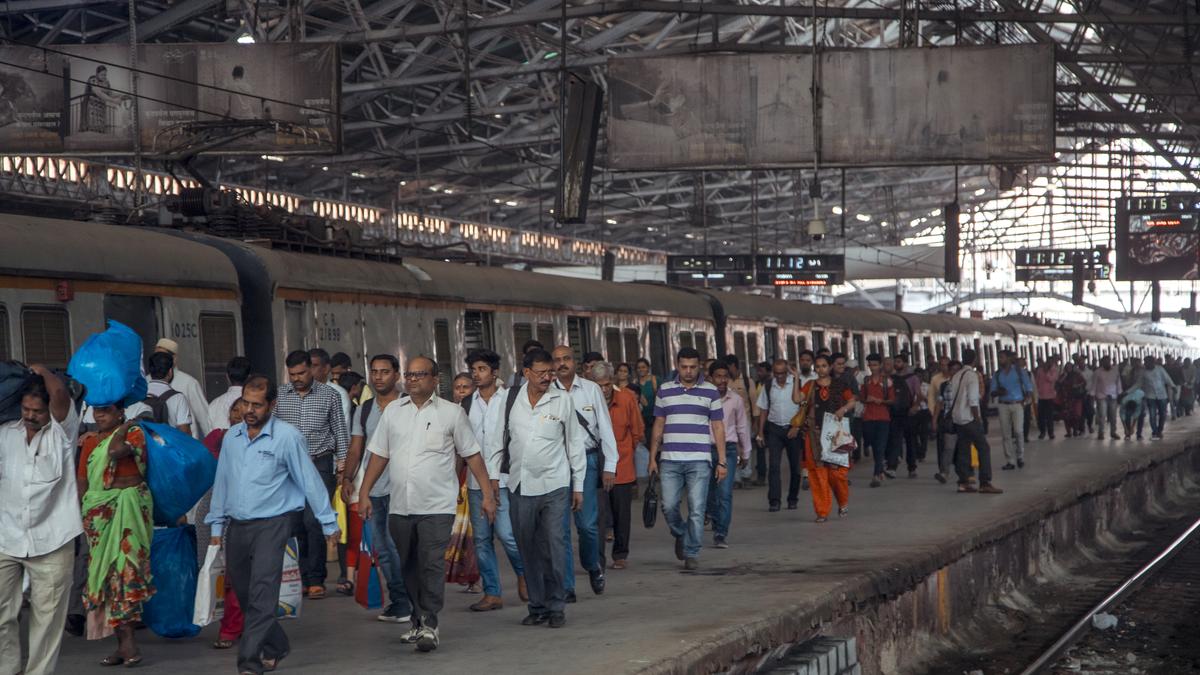
The locals from Dahanu travelled daily to Mumbai for work on a train called the Flying Rani. | Photo Credit: Getty Images Chand and Sridevi were married in March 1978, and the very next day, she had to go back to finish her training in Hyderabad. She was pregnant by the time she wrote her final exams. They were the first couple in India where the wife was an IPS officer and the husband was an IAS officer and this made their seniors proud of them. If two people from the academy married each other, the administration placed them in the same State so they could raise a family together. Since he was from the north and she was from the south, they decided to start their new life in the middle, i.e. Maharashtra. As expected, the first few years of marriage and parenthood were tumultuous and there were many differences and miscommunications between the newly married couple. But their love and respect for each other saw them through.After delivery, they left their newborn daughter Lakshmi with Chand’s mother in Mathura for the first year. Sridevi underwent Maharashtra State training that year and then they carried on to their first posting in Dahanu in 1982. When Lakshmi turned one, they brought her with them to Dahanu and Sridevi jokes that her first-born practically grew up in the police jeep. She would get calls at all hours of the day and night and have to leave at a moment’s notice. Chand would often drive her with their toddler sleeping on the lap of her uniformed mother sitting in the passenger seat.Anger on the tracks Dahanu was her first posting so everything that happened there felt dramatic and left an impact on her memory, such as the head constable’s murder. Another time, she prevented a riot from breaking out. There was an agitation of 5,000 people on the railway tracks and Sridevi was just a young female officer of twenty-six. The locals from Dahanu travelled daily to Mumbai for work on a train called the Flying Rani and rushed to their jobs as soon as the train pulled into Mumbai Central Station. However, this train was held up occasionally to let the Rajdhani train pass first. Since the Rajdhani was a long-distance, fast train that did not stop at Dahanu road station, it got precedence and this resulted in irksome delays for those aboard the Flying Rani.On the day of the incident, the Rajdhani was delayed because of some derailment on its route and it was to arrive at Dahanu station on the Western Railways track, which clashed with the regular time of the local train. The Flying Rani passengers were fed up of the delay and came out onto the tracks to block the Rajdhani from passing through. Meanwhile, the Rajdhani passengers had been travelling for over twenty-four hours and didn’t even have food or water to feed their children, so they also came out onto the tracks. Another set of Dahanu locals who had been demanding that the government build a foot over bridge at the same station showed up with their own axe to grind at this inopportune moment. The crowd grew from 500 to 1,000 to 5,000 people in the span of four hours. Everyone was angry. People were shouting and Sridevi was worried that soon the crowds would start pelting gravel at each other and at the officers trying to handle the situation. She muses that had she given orders for lathi charge to prevent a riot, she would have earned the title of Singham.A moment of quick thinking But she wanted to resolve things with the least amount of violence. The station master had standard orders to make the Flying Rani wait for the Rajdhani train and was refusing to budge. Sridevi tried to reason with him and convince him to let the Flying Rani leave first but he was very clear that he had to follow orders from his headquarters. Sridevi could see that the situation was going to get very ugly very quickly.In a moment of quick thinking, she quoted a section of the law that requires all citizens to follow the instructions of a police officer in order to maintain law and order. She wrote down her orders and gave it to the station master letting him know that he was breaking the law by not listening to her. She also explained that the near-explosive situation outside needed to be resolved before it went out of control and people got hurt. This finally convinced him and he called his headquarters asking what to do. They told him to let the Flying Rani pass, and all the 5,000 people gathered there cheered for Sridevi when the situation finally cleared. She learnt an important lesson that day: using powers of persuasion is sometimes much wiser than using brute force.Excerpted with permission from Pan Macmillan India, from Jasreen Mayal Khanna’s Bullet Nani and Other Badass Indian Grandmas. Published - August 28, 2026 04:34 pm IST
How a young IPS officer stopped a riot
Full Article
Original Source
Read the full article at Thehindu →KhanList aggregates and links to publicly available news content. We do not host full articles from third-party sources. Always verify important information with original sources.