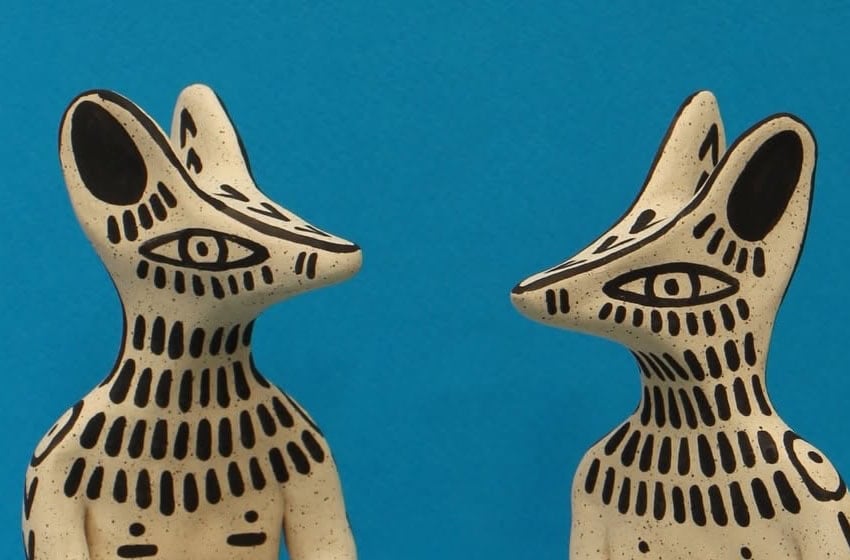
When Sócrates Medina first started playing around with ceramics, he found it served a therapeutic purpose, helping to channel and manage the ADHD he’d been struggling with. However, he could never have imagined it would become a successful studio with international collaborators across various disciplines. Medina founded Perro Y Arena, an aesthetic ceramics design studio, in 2018 while living in Los Angeles. Initially, the work was nothing more than a passion project. However, in 2021, the artist moved back to his native Tijuana, a border town roughly 140 miles south of L.A. in the Mexican state of Baja California, to turn his nascent hobby into a full-fledged career. Since then, Medina’s creative universe has expanded through collaborations with artists, designers, other ceramic artisans and textile creators. The studio hosts pop-up events in cities such as Los Angeles, San Diego, Tijuana and Mexico City. From desert mythology to the world Medina’s early ceramic sculptures were inspired by the profound connection between humans and dogs in Mexican culture, such as the once-nearly extinct hairless Colima dog, which Mesoamerican societies revered as a guardian in both the mortal and metaphysical planes. The creatures Medina looked to largely came from the desert landscapes he calls home. The coyote, for example, has “symbolic significance in Tijuana as a symbol of the border,” Medina says, adding, “I really identify with this animal.” Over time, his animals have grown more fantastical, borrowing elements not only from Mexican mythology, but also Greek and Egyptian art, while still maintaining an aesthetic defined by minimalist lines that echo desert landscapes as well as symbols from nahualism, or Indigenous shamanic traditions. The desert as a muse For Medina, the desert is a natural source of inspiration. “When I started focusing on a desert-like aesthetic with a Mediterranean, sandy palette and pale, warm colours, that’s when I began devoting myself 100% to the project,” he says. Sandy desert colors are a key component in Medina’s design color palette, often juxtaposed with yellow or blue. (Perro Y Arena) He’s experimented with other colors, such as yellow and blue, but always juxtaposed with his signature sand tone. Thematically, every piece evokes the desert’s mysticism. According to Perro Y Arena, the animal figurines invite the viewer “into a spiritual and mythological world where you can dance with coyotes and hares while serenading the moon.” Living vicariously through his art Medina’s connection to his craft goes beyond the art of creation. Rather, his pieces serve as something of an alter ego; each sculpture a vessel for personal reflection and quiet introspection. He explained that when he first started creating his dogs, they represented states of being or attributes he desired for himself. He also feels a deep bond with them, viewing them as a living synthesis of rural and urban creatures. But his ceramic designs also serve as a philosophical statement, often depicted engaged in meditative activities. “It’s as if my characters do or become things that I want for myself. I want to be calm, to reflect and to enjoy a cup of coffee,” Medina says. “Sometimes I give them a tattoo or an earring that I’d like to have myself. They’re like a fantasy version of me, an alter ego.” Medina views the dogs so often used in ceramics as an alter ego and often gives them attributes or adornments he desires for himself. (Perro Y Arena) Perro y Arena invites us to pause and enjoy the moment. “One of my favorite pieces is an incense holder,” Medina says. “The simple act of lighting and arranging incense is a reminder to make time for ourselves.” Crows, rabbits, serpents, coyotes and dogs are all part of this unique, handmade collection, which captures a dynamic aesthetic with nothing more than a few lines. Ana Paula de la Torre is a Mexican journalist and collaborator for various outlets, including Milenio, Animal Político, Vice, Newsweek en Español, Televisa and Mexico News Daily.
How a Tijuana ceramicist turned desert animals into an interior design concept
Full Article
Original Source
Read the full article at Mexiconewsdaily →KhanList aggregates and links to publicly available news content. We do not host full articles from third-party sources. Always verify important information with original sources.