
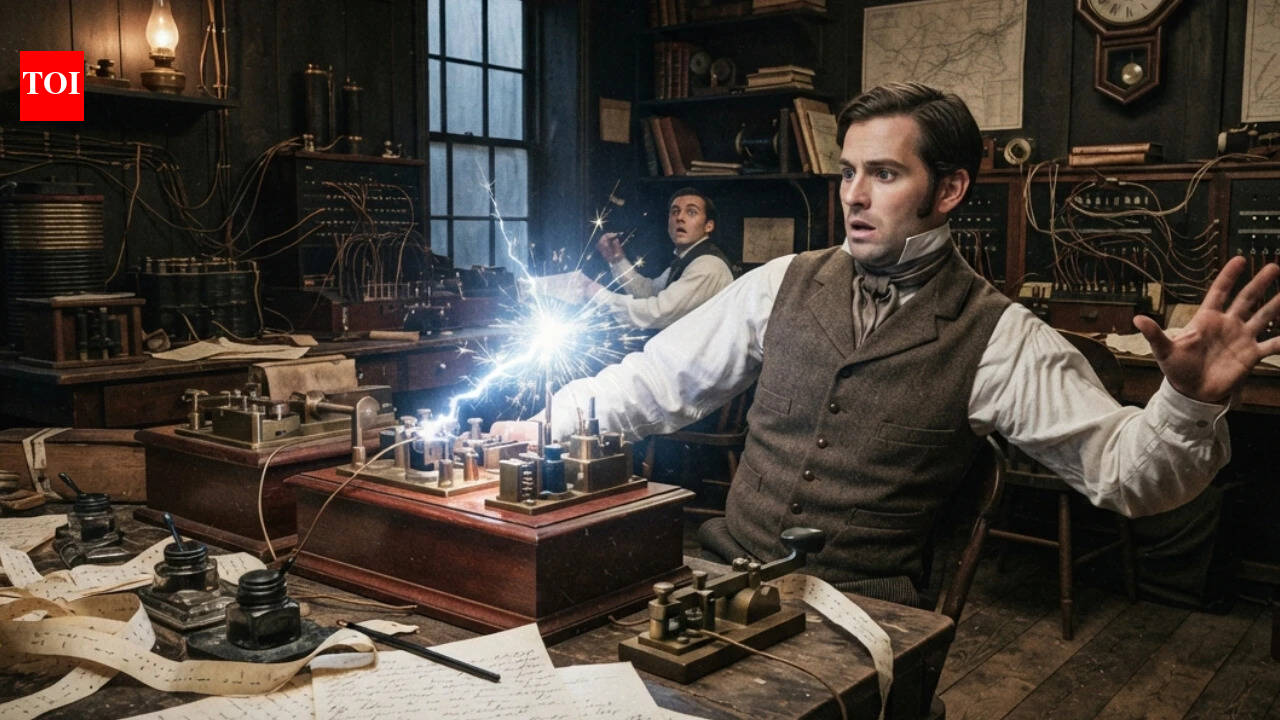
The event disrupted telegraph networks, causing electrical sparks, fires and shocks to operators. AI imageIn 1859, a powerful solar storm caused an unusual chain of events on Earth. Telegraph equipment began producing electrical sparks, operators suffered shocks and paper caught fire at some stations. At the same time, bright auroras appeared in the night sky, confusing people who had never witnessed such a display.According to the information available on History.com, some telegraph operators found that their equipment could still transmit messages after its batteries had been disconnected. They were able to use electrical currents generated during the storm to keep communication going, although the process was slower than normal.The event took place between August and September 1859 and is now known as the Carrington Event. It was named after British astronomer Richard Carrington, who observed an unusual flash on the Sun on September 1. His observation helped establish the connection between activity on the Sun and the disruption experienced on Earth.Carrington was studying dark patches on the Sun's surface from his private observatory when he noticed two unusually bright areas. The flashes disappeared within minutes. However, the effects of the solar activity soon became visible across different parts of the world.The event was caused by a massive solar flare that sent electrified gas and subatomic particles towards Earth. This triggered an intense geomagnetic storm, producing electrical disturbances and unusually bright auroras. It remains the largest recorded solar storm to have struck Earth.Telegraph systems faced widespread disruptionIn 1859, telegraph networks were essential for sending information over long distances. People and businesses depended on them to exchange messages, while newspapers used the technology to receive news. The system was therefore an important part of communication at the time.Telegraph operators had encountered interruptions during thunderstorms and auroral activity before. However, the disturbances in August and September 1859 were far more severe.The first major problems appeared on August 28, when a solar storm affected telegraph lines across North America. The electrical currents flowing through the wires became strong enough to threaten the equipment.E W Culgan, a telegraph manager in Pittsburgh, reported that the currents were so powerful that platinum contacts in the machines were at risk of melting. He also described flames emerging from electrical circuits.The situation was dangerous for operators as well. In Washington, DC, Frederick W Royce suffered a severe electric shock when his forehead came into contact with a ground wire. A witness reported seeing an electrical arc jump from his head towards the telegraph equipment.Some telegraph stations used chemicals to record messages on paper. During the electrical disturbance, powerful surges caused some of these papers to catch fire.These incidents showed that the storm was affecting more than the ability to transmit messages. It was also creating dangerous conditions for people operating the equipment.Operators managed to send messages without batteriesA second wave of solar activity brought further disruption on September 2. The experience at an American Telegraph Company office in Boston revealed just how unusual the electrical conditions had become.Employees arriving at 8 am found that their regular communication system was not working. They could neither send nor receive messages through the usual process.But instead of ending operations, some employees discovered another way to use their equipment. They found that the telegraph could continue working even after its batteries were disconnected.The operators used the electrical current associated with the auroral disturbance to transmit messages to Portland, Maine. They managed to send communications at intervals of 30 to 90 seconds.This was not as efficient as the normal system, but it allowed messages to travel between the two locations despite the battery failure.The experiment continued until the geomagnetic disturbance began to weaken. By around 10 am, the operators were able to reconnect their batteries. However, the effects of the storm continued to interfere with transmissions for the rest of the morning.The discovery was one of the most unusual aspects of the Carrington Event. The same electrical disturbance that had damaged telegraph equipment had also provided an alternative source of current for some operators.Bright auroras made people mistake night for dayThe electrical disruption was not the only visible effect of the solar storm. Across several countries, people witnessed an extraordinary display of auroras.These colourful lights appeared much farther south than usual. Their brightness was so unusual that some people initially thought nearby buildings or areas were burning.Newspapers in countries such as France and Australia carried accounts of the phenomenon. In the United States, people described skies filled with intense red light.One account published in the Charleston Mercury described what a woman on Sullivan's Island in South Carolina had witnessed. The eastern sky appeared deep red, while the light spread across the island and reflected off the sea. Even shells lying on the beach appeared to glow.The auroras were visible in parts of the southern United States, with reports also coming from Cuba and Jamaica. Their appearance in these locations made the event particularly unusual.The brightness also affected people's daily routines. In Abbeville, South Carolina, masons woke up and started working at a construction site, believing morning had arrived. They stopped after realising that it was still night.In Bealeton, Virginia, birds began singing at around 1 am after the bright display disturbed them. Residents in several American cities also gathered outdoors to watch the sky. In Boston, the light was bright enough for some people to read newspapers outside.What could happen if a similar solar storm struck today?The Carrington Event is considered particularly significant because of its extraordinary strength. Ice core samples have indicated that it was twice as large as any other solar storm recorded during the previous 500 years.Its effects also raise questions about the vulnerability of modern technology to extreme solar activity. In 1859, telegraph networks were among the main systems affected because they relied on electrical currents passing through long wires. Today, communication and other essential services depend on much more extensive technological infrastructure.A 2008 report by the National Academy of Sciences warned that a solar storm of comparable strength could cause extensive social and economic disruption. The potential effects could include damage to power grids and problems with satellite communications and GPS systems. The report estimated that the economic cost of such an event could range from $1 trillion to $2 trillion.
How a solar storm in 1859 let telegraph operators send messages without batteries
Full Article
Original Source
Read the full article at Timesofindia →KhanList aggregates and links to publicly available news content. We do not host full articles from third-party sources. Always verify important information with original sources.