
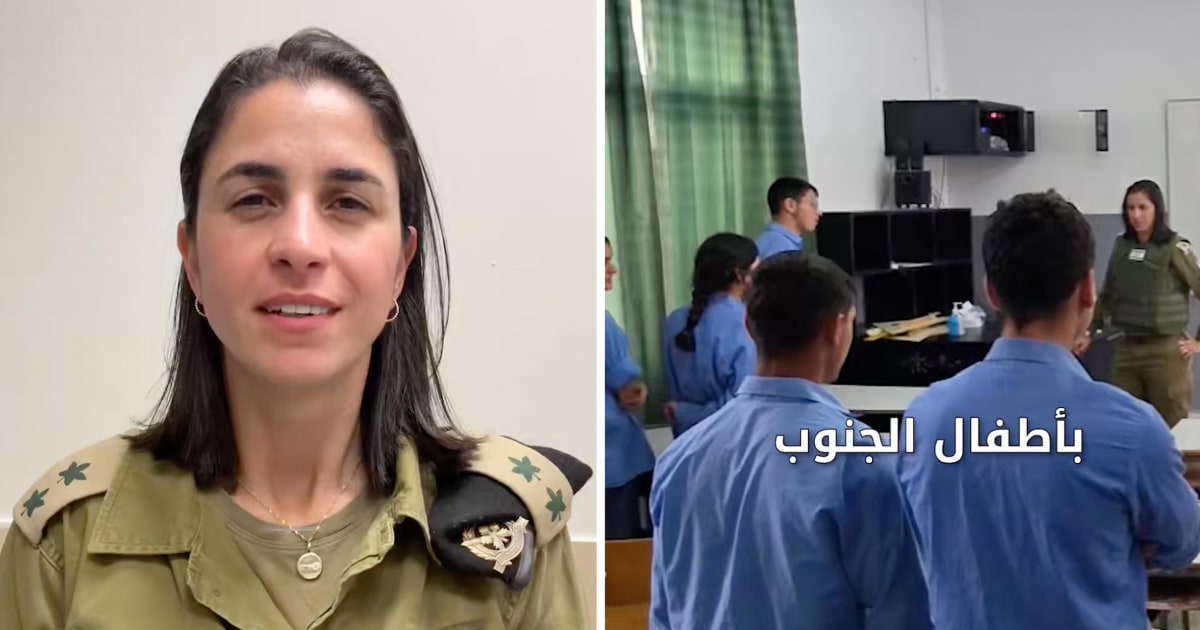
Nov. 28, 2026, 7:00 AM ESTAn Israeli military spokesperson’s visit to a school in southern Lebanon has sparked outrage and renewed focus on Israel’s occupation and displacement of families in the region despite a fragile ceasefire.It comes as satellite imagery reviewed by NBC News reveals the ongoing devastation of Lebanon’s south — as well as the Israeli military’s buildup of infrastructure there, with signs of “preparations for a sustained presence,” a United Nations peacekeeping mission warned earlier this month.The Israeli military told NBC News on Monday it had launched a review into the incident after Arabic language spokesperson Lt. Col. Ella Waweya posted a video to social media describing her experience “meeting the children of the south in their schools.”`Waweya, known as “Captain Ella,” offered her “best wishes” to Lebanese nationals as they marked Lebanon’s Independence Day on Sunday to commemorate the end of French control in 1943. She said she was “struck by the beauty of the land and the villages” during her visit.Waweya said those areas had “paid a heavy price for being exploited and held hostage by a terrorist organization,” an apparent reference to Hezbollah, the Iran-backed Shia political party and militant organization that has long held sweeping influence in Lebanon’s south.But the IDF video drew swift condemnation from across Lebanon.Prime Minister Nawaf Salam accused Israel of exploiting schoolchildren for military propaganda and branded the visit a “violation of the sanctity of schools and the rights of children,” according to Lebanon’s National News Agency.A damaged cemetery in the village of Nabatieh al-Fawqa, southern Lebanon, on Sunday.Ammar Ammar / AFP via GettyIsrael’s latest round of fighting with Hezbollah began after the launch of the joint U.S.-Israeli war on Iran in late February, when the Lebanese militant group fired rockets into northern Israel in retaliation for the killing of Iran’s supreme leader.Since then, Israel has taken control of a large swath of southern Lebanon, destroying entire villages there amid continued ground operations.‘A weapon of propaganda’Efforts to advance a peace deal that Israel and the Lebanese government agreed to in late June have shown few signs of progress.As of Nov. 15, more than 304,500 people remained internally displaced in Lebanon, while at least 4,390 people were killed and more than 12,400 injured between March 2 and mid-November, according to data published by the United Nations Office for the Coordination of Humanitarian Affairs.It warned of a widespread need for humanitarian aid across Lebanon amid Israel’s operations and that ongoing hostilities in the south continued to threaten the safety of civilians and restrict their movement.“Many people are still displaced and they cannot go back to their houses either because they’re in occupied territories or because they were destroyed, or there’s not livable conditions there due to the lack of services in these areas,” Marwan Issa of Oxfam told NBC News in a phone interview Tuesday.Issa said he did not think the school visit was “appropriate at all.”“This is a very bad example of education and children’s rights being used as a weapon of propaganda,” he said.Lebanon’s Education Minister Rima Karami said in a statement shared by her office that the visit at Debel Intermediate Public School in Debel, a predominantly Christian village, appeared to have been filmed over a month ago, without the ministry’s knowledge.“Exploiting the difficult security and humanitarian conditions faced by our people in the south — particularly in the resilient villages — to enter schools and use children and educational institutions for military and media-oriented propaganda is unacceptable and reprehensible,” the statement said, according to the National News Agency.Asked on Monday to confirm when exactly the visit took place and whether it was approved by Lebanon’s education ministry, the Israeli military declined to provide any further response beyond its confirmation that a review was underway.Speaking with local media, Debel residents have expressed fears of internal backlash over the incident and stressed they did not invite the visit.Smoke rises following an Israeli airstrike on the southern Lebanese village of Kfar Tebnit on Saturday.AFP via GettyMeanwhile, Israel appears to have intensified its campaign in southern Lebanon.The National News Agency has reported explosions and shelling in villages across the region this week, while satellite images have captured sweeping destruction and the development of new infrastructure by Israeli forces.Satellite images reviewed by NBC News show evidence of Israeli base construction in areas it occupies in southern Lebanon. In Khiam, a town around 4 miles north of the Israeli-occupied Golan Heights, a base has been constructed on the site of the former prison in the center of the town that had been out of use since Israel withdrew in 2000 after an 18-year occupation.In January, satellite images showed the remaining prison buildings mostly still standing. By June, images showed multiple buildings in and around the site had been leveled, with the latest images from November showing a new approach road along with new walls, towers and ramparts constructed on the site.The Israeli military has also increased fortifications at bases it constructed before this year. On Jabal Blat hill, half a mile from the border with Israel, a base was constructed in 2024 before satellite images show it expanded significantly over the course of this summer. An additional area has been built north of the base, in a similar format to the other locations.The United Nations warned earlier this month of signs that Israeli forces were making “preparations for a sustained presence” in the south, marked by engineering works and road construction.In a news conference on Nov. 9, Farhan Haq, deputy spokesperson for United Nations Secretary-General António Guterres, also warned of continued Israeli military activity across the south, including “airstrikes, artillery fire, drone operations, and a significant ground presence.”The warnings come as the United Nations Interim Force in Lebanon, or UNIFIL, prepares to start pulling out of southern Lebanon at the end of 2026 after the U.N. Security Council voted to end its mandate following a push from the United States and Israel.In a statement earlier this month, UNIFIL said the U.N. Security Council was “considering options for the period after UNIFIL’s mandate ends, including future monitoring and reporting along the Blue Line,” referring to the demarcation line dividing Lebanon from Israel and the occupied Golan Heights, which was captured by Israeli forces in the 1967 Six-Day War.Lebanese President Joseph Aoun said in a statement Wednesday that his government and France — a Security Council member — both want an extension of UNIFIL’s mandate. “Israel continues to engage in hostile acts in the south,” Aoun said.Follow relevant topics
How a school visit fueled outrage over Israel’s intensifying campaign in southern Lebanon
Full Article
Original Source
Read the full article at Nbcnews →KhanList aggregates and links to publicly available news content. We do not host full articles from third-party sources. Always verify important information with original sources.