
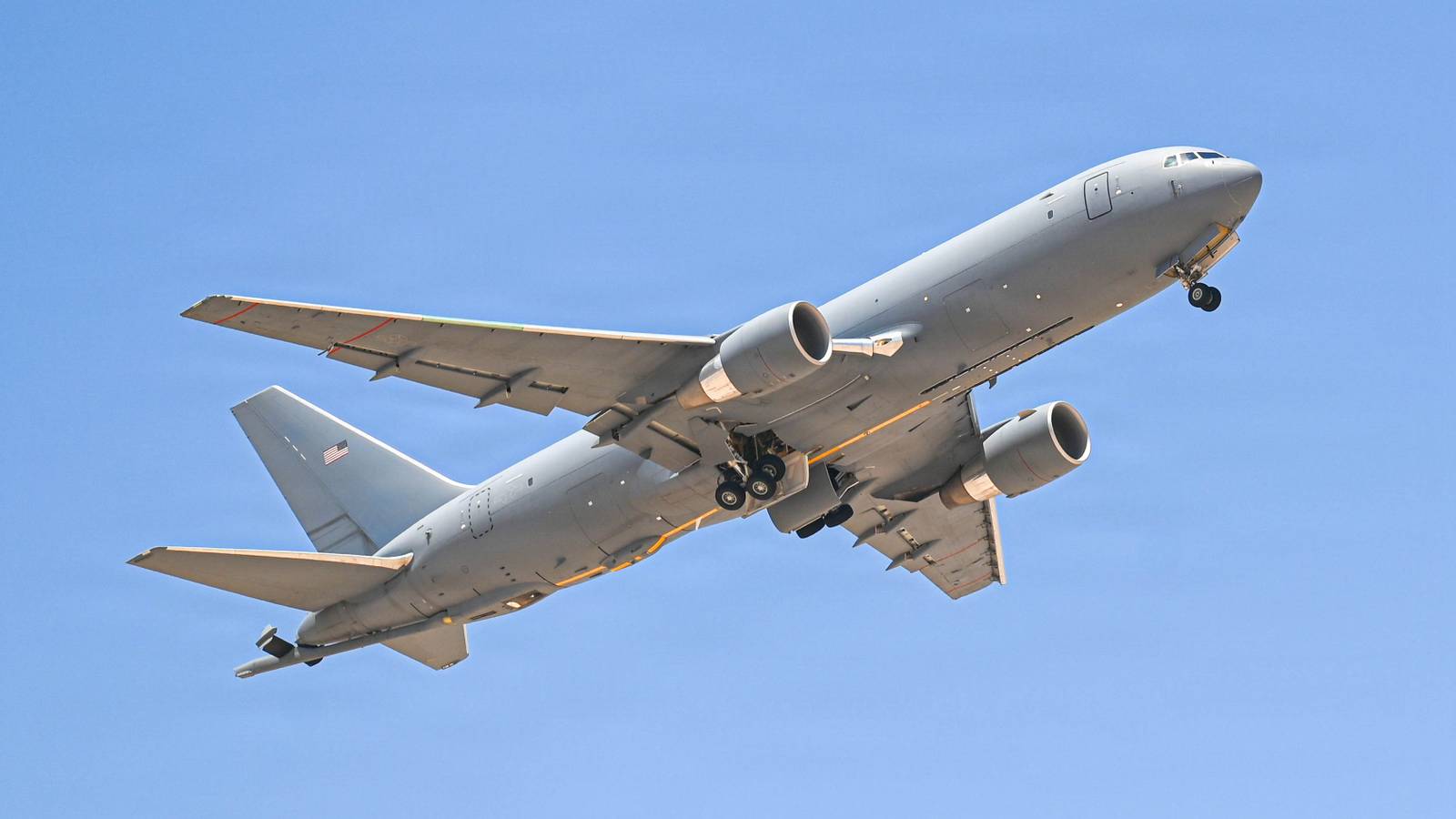
Published Oct 2, 2026, 6:01 PM EDT Aaron is an aviation enthusiast and world traveler with a deep interest in aerospace history and technology. He has traveled around the world numerous times, often incorporating visits to aviation museums and historic aircraft collections into his journeys. A native of New Zealand, he is an expert in aviation and maintains a broad interest in a variety of other subjects. In the event of a full-scale conflict in the Indo-Pacific, the United States Air Force's fleet of tanker aircraft would likely be strained to the limit. Given how many were used in Operation Epic Fury against Iran and the vast distances of the Pacific theater, the US will feel like it doesn't have enough. This effort would likely pull in every available tanker the Air Force has. For the purposes of this article, only large jet-powered tankers like the KC-135 Stratotanker and KC-46 Pegasus will be considered. These aircraft are able to provide flying boom method refueling and are designed to operate across strategic distances. Other aircraft able to provide in-air refueling, like the KC-130, F/A-18 Super Hornet buddy, V-22 Osprey, etc., will be excluded. These are often limited to probe-and-drogue and often refuel helicopters more than fighters and transport aircraft (except for F/A-18s). The Tanker Dominance Of The USAF Credit: DVIDS It is almost difficult to overstate the massive dominance of the United States Air Force when it comes to tanker aircraft. It has a fleet of around 475 tankers. As of September 2026, the statutory minimum remains 466 aircraft. That rises to 478 from October 2026, 490 from October 2027, and 502 from October 2028. The Air Force's FY2027 budget documents indicate roughly 370 KC-135s and 105 KC-46s, putting the nominal fleet at around 475 aircraft, although this does not necessarily mean that all are simultaneously available for operational tasking. Some KC-135s were lost and damaged during Operation Epic Fury, but evidence suggests some damaged aircraft are being repaired, and replacement stored KC-135s are being hauled out of the boneyard to return to service. The US also has a small commercial aerial-refueling sector. Omega Air Refueling Services operates KC-707 and KDC-10 tankers, while Metrea operates additional tanker aircraft. These provide useful additional refueling capacity, particularly for training, testing, and exercises, but should not be treated as equivalent to USAF combat-coded KC-135s and KC-46s. Together, these could contribute another 23 or so tankers. Contractors provide training, test support, qualification, exercise support, and some operational refueling. Much of the tanker efforts will not be in the combat theater. For example, some aircraft will require refueling soon after takeoff from the mainland to begin their flight over the Pacific. Chinese Tankers & Other Countries Credit: DVIDS By contrast, China may have around 50 tanker aircraft, though these are not necessarily direct equivalents to the US's dedicated tankers. China's tankers include around 15 older dedicated tankers based on the H-6 bomber (H-6U and H-6DU variants) and a rapidly expanding fleet of tankers based on the Y-20 strategic transport. These include the Y-20U and YY-20A variants, with an estimated 30 to 40 in service. It also has three legacy ex-Ukrainian Il-78 Ilyushin tankers. Elsewhere in the region, Russia has around 18–20 surviving Il-78 tankers. At least one is believed to have been lost in a Ukrainian attack. They are mostly used to supply Russian strategic bomber patrols and not to refuel fighter jets as the West does. Japan operates a fleet of six newly delivered KC-46A Pegasus tankers as well as four older KC-767J tankers. It has three KC-130H tankers. Select jet-powered tanker fleets Quantity (approx.) Aircraft types United States Air Force 475 KC-135s, KC-46s US-based contractors 23 KC-135s, KC-10s, 767s Japan 10 KC-46s, KC-767Js Australia 7 A330MRTTS South Korea 4 A330MRTTs Singapore 6 A330MRTTs United Kingdom 14 A330MRTTs China 50-60+ Il-76s, H-6s, Y-20s Should Australia enter the fight, it has a fleet of seven Airbus A330MRTTs; these are broadly comparable to the KC-46A Pegasus. Other countries, like the UK, Singapore, New Zealand, Vietnam, South Korea, the Philippines, etc., either don't operate tanker fleets or are too far away or otherwise unlikely to participate directly in a Pacific conflict. The UK could if given time, but it's perhaps unlikely. Additionally, Russia is unlikely to intervene directly. This would give China a fleet of 50-60+ tankers, while the US could leverage around 17 more allied tankers (assuming Japan and Australia participate directly). Not A Fair Fight Credit: DVIDS However, just looking at the number of tankers the US has vis-à-vis China is incredibly misleading. A conflict in the Pacific is not an even or fair fight. Taiwan would likely defend itself while perhaps launching limited missile- and drone-based counterattacks on select Mainland targets. Japan would be focused on area denial. China would be launching a massive effort to project power away from the Mainland, but not very far. Chinese fighters are designed with large internal fuel volumes, and many missions may be possible from dispersed airbases without in-air refueling. China would certainly need large tanker fleets to launch long-range air strikes on more distant targets like Guam or Alaska, but not so much for Taiwan, the South China Sea, and Japan's southern islands. Meanwhile, the US would need to sustain a massive airbridge across the Pacific. This would be far more exhausting than its effort to supply bases in the Middle East with Operation Epic Fury. Forward air bases (e.g., in Okinawa) could quickly become untenable, forcing it to pull fighters back further to bases like Guam's Andersen; these would need in-air refueling to reach the area of operations. Bombers would likely be based in Northern Australia (and other further away bases); sorties from there would require extensive in-air refueling. The Problem With The ACE Doctrine Credit: DVIDS As the US's forward airbases are likely to be vulnerable in the event of a conflict, the US is introducing its Agile Combat Employment (ACE) doctrine to operate from dispersed airfields. To this end, it is rehabilitating numerous airbases, airports, and airstrips across the region at the cost of billions of dollars. But ACE makes tankers more important while also making them harder to use effectively. Air Forces (and airlines) prefer to operate from large logistical bases for efficiency. Operating from dispersed bases makes fighters even more reliant on tankers as the connective tissue. But tankers can't just disperse like fighter jets. These aircraft need long runways, large quantities of aviation fuel, ground support, and more. ACE also increases the distance tankers must fly, forcing them to burn more of the fuel they carry just to rendezvous with the fighters. Unfortunately for the tankers, this makes them one of the most valuable targets. An enemy can effectively counter advanced F-35 fighter jets merely by destroying or otherwise suppressing the tanker fleets that they rely on. No One Has Enough Tankers Credit: DVIDS Historically, in most conflicts, Air Forces have almost always complained about not having enough of almost everything. The military almost universally wishes they had more. In Operation Epic Fury, very quickly there were complaints about not enough Patriot and THAAD interceptor missiles and precision-guided munitions. While the number of tankers was adequate for the job, observers noted wear and tear on the fleet that may reduce readiness going forward. Realistically, in a high-end conflict, the US, Japan, Australia, and China would likely all wish they had more tankers. But they would likely also face constraints on available fighter jets and bombers, available pilots, survivable and useful airfields, precision munitions, and so on. It is important to note that the availability of tankers will likely drop significantly over the first few months in the event of a protracted conflict. The central question, then, is not simply who has more tankers. It would be whether tanker availability becomes a bottleneck that limits the number, distance, or persistence of combat sorties an air force can generate. Very important factors include the scope of the war (e.g., do the US and China agree to operationally limit the geography of the conflict), what allies the US has, the duration of the conflict, and how well the US can protect its forward airbases. The Course Of A Pacific Conflict Is Unknowable Credit: DVIDS While wargames, such as those of the think-tank CSIS, are extremely insightful in understanding how such a scenario might unfold (at least initially) and what areas the US and its allies need to work on to address weaknesses, there is also truth in the maxim, "no plan survives contact with the enemy." The belief that the outcome is foreordained and that the enemy will act and react as expected is, bluntly, a fool's errand. A case can be made that hubris and overconfidence, together with underestimating the enemy, were major factors in Russia's decision to invade Ukraine in 2022, for the US to start Operation Epic Fury in 2026, and, most recently, for Saudi Arabia to sponsor a disastrous campaign against the Houthis in Yemen in the second half of 2026. One common perception is that China is somehow a uniquely rational actor and is above hubris; that is simply wrong. In 2022, most analysts thought Ukraine's air force would not survive more than a few weeks. 4.5 years later, it continues to contest the skies against the on-paper overwhelmingly superior Russian Air Force while rebuilding under sustained pressure as more F-16s, Mirage 2000s, and soon Saab Gripens are delivered. It is reasonable to say that a full-scale conflict in the Indo-Pacific between China and the United States (to which the US fully commits) will pull in almost all its available tanker aircraft. But how such a conflict would unfold and develop cannot be known.
How A Pacific Conflict Would Need Every Tanker The US Air Force Owns
Full Article
Original Source
Read the full article at Simpleflying →KhanList aggregates and links to publicly available news content. We do not host full articles from third-party sources. Always verify important information with original sources.