
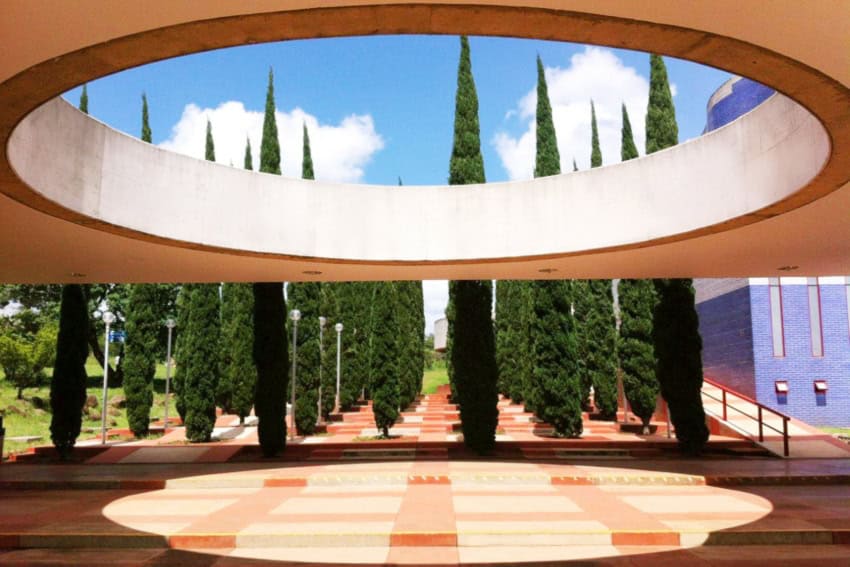
The area known as Los Altos de Jalisco, located in the northeastern part of the state, is renowned as a major tequila-producing region. However, its environment and biodiversity are remarkably complex and unique. While its landscapes are filled with extraordinary colors, the soil is surprisingly red, creating a vibrant contrast with the blue-green agave used to make tequila. These qualities, which shape the region’s unforgettable landscapes, were deeply appreciated by Fernando González Gortázar, one of Mexico’s most recognized architects and sculptors. He was commissioned in the early 1990s to create an architectural complex in Jalisco, a project he would dedicate more than two decades of his professional life to. Today, the site has become a worldwide benchmark for topographic design: Los Altos University Center (CUALTOS). In Fernando González Gortázar’s innovative design, buildings emerge from prickly pear cacti, a ravine and a stream. (Ana Paula de la Torre) Brutalist architecture meets natural beauty When González Gortázar was assigned to design the project, his primary goal was to honor and respect the local topography and landscape. He achieved this by blending his brutalist sculptural style into the terrain’s natural slope. The work was so important to González Gortázar that he devoted more than 23 years of his life to it. “It is undoubtedly my life’s work,” González Gortázar said in 2017. “It reflects who I am.” This architectural complex was designed as the first public university center outside Jalisco’s capital, Guadalajara. Its main objective was to decentralize education while promoting regional development and cultural identity through the strength of local economic activities. Framing nature through architecture: An interview with acclaimed architect Diego Villaseñor Designing an institution becomes a lifelong endeavor The complex consists of eight main buildings, including classrooms, an auditorium, a roundabout, a plaza, laboratories, a library, a computer center and administrative offices, while the layout expands naturally across the local hills and slopes. The construction began with the classrooms, followed by the rector’s office, laboratories and library. González Gortázar conceived the project as a living, lifelong endeavor that would never truly end as long as he was alive. As such, the entire complex gradually took shape. “Each new phase reflected my approach to architecture at that time — who I was,” González Gortázar said prior to his death in 2022. “So, this is not only my work but also my self-portrait.” In his design, native vegetation served as the primary muse. “Here, trees known as varaduces, tepehuajes and mezquites, together with stone benches, oak forests, nopal cacti and agaves, are an intrinsic part of a composition that is both architectural and sculptural,” noted Francisco Sandoval, a sculptor, cultural promoter and coordinator of cultural activities at CUALTOS. The architecture of CUALTOS resembles large, abstract sculptures.(Ana Paula de la Torre) As Sandoval points out, the space feels entirely ceremonial. Its vibrant vegetation attracts a constant presence of birds, creating continuous natural symphonies. Furthermore, when it rains, channels made of local stone form streams whose soothing sound can linger for several days. A living environment Regarding the construction process, Sandoval said that for more than 20 years, González Gortázar visited the site at least twice a year. He treated these visits as workshops that respected the natural evolution of the landscape. “If a new prickly pear grew, it became part of the architectural space,” Sandoval said. “The development of the project constantly adapted to the living environment around it.” Today, the university hosts nearly 5,000 students each year, along with a staff of almost 500 employees. Beyond the vital social and economic role that this gem has played in the region, the complex embodies a design philosophy in which architecture steps back, allowing the natural landscape to take center stage. Ana Paula de la Torre is a Mexican journalist and collaborator for various outlets, including Milenio, Animal Político, Vice, Newsweek en Español, Televisa and Mexico News Daily.
How a Mexican university emerged from Jalisco’s wilderness
Full Article
Original Source
Read the full article at Mexiconewsdaily →KhanList aggregates and links to publicly available news content. We do not host full articles from third-party sources. Always verify important information with original sources.