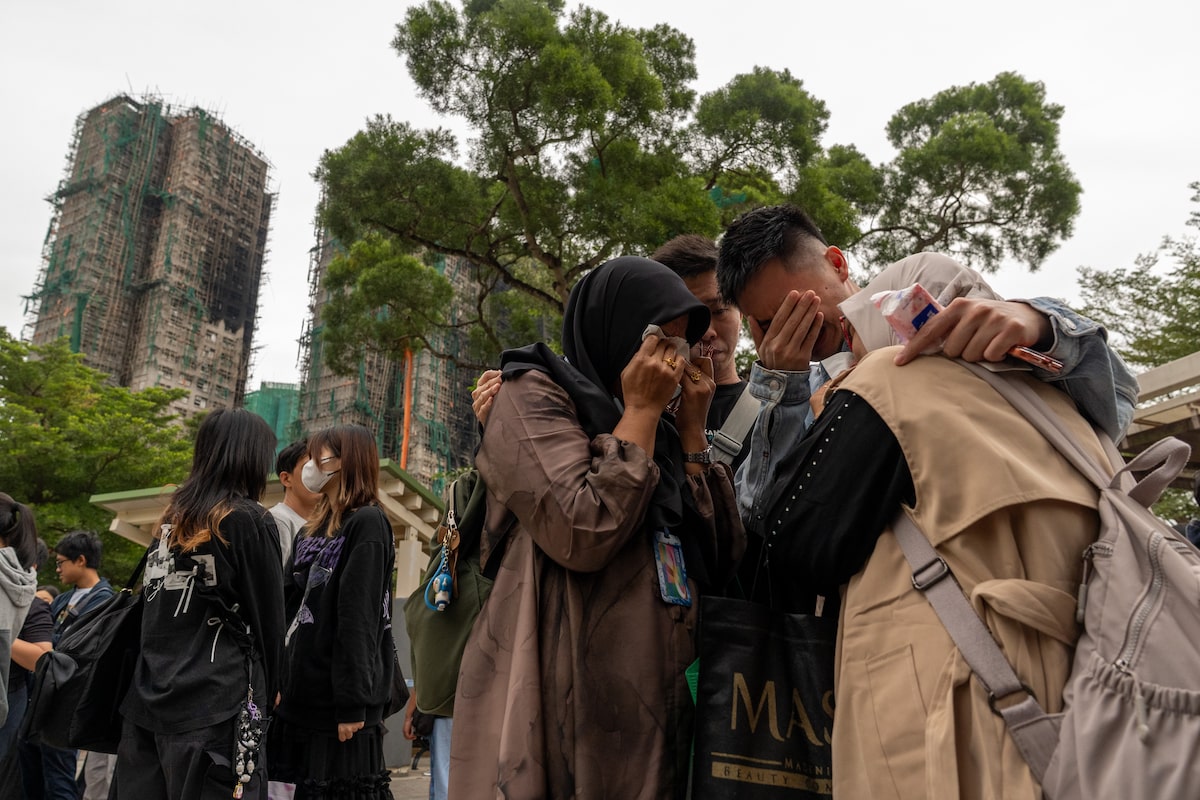
Open this photo in gallery:Mourners embrace at a park near Wang Fuk Court in the aftermath of the fire at the public housing estate, Hong Kong's worst disaster since the Second World War, in November, 2025.Anthony Kwan/Getty ImagesThe first Leung Ho-hin heard about a fire was through WhatsApp. It was 3:10 p.m. on Nov. 26, 2025, and Mr. Leung was in the bedroom of his apartment in Block G of Wang Fuk Court, a public housing estate in northern Hong Kong. The estate had been undergoing renovations for more than a year, with all eight 31-storey buildings wrapped in bamboo scaffolding and green safety nets. Twenty minutes before Mr. Leung received the WhatsApp message, some of the netting on Block F caught on fire, and the blaze was spreading rapidly. The resulting inferno engulfed seven blocks of Wang Fuk Court, burning for more than 43 hours and killing 168 people.Hong Kong’s worst disaster since the Second World War, the fire shook the confidence of the millions who live in similar high-rise buildings, sparking demands for a public inquiry, which is in the process of wrapping up after months of hearings. On Friday, the lead counsel for the inquiry, Victor Dawes, said “the scale of the disaster − the loss of 168 lives and the abrupt destruction of a neighbourhood which thousands called home, where they built families and created memories – remains difficult to comprehend.”It “should never have occurred and should never occur again,” he said.Canadians with roots in Hong Kong devastated after deadly apartment fireOver the past seven months, the inquiry has revealed an almost unbelievable cavalcade of failures leading to the disaster. Netting and polyfoam boards erected by workers were not up to code, allowing the flames to spread rapidly. Fireproof windows had been removed from staircases, causing vital escape routes to fill with smoke. And fire alarms had been deactivated, which meant that by the time many had been alerted of the fire spreading through the buildings at speeds of as much as 10 metres per second, it was already too late. Complaints by residents about the increasingly unsafe environment were repeatedly ignored or passed endlessly from government department to department.“The result of this litany of failures is that every single fire safety measure designed to protect life at Wang Fuk Court … failed to operate as designed during the fire,” Mr. Dawes said. Open this photo in gallery:A man cries as his wife is trapped inside the building still on fire. The estate had been undergoing renovations for more than a year, with all eight 31-storey buildings wrapped in bamboo scaffolding and green safety nets. Concerns about the netting and polyfoam boards were bounced from department to department.Tyrone Siu/ReutersOn June 10, seven people and two companies – Prestige Construction and Engineering and Will Power Architects, which oversaw the renovations at Wang Fuk Court – were charged with dozens of offences, including manslaughter and various corruption offences.Mr. Leung testified that he heard loud noises around 2:50 p.m., soon after the fire broke out. But residents had become used to the clatter of construction, and it was not until a relative messaged him that Mr. Leung realized his neighbouring block was on fire. “I saw through the peephole of my door there was a couple, and they tried moving the fire hose reel and tried to put out the fire themselves, but I didn’t see any water coming out,” he said. Like the alarms, the hoses had been disconnected while water tanks were being renovated. At that point, Mr. Leung began to panic. Rushing to grab some things, he noticed a burning smell, and when he returned to the peephole, the corridor was dark with smoke. Holding a towel to his face, he fled down a fire escape. He was lucky. He lived on the third floor and was able to get out, joining a crowd staring in horror as the inferno grew or shouting into phones to those still inside, urging them to evacuate.One such person was Yip Ka-kui. He lived with his wife, Pak Shui-lin, on the 17th floor of Block E, on the other side of the tower where the fire started. Mr. Yip was napping when his wife woke him to say she smelled something burning. They could see smoke coming from Block F, but no flames, and Mr. Yip went downstairs to investigate. No fire alarm had sounded. From ground level, Mr. Yip could see fire spreading up Block F and burning debris falling to the ground. He began frantically calling his wife. Inside Block E, Ms. Pak had already sprung into action. She began knocking on the doors of their neighbours, many of whom were elderly, warning them to leave. Reaching her again on the phone, Mr. Yip urged Ms. Pak to flee herself. “My wife said it was very dark and she couldn’t see clearly,” he testified. “She told me the fire had spread to our unit. After that, I only heard static.” Ms. Pak’s body was found a week later in their apartment. In his testimony, Mr. Yip said he “firmly believed” she would not have regretted her decision to save others before herself. “As her husband, I am proud of my wife’s noble spirit,” he said. Open this photo in gallery:Yip Ka-kui, pictured after the closing submissions at the hearing of an independent committee on July 17, lost his wife in the Tai Po fire while she was trying to warn elderly residents to leave. Her body was found a week later.May James/The Associated PressLike other residents of Wang Fuk Court, Mr. Yip was not aware of the immense danger they had been placed in. But he was not blind to the risks posed by the renovation project. After a typhoon damaged some of the netting on his building, he complained to Prestige about what he felt was shoddy replacement material. Like many, many other residents, Mr. Yip also raised concerns about workers smoking on the site. Fire investigators believe the blaze started when a cigarette butt fell on cardboard boxes on a platform near the ground floor, where workers were often seen smoking. Such complaints went nowhere. In July, 2024, the Labour Department investigated claims of smoking but found no proof. It referred the matter to the Fire Services Department, which said in an e-mail that “the subject matter is not under the jurisdiction of FSD.” There is now a comprehensive smoking ban on construction sites in Hong Kong. Opinion: If Hong Kong’s heritage is to blame for the Tai Po fire, it wasn’t the bambooConcerns about the netting and polyfoam boards were also bounced from department to department. Regular inspections, including one just days before the fire, failed to find any problems, even as residents provided photos and videos to back up their concerns. Testifying before the inquiry, Rudolf Lau, the head of the Housing Department’s Independent Checking Unit (ICU) at the time, admitted there were “large-scale loopholes” in a system that largely relied on construction firms to self-regulate. In the words of FSD director Andy Yeung, there was a “legal vacuum.”There were also “deeply concerning” signs that Prestige had been tipped off about impending inspections, Mr. Dawes said. “Tomorrow afternoon expect ICU to visit the site,” Prestige director Hau Wa-kin texted employees in October, 2024. “Expect that the net will be burned. Please check in advance which ones are all right.” Open this photo in gallery:A woman fixes a written note outside the Wang Fuk Court in the aftermath of the fire on Nov. 30. While the public inquiry is wrapping up, survivors will likely spend far longer putting their lives back together.PHILIP FONG/AFP/Getty ImagesOn Friday, Mr. Dawes said Prestige and Will Power deserve the “strongest condemnation” for their “sustained course of deception” in cutting corners and lying to regulators.At the same time, he added, “there were ample opportunities for the government to detect and rectify the fire risks at Wang Fuk Court, but none was taken.” Residents who tried to raise the alarm “were failed by the system.” In his own closing submission, Jenkin Suen, a lawyer for the government, blamed the “deceit, inaction and deliberate omission” of the contractors involved for the fire, adding that “the government’s responsibility should not be placed on the same scale as that of the private actors involved.” While the public inquiry is wrapping up, survivors will likely spend far longer putting their lives back together.“I grew up there,” Mr. Leung said of Wang Fuk Court. When he testified in March, it was around the time the renovations were supposed to have been completed. “We would finally be able to see light outside with the scaffolding removed and enjoy life with other residents,” he said. “But now all of our neighbours and friends are scattered everywhere. We won’t be able to live near them again.”
How a Hong Kong fire turned into the city’s deadliest inferno in decades
Full Article
Original Source
Read the full article at Theglobeandmail →KhanList aggregates and links to publicly available news content. We do not host full articles from third-party sources. Always verify important information with original sources.