
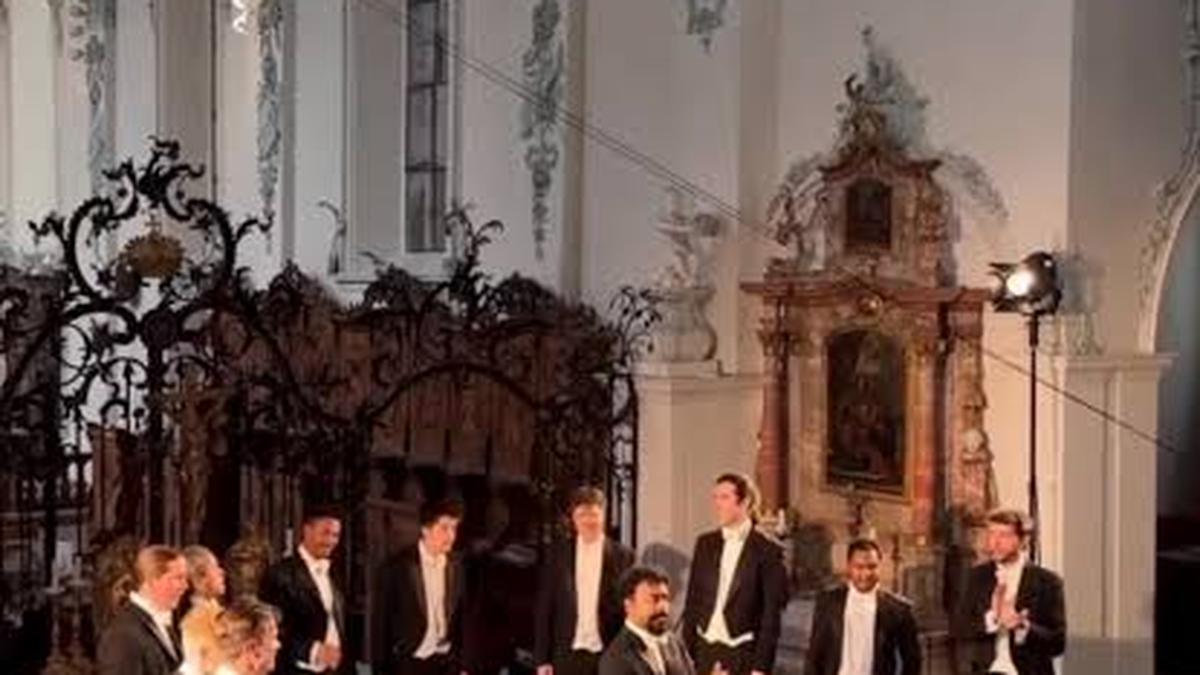
Chanticleer performing at the Stadtkirche St. Martin in Rheinfelden, Switzerland | Photo Credit: Special Arrangement As Vineel Garisa Mahal sings ‘Brahmam Okate’, his voice soars like a phoenix to reach the high note, while the other members of Chanticleer, the San Francisco-based men’s a cappella choir, sing along, clapping their hands in perfect rhythm. Soon, the popular composition by 15th-century saint-poet Annamacharya, who hailed from Tallapaka in Andhra Pradesh, resonates across the globe as it goes viral on the Internet.In a remarkable confluence of cultures, the over 500-year-old song, which celebrates the universality of God, was performed at the stunning, more than 1,000-year-old Stadtkirche St. Martin in Rheinfelden, Switzerland, as part of the 2026 Solsberg Festival.Currently on its Christmas tour, Chanticleer, founded in 1978, has won multiple Grammy Awards and was inducted into the American Classical Music Hall of Fame in 2008. Vineel, a tenor soloist with the group, also arranged the Annamayya keertana.“I did not learn Carnatic music. I actually studied only Western classical music,” says the San Francisco-based singer, while preparing for a show that evening.Vineel’s family hails from Andhra Pradesh. He joined a choir while in school, encouraged by the fact that some of his friends were already members. “I joined to overcome my introverdedness, but I began to love singing.”Vineel’s music-loving mother would often ask him to sing Kishore Kumar’s songs. But, “Frankly, I couldn’t sing them well because, as a Western musician, it was hard to grasp the stylings of Indian vocalism.”Later, Vineel’s grandmother insisted that he learn to sing ‘Aaj jaane ki zid na karo’, a staple at ghazal soirees. “Rather than simply learning to sing it, I transcribed its notes using Western sheet-music notation, with articulation lines and grace notes to capture all the nuances. It helped me understand how music works in this part of the world,” he shares. Vineet Garisa Mahal, Chanticleer’s Indian-American tenor soloist and arranger | Photo Credit: Special Arrangement While pursuing his postgraduate programme in vocal pedagogy at New York University, Vineel auditioned for Chanticleer and became its first Indian member. It was then that he focused on deepening his understanding of Carnatic and Hindustani music, as the ensemble wanted him to curate a programme devoted entirely to Indian music.“We did a concert series called Choodandi, which ended with ‘Brahmam Okate’. I picked up the nuances of the song by listening to Sudha Ragunathan’s recording. The choir members worked really hard to ensure that we presented the piece with due respect to its character. When I explained its essence to the ensemble’s music director, Tim Keeler, he felt the composition was so relevant to the times that we should continue performing it at our other shows too.”So, what began as the finale of Choodandi soon became the closing piece at our performances during the US and Europe tour. In its call for oneness, ‘Brahmam Okate’ has transcended linguistic and musical boundaries. Published - November 29, 2026 03:11 am IST
How a Grammy-winning American choir took Annamacharya’s ‘Brahmam Okate’ to the world
Full Article
Original Source
Read the full article at Thehindu →KhanList aggregates and links to publicly available news content. We do not host full articles from third-party sources. Always verify important information with original sources.