
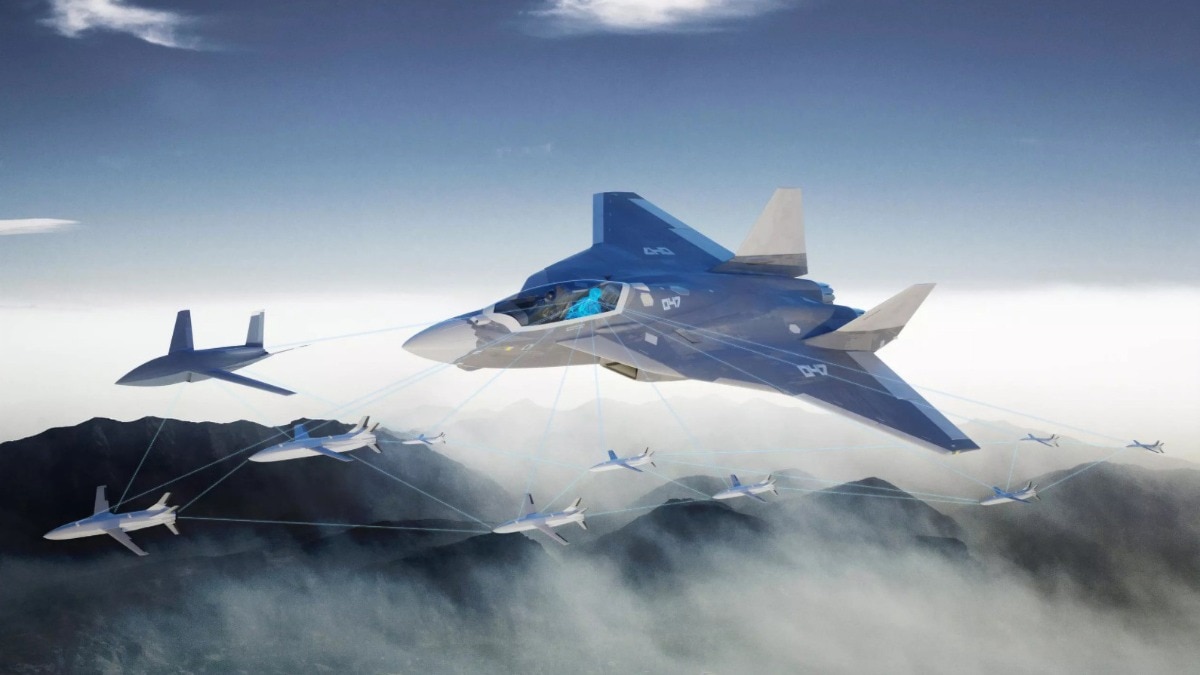
The Future Combat Air System that India is looking to join promises technologies vital for a credible air shield against China and Pakistan in the decades to comeIndia has taken its most consequential step yet towards sixth-generation military air power. The ministry of defence (MoD) has formally begun efforts to join the French-led Future Combat Air System (FCAS), according to an action-taken report tabled in Parliament last week.This is not merely another fighter procurement but marks New Delhi’s clear recognition that the decisive contest in military aviation in the future would be fought over technologies that extend far beyond fifth-generation platforms—combat clouds, manned-unmanned teaming and system-of-systems architectures, all of which would define air superiority for decades to come.The FCAS, spearheaded by France, envisages a “system of systems” centred on a next-generation fighter operating alongside uncrewed remote carriers, all connected through a combat cloud with assets across space, air, land, sea and cyberspace. The networked architecture is designed to enable information dominance, coordinated effects and survivability in highly contested environments.France is seeking partners for FCAS following Germany’s withdrawal from the project, and India’s interest could provide new impetus to a programme that has faced political and industrial complications. For India, participation could be an opportunity to gain exposure to air combat-dominating technologies of the future. This comes amidst an accelerating global race. The United States is advancing its next-generation air dominance platform while China is rapidly progressing its own stealth initiatives, already testing prototypes that hint at the future of air combat. The US is pursuing the Boeing F-47 programme to replace the F-22; China is widely believed to be developing a platform under the PLA Air Force's sixth-generation fighter effort, with two platforms already breaking cover in the past two years. Experts point out that the battlespace is becoming more crowded and contested, and far less predictable.The parliamentary standing committee on defence has already pushed the government in this direction. It called for a clear trajectory for the technical upgrading of existing aircraft to enhance their combat capability while simultaneously scaling up planning for the development and acquisition of sixth-generation aircraft. In its action-taken reply, MoD said it had initiated concerted efforts to “co-join” the FCAS programme.The committee has now sought a detailed status report on India’s participation in FCAS, and the roadmap and tentative timelines for development and acquisition of sixth-generation aircraft. That demand reflects a wider strategic concern: India cannot afford to wait until sixth-generation technology becomes mature before deciding how it wants to participate in it.The urgency is driven largely by China. The Indian Air Force continues to face a substantial fighter-aircraft deficit. It operates roughly 29 fighter squadrons against a sanctioned strength of 42. Its frontline fleet includes around 250-260 Su-30MKIs, 36 Rafales, a growing number of Tejas fighters and older Mirage 2000, MiG-29 and Jaguar jets.Against Pakistan, India retains a significant qualitative advantage. Pakistan operates roughly 20-25 combat squadrons, including JF-17s, F-16s, J-10Cs and legacy Mirage and F-7 aircraft. India’s combination of Rafales, Su-30MKIs, advanced weapons, sensors and networked capabilities gives it an edge.But China presents a fundamentally different challenge. The PLA (People’s Liberation Army) Air Force operates over 1,400 fighters, including large numbers of modern 4-plus and 4.5-generation aircraft. More importantly, China has already fielded a substantial fifth-generation stealth-fighter fleet. Estimates put the number of J-20s in service at around 500, with production reportedly exceeding 100 aircraft annually and projections pointing towards a fleet approaching 1,000 by 2030.India currently has no operational fifth-generation fighter. That gap is precisely why the sixth-generation question cannot be treated as a distant technological ambition. By the time India’s indigenous fifth-generation Advanced Medium Combat Aircraft (AMCA) enters service, China could already be moving from mass deployment of fifth-generation aircraft towards more sophisticated systems built around autonomous platforms, artificial intelligence (AI), advanced sensors and manned-unmanned teaming.The AMCA is moving towards prototype development, with Tata Advanced Systems, Larsen & Toubro and Bharat Forge shortlisted to build five flying prototypes. Infrastructure for integration and flight testing is also being established in Andhra Pradesh. Prototype assembly is expected around 2027, with rollout targeted for 2028 and the first flight expected between 2028 and 2029. If the programme remains broadly on schedule, induction could begin in the mid-2030s.The AMCA is critical for India but not the end of the journey. The real question is whether India begins working on technologies that will follow it before the aircraft even enters service. That is where FCAS could become strategically important. Participation would potentially expose Indian industry and research institutions to next-generation propulsion, stealth, sensors, AI, electronic warfare, combat networking and autonomous systems. It could also help India avoid repeating the long development cycles that have affected previous indigenous aerospace programmes.For India, the objective should therefore be bigger than acquiring a future fighter. It should be about acquiring the technological base needed to build one. A sixth-generation fighter will not simply be a faster or stealthier version of the F-35 or another fifth-generation aircraft. The concept is increasingly centred on the aircraft as the core of a wider combat system.Future fighters are expected to be large, twin-engine, highly survivable platforms capable of penetrating heavily defended airspace and operating at long ranges. Their designs are likely to combine advanced low-observable shaping, radar-absorbent materials, infrared signature management and internal weapons carriage.Next-generation adaptive-cycle engines are expected to provide greater thrust, improved fuel efficiency and significantly more electrical power. That additional power would be critical because future aircraft will be carrying increasingly sophisticated radars, electronic-warfare systems, computing architecture and potentially directed-energy weapons.Range will also be crucial. The ability to operate deep inside contested airspace without depending heavily on external support could become a defining advantage. Yet propulsion and stealth are only part of the transformation. The sixth-generation aircraft is expected to function as a flying sensor and command hub.Advanced AESA (active electronically scanned array) radars, electro-optical and infrared sensors, passive detection systems and electronic-warfare suites will be fused into a single real-time picture of the battlespace. Instead of pilots manually interpreting information from multiple systems, AI will increasingly assist with threat detection, target prioritisation, route planning and engagement decisions.The aircraft could effectively become an airborne supercomputer. AI systems are expected to help generate and manage kill chains, identify emerging threats and recommend responses even when communications with external command networks are disrupted. Software-defined architectures would allow new capabilities to be introduced through rapid upgrades rather than waiting for major hardware modifications.The cockpit itself is likely to change dramatically, with augmented-reality helmet displays, eye tracking, gesture controls and other human-machine interfaces replacing many conventional controls. Pilot biometrics could continuously monitor fatigue, stress, hypoxia and G-force exposure.But the most important transformation may happen outside the cockpit. A sixth-generation fighter is expected to command other aircraft. The concept of manned-unmanned teaming envisions a crewed fighter controlling multiple autonomous “loyal wingmen” or remote carriers. These unmanned systems could perform reconnaissance, electronic warfare, strike, decoy and suppression missions.Instead of sending one expensive fighter into a heavily defended area, commanders could distribute risk across a network of crewed and uncrewed platforms. This fundamentally changes the economics and tactics of air warfare. The crewed fighter becomes the decision-making and command node, while autonomous aircraft extend its reach, increase the number of weapons available and complicate an adversary’s air-defence calculations.Sixth-generation fighters are therefore being designed less as individual aircraft and more as airborne nodes within a larger combat cloud connecting air, space, cyber and electronic warfare domains. Future fighters will require weapons capable of exploiting their extended range and advanced sensing. That means next-generation air-to-air missiles, long-range precision weapons, hypersonic systems and advanced electronic-warfare payloads. High-power electrical architectures could eventually enable directed-energy systems such as combat lasers.The objective will be to detect, decide and engage before an adversary can do the same. That is particularly important in an environment where stealth alone may no longer guarantee survivability. Modern air-defence systems are becoming increasingly sophisticated, while passive sensors, infrared search-and-track systems, electronic warfare and long-range missiles are making the airspace more dangerous even for advanced aircraft. The future fighter jet, therefore, will need to combine stealth with deception, electronic warfare, distributed sensing, autonomous systems and long-range weapons.India’s immediate priority remains closing the gap in fighter numbers and accelerating the induction of Tejas Mk1A, additional Rafales and upgraded Su-30MKIs. But those measures address today’s battlefield. FCAS addresses the battlefield of tomorrow.India is considering additional Rafale acquisitions while the Tejas programme is expanding and the AMCA is slowly moving towards prototypes. These programmes are essential to rebuilding the country’s fighter fleet. Yet none, by themselves, answers the question of what comes after the fifth generation.That is why participation in FCAS could be strategically valuable even if India ultimately decides not to acquire the aircraft in its original configuration. The real prize could be technology, industrial capability and experience. If India can use participation to build expertise in adaptive propulsion, stealth materials, autonomous systems, AI-enabled combat management, electronic warfare, advanced sensors and combat-cloud architecture, it could accelerate the development of its own future air-combat ecosystem.The parliamentary standing committee’s demand for a roadmap and timeline is therefore apt. India needs clarity not only on whether it will participate in FCAS but on what it expects to gain from that participation and how those technologies will feed into its own aerospace programmes.AMCA may give India its long-awaited entry into the fifth-generation era. FCAS could determine whether the country has a credible path into the sixth. Industry experts believe India’s participation could help increase manufacturing volumes and improve cost competitiveness. The country’s involvement goes beyond simply buying advanced fighter aircraft. Participation would allow Indian industry and engineers to become part of an international aerospace network working on future warfare technologies.For New Delhi, the choice is no longer simply about buying or building another fighter. It is about deciding whether India wants to remain a consumer of advanced air power or become one of the countries shaping what air warfare looks like after the fifth generation.Subscribe to India Today Magazine- EndsPublished By: Shyam BalasubramanianPublished On: Aug 11, 2026 20:23 IST
How a France-led plan could set the flight path for IAF's sixth-gen fighters
Full Article
Original Source
Read the full article at Indiatoday →KhanList aggregates and links to publicly available news content. We do not host full articles from third-party sources. Always verify important information with original sources.