
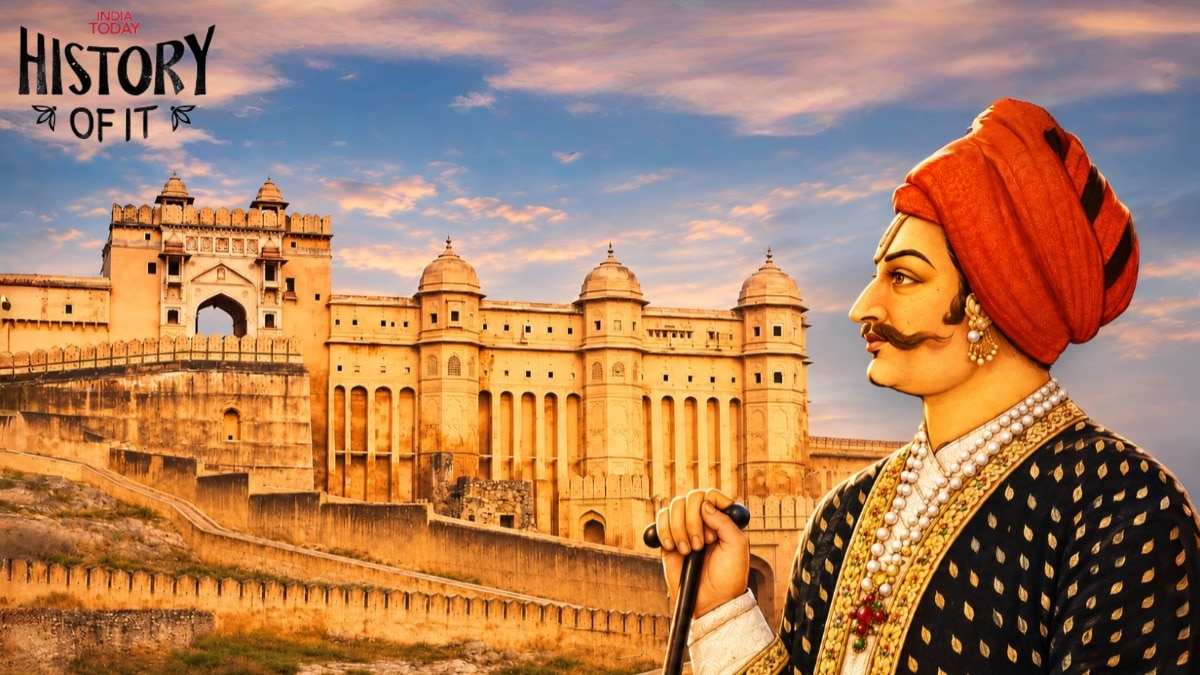
When British military officers visited Jaipur in 1820, they were told an absurd story. It was about the man who had designed the city. They were told that it was an Italian who had travelled to Europe to acquire the scientific and architectural knowledge needed to build the magnificent capital."Yes, a black man can do nothing good," historian Sir Jadunath Sarkar later wrote sarcastically in his book 'A History of Jaipur', dismissing the story and challenging the colonial belief that such a well-planned city could not have been designed by an Indian. Sarkar instead identified Jaipur's "true designer" as Vidyadhar Bhattacharya, a Bengali Brahmin who served Maharaja Sawai Jai Singh II of Amber, the founder of the 18th-century city.Bhattacharya, who later rose to the position of 'Desh Diwan' (State Minister), helped transform a sandy plain surrounded by the Aravallis to establish the planned capital of the Kachhwaha Rajput kingdom of Amber in 1727. The planning was so tightly regulated that a royal letter in 1729 instructed a merchant building his house in the new capital to follow Bhattacharya's directions. To attract merchants, the king offered tax breaks and even stood as a guarantor. With no perennial river flowing through the city, its founders had to arrange for water and devise ways to store it. How was that done?And Jaipur's famous pink colour, often attributed to a British royal visit in 1876, may have been part of the city's identity long before that. Jaipur completed 299 years on Wednesday (November 18), marking the anniversary of its formal foundation in 1727. The city, now the capital of Rajasthan has entered its 300th year ahead of its tricentennial in 2027. Over the centuries, Jaipur grew from the capital of the princely state of Amber into the capital of Rajasthan in 1949, following Independence. Its historic walled city was recognised as a UNESCO World Heritage Site in 2019, for its distinctive urban planning, architecture and trading traditions.Social media is flooded with tributes to Jaipur's timeless glory, royal heritage and vibrant traditions. Rajasthan Tourism described it as a city where every street has a story. Rajasthan Deputy Chief Minister Diya Kumari, a member of Jaipur's erstwhile royal family, also extended her greetings and shared a Reel as tribute to the city as it entered its 300th year of foundation.Here's the story of Jaipur's origins, and how a Bengali Brahmin, an ambitious Rajput king, and an army of engineers and workers helped turn a sandy, rocky stretch of the Aravallis into a planned capital. We will have a look at centuries-old royal orders, records of rewards given to the city's builders, and an unusual gift Vidyadhar received shortly before his death. Equally intriguing is how Jaipur became the Pink City.WHY DID RAJA JAI SINGH OF AMBER WANT TO CHANGE HIS CAPITAL? Before Jaipur was founded in 1727, the Kachhwaha Rajputs ruled from Amber, a fortified town nestled in the Aravalli hills, around eight kilometres north of the site chosen for the new capital. Amber had been their capital for nearly six centuries. Its rulers had partnered with the Mughal emperors and served as brave generals, governors and allies for generations.But by the time Sawai Jai Singh II inherited Amber's throne in 1699, the relationship became troubled.After Aurangzeb's death in 1707, Jai Singh backed Prince Azam Shah in the Mughal succession struggle. Azam lost the succession battle to his brother, with the latter being crowned as Emperor Bahadur Shah I. According to historians Vibhuti Sachdev and Giles Tillotson's book, 'Building Jaipur', the victorious Shah punished Jai Singh for backing his rival. He sent Mughal troops to occupy Amber and temporarily stripped Jai Singh of his position, and installed his younger brother to the throne. Later in 1708, with assistance from the Rajput rulers of Jodhpur and Udaipur, Jai Singh regained his control.All this unfolded amid the decline of Mughal authority following the death of Aurangzeb. Regional powers were increasingly asserting their independence. Ground was prepared for new regional urban centres like Lucknow, Hyderabad and Murshidabad to come up. The Mughals could no longer remain the patrons of art, business, and trade.Historians Vibhuti Sachdev and Giles Tillotson wrote that Jai Singh sought to "assert himself and his kingdom as an alternative power base" amid Mughal decline. The new capital, they argued, was part of his effort to establish "Kachchwaha pre-eminence" over rival powers, including other Rajput courts.There was another, and a more practical and geographical problem. Amber, situated atop a hill, was becoming too small. The capital on the steep Aravalis hills had once made the city easy to defend. But the same terrain restricted its expansion. Its streets were narrow, its residential areas congested, and there was limited room for the commercial centre Jai Singh wanted to develop. Amber Fort, the seat of Jaipur's former capital, sits amid the Aravalli hills, whose terrain restricted the old city's expansion. The satellite view shows how modern Jaipur has spread across the plains to the south, with sprawling suburbs and its airport visible. (Images: AI-generated, Google Maps) The open plain to the south of the hill offered a solution. The plain was also bounded by hills to the north-west and east, which gave the proposed capital some degree of natural protection. A continuous stretch of hills linked the proposed site of Jaipur to Amber and adjoining Jaigarh Fort, which allowed the royal family to retreat to the safety of the old fortified capital if the new city came under attack.The plain also had important trading routes in close proximity. One road linked Amber with Sanganer, an established commercial town. Another connected the Mughal centres of Agra, Ajmer and Delhi.The new proposed city could therefore benefit from trade without surrendering all the defensive advantages of the old capital. This was a fundamental change in the idea of what a Rajput capital should be. Instead of remaining confined within a mountain stronghold, Jai Singh wanted an accessible city that could accommodate merchants, artisans, bankers and a growing royal administration.According to Vibhuti Sachdev and Giles Tillotson, the site had previously been used as a hunting ground. Jai Singh had established a pleasure garden and hunting lodge there in 1713, known as Jai Niwas, adjacent to a small lake called Tal Katora.The place was not entirely empty when Jaipur's construction began. Nor was it a perfectly flat stretch of land. A long ridge crossed the plain, while an existing road network, hills and water bodies presented constraints for its planners. Going forward, all these features would influence the city's eventual layout that Vidyadhar Bhattacharya would draw. A view of Jaipur's historic Jai Niwas garden, near Tal Katora, and the lake surrounded by the densely built-up old city. (Images: Google Maps) HOW JAI SINGH LAID THE FOUNDATIONS OF JAIPUROf course, the new capital of the Rajput kingdom did not appear overnight.In his 1984 book 'A History of Jaipur', historian Sir Jadunath Sarkar recorded that after capturing the Jat stronghold of Thun, (earlier part of Rajasthan's Bharatpur district and now in Deeg district), in November 1722, Jai Singh spent the following years in Delhi and Mathura, undertaking pilgrimages and pursuing his interests in religion and astronomy.In 1725, Jai Singh was busy constructing the Jantar Mantar astronomical observatory in Delhi, south of Shahjahanabad, the Mughal capital. He also issued instructions to his officers in Amber to begin building Jai Niwas on the plain below the old capital.Sarkar dated the laying of the foundations of the palace and garden to 1725. In November 1727, according to Sarkar, construction of Jaipur and its surrounding walls and gates began with religious ceremonies. The priest who conducted the rituals received eight bighas of rent-free land.Jai Singh's vision for the new capital finds mention in Bhojnasar, a poem written in 1739 by Girdhari, a poet at his court, just 12 years after Jaipur was founded. It recorded Jai Singh instructing Vidyadhar Bhattacharya to establish the city, according to historian and Sanskrit scholar Parashuram Krishna Gode's 1946 research paper."Ath Sawaai Jaipur basaayo taakau varnan, puraakare bahu harsh kari manmahimod badhaaye, Vidyaadhar sau boli kahi saharsu ek basaaye," the poem reads, meaning, "Sawai laid the foundation of Jaipur, he laid out many streets, and thus enhanced the joy of heart. He said to Vidyadhara that a city should be founded here."The poem also recorded the ruler telling Vidyadhar to use the resources necessary for the undertaking."I [Jai Singh] have got immense treasure. Take what you [Vidyadhar] want and use it. Sawai Jaipur should be made a unique city". Maharaja Sawai Jai Singh II, the ruler of Jaipur, built the Jantar Mantar observatories in Delhi (left) and Jaipur in the 18th century to study celestial movements and improve astronomical calculations. HOW JAIPUR WAS BUILT INTO A TRADING CAPITALMore than a royal palace, Jai Singh wanted a commercial capital that would attract wealthy traders and develop a reputation for security amid the political instability of the period. Letters were sent to merchants offering land and concessions to encourage them to settle there. Jain merchants were particularly encouraged, helping establish Jaipur as a centre for banking, jewellery and high-value trade.Nobles also had to establish residences in Jaipur. The kingdom built houses for them and recovered the cost through deductions from their incomes. Also, the new city was divided by broad, straight roads into large wards known as chowkris. Smaller streets subdivided these into residential and commercial neighbourhoods.At the centre stood the royal palace complex. Its location was influenced by the existing Jai Niwas garden and the principles of traditional Indian architectural planning, known as vastu vidya. Sir Jadunath Sarkar wrote that "plans were drawn up by a Bengal brahman named Vidyadhar Bhattacharya", who was "deeply read in the ancient Sanskrit books on architecture and town-building (silpa sutra)".The principal streets were lined with shops built according to uniform designs. Their facades, building heights and verandas were regulated to create a consistent appearance.These bazaars were not merely markets and were meant to serve as an essential part of the economic and ceremonial life of the city.A remarkable feature was the continuous verandah running along the shopfronts, which to this day, provides shelter for shoppers. Upper terraces also allowed people to watch religious and royal processions. The main streets were unusually wide for the period.Writing about Jaipur, the Jesuit geographer Joseph Tiefenthaler admired its straight, spacious streets, which contrasted sharply with the narrow lanes of older Indian cities.The city's construction proceeded rapidly. According to Sachdev and Tillotson, the principal wards had been laid out by 1734, within seven years of the foundation ceremony. In 1733, Mughal Emperor Muhammad Shah had formally recognised Jaipur as the state's capital. An 1884-85 survey map of Jaipur and its surroundings, including Amber, shows the city's planned layout, major buildings and monuments in remarkable detail. (Credit: Rajputana Topographical Survey, 1886/ Google Arts & Culture) HOW JAIPUR, WITHOUT A PERENNIAL RIVER, SORTED ITS WATER NEEDSJaipur's founders faced a major challenge. The new capital had no perennial river flowing through it, and rainfall was largely confined to the monsoon months. Without a reliable water supply, its grand plans would mean little. Water management, therefore, began even before Jaipur's formal foundation in 1727.According to Sarkar, an official named Anandram submitted a survey, identifying the Jhotwara river, around 6.5 km north-west of the proposed city, as a possible water source. Other sources, including the Bandi river, were also considered. However, the Jhotwara was preferred because it was shorter and more practical.Water was brought towards the new capital through canals and a nallah system. The engineers had to negotiate uneven terrain, sandy stretches and differences in elevation to maintain the flow. But bringing water to Jaipur was only half the challenge. It also had to be stored and distributed. The water-management network also connected its central reservoirs to the older Man Sagar Lake, now famous for Jal Mahal.Tal Katora, a reservoir near the royal palace, became an important part of the arrangement. Water was lifted towards Badal Mahal and channelled into palace buildings and gardens.Another reservoir, Rajamal-ka-Talab, supplied other parts of Jaipur. Underground conduits carried water towards the city's central squares, Badi Chaupar and Chhoti Chaupar, where storage tanks called kunds were connected to wells and step wells in adjoining neighbourhoods.The system was expanded over time. In 1735, Vidyadhar received a royal reward for work associated with bringing water from the Dravyavati river system towards Jaipur. These canals, reservoirs and underground channels helped sustain Jaipur for generations before piped water supply began replacing parts of the older network in the 19th century. Jal Mahal, the 18th-century water palace associated with Sawai Jai Singh II, stands in the middle of Man Sagar Lake, a reservoir created by damming a seasonal watercourse near Jaipur. (Image A Savin/ Wiki) THE BENGALI BRAHMIN WHO HELPED BUILD JAIPURAmong those who helped build Jaipur was Vidyadhar Bhattacharya. According to historians Vibhuti Sachdev and Giles Tillotson, his ancestor Ratnagarbha Sarvabhauma Bhattacharya had come to Amber in connection with the goddess Shila Devi.Vidyadhar became one of Sawai Jai Singh's trusted officials. Historian Sarkar, credited him with designing the city. Sarkar identified him as Jaipur's "true designer".However, historians Vibhuti Sachdev and Giles Tillotson have debated Vidyadhar's role as the city's main architect. "Clearly, Vidyadhar was closely involved in supervising the construction of the city," they wrote, but maintained that "he was involved as an official of the patron, not as the designer.""The real architects and planners of this remarkable city remain sadly unknown, as their names were probably never recorded," they concluded.However, surviving royal records also highlight and leave little doubt about Vidyadhar's authority in overseeing Jaipur's construction."Tune Vidyadhar kahe tin mafiq kijo", the instructions read, meaning, "You act as per the instructions of Vidyadhar," noted a Rajasthan State Archives document.He was also rewarded by the king. Jadunath Sarkar recorded that Vidyadhar was rewarded in 1734 for the speedy construction of a seven-storeyed palace and again in 1735 for bringing water from the Dravyavati river system towards Jaipur. Records also associate him with work at Jaigarh Fort. But his most unusual reward came towards the end of his life.In 1751, Vidyadhar received an elephant as a royal gift. However, he was already bedridden and died months later. His son Murlidhar subsequently became Desh Diwan. Vidyadhar's legacy survives in Jaipur's historic Vidyadhar-ka-Bagh. The ASI says, Vidyadhar-ka-Bagh is a garden associated with Pandit Vidyadhar, whom it identifies as the "Chief Architect of the Walled City of Jaipur", and notes its fountains, marble-lined pond and imperial-style structures. HOW JAIPUR BECAME THE PINK CITYThe best-known story about Jaipur's pink colour takes us to 1876. That year, Albert Edward, the Prince of Wales and future King Edward VII, visited Jaipur during his tour of India. According to the popular account, Maharaja Sawai Ram Singh II had the city painted pink to welcome British royal visitors.But there's a problem with the chronology. Historical evidence suggests that Jaipur's buildings were already terracotta or reddish-pink long before 1876. Sachdev and Tillotson challenged the idea that the city's characteristic colour was introduced ahead of the British guests' visit.According to them, paintings from the mid-18th century show terracotta-coloured buildings around the city's Chaugan ground. They also cited historical maps preserved in the City Palace collection, in which the walls of Jaipur are marked in terracotta. The colour, they argued, belonged to the city's original architectural conception.There's also a practical explanation. Jaipur was built rapidly, and constructing its principal buildings entirely from dressed sandstone would have been expensive and time-consuming. Much of the masonry consisted of rubble made from locally available quartzite quarried from the surrounding hills. This rubble required plastering and painting to create a finished appearance. The builders used a reddish-earth wash known as 'geru'. Jaipur district has at least 84 protected heritage monuments and sites, including nine listed by the Archaeological Survey of India (ASI) and 75 under the Rajasthan government's protection, according to compilations of official monument registers. The wash was meant to imitate the red sandstone used in the grand Mughal monuments of Agra, Delhi and Fatehpur Sikri. For Jai Singh, perhaps, to establish his capital as a rival centre of political and cultural power, the resemblance was important. Sachdev and Tillotson wrote, "The point of the pink is to look imperial".They also recorded an episode in 1868, eight years before the Prince of Wales visited the city. Ram Singh II experimented with painting different streets in different colours. The experiment was abandoned, and according to the historians, the pink wash was restored in 1870.Now, nearly three centuries later, Jaipur is a testament to the vision of its founder, the brain of Vidyadhar Bhattacharya and the hands of thousands of artisans. They turned an uneven plain into a booming capital for ages. The planned streets, ingenious water system and pink facades have a richer story than the one British officers were told in 1820. The Italian architect of the story might never have existed, but the city he was falsely credited with building certainly does.- Ends
How a Bengali Brahmin helped river-less Jaipur rise from sand. How it turned pink
Full Article
Original Source
Read the full article at Indiatoday →KhanList aggregates and links to publicly available news content. We do not host full articles from third-party sources. Always verify important information with original sources.