
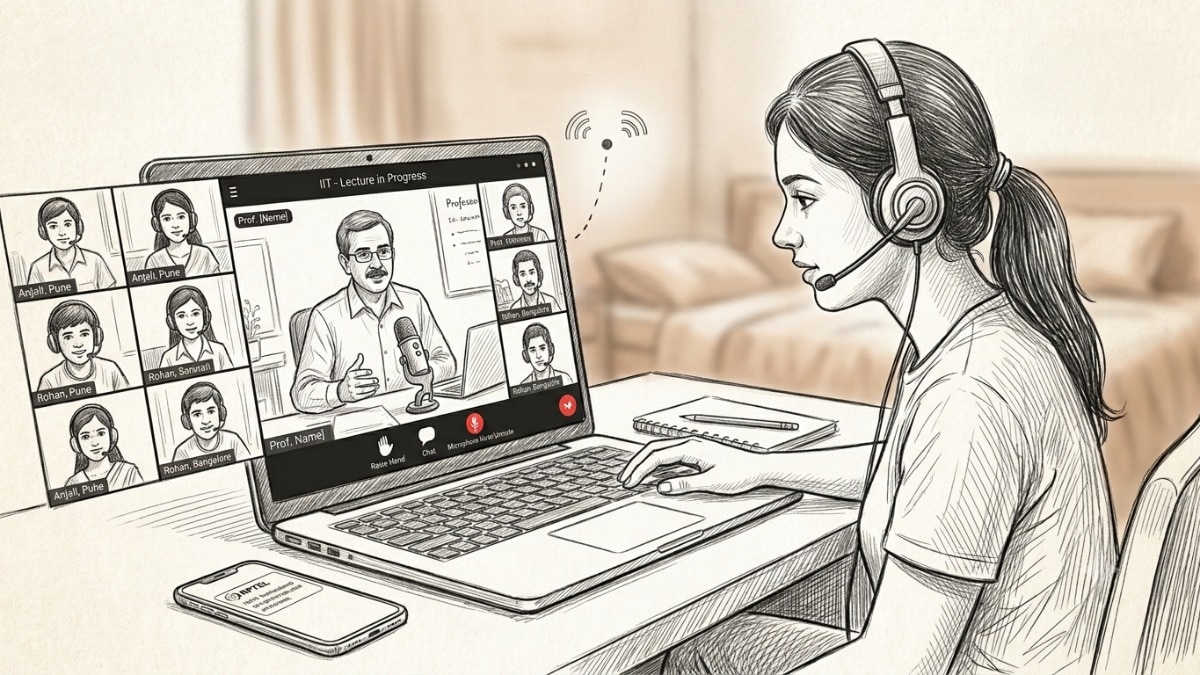
NPTEL began as an IIT-led effort in the early 2000s to take quality technical education beyond campus walls. Years before the global MOOC boom, IIT faculty were recording and broadcasting lectures. Today, NPTEL offers thousands of free courses, giving millions access to elite academic resources.How NPTEL turned IIT classrooms into a free digital library (AI generated image)“It has become fashionable these days to abuse IITs and their faculties.”That is how an X user began a post highlighting what they described as the IITs’ often-overlooked contribution to online education. The post argued that while criticism of the institutions is fair, their efforts to make high-quality academic content freely accessible deserve greater attention.The user pointed to the National Programme on Technology Enhanced Learning (NPTEL), a government-funded initiative involving the IITs and the Indian Institute of Science (IISc), which has built a vast digital repository of engineering and science courses.But the story of NPTEL began long before the current online-learning boom. X user Parimal's tweet THE IDEA TOOK SHAPE IN THE EARLY 2000sAccording to NPTEL, the programme was conceptualised in 2001 following discussions among the IITs, IISc, IIMs, the Ministry of Human Resource Development and Carnegie Mellon University.The initiative was designed to make high-quality learning resources available to students beyond the IIT system. NPTEL was subsequently launched in 2003 as a joint initiative of seven IITs and IISc, with funding from the Ministry of Education, according to the Ministry of Education.EKLAVYA BROUGHT IIT CLASSROOMS TO HOMESEven before NPTEL's formal rollout, efforts were underway to use technology to take lessons from IIT classrooms to learners across India.The Ministry of Education reported that the Eklavya Technology Channel was launched on January 26, 2003, under the coordination of IIT Delhi, with support from IGNOU.The channel was designed to broadcast technical education programmes, including lectures and courses produced by IIT faculty, through satellite transmission, as reported by the Ministry of Education.The initiative reflected an early attempt to take India's premier technical education beyond physical campuses.THIS WAS BEFORE THE MOOC BOOMThe term “MOOC” was coined in 2008, while platforms such as Coursera and edX emerged in 2012. NPTEL had already begun developing and recording engineering and science lectures years earlier.NPTEL's origins therefore predate the global MOOC boom, although its formal online certification programme came later. According to NPTEL, its open online courses and certification exams began in 2014.NPTEL HAS GROWN INTO A MASSIVE DIGITAL CLASSROOMToday, NPTEL offers thousands of courses across engineering, science, and several other disciplines.The official NPTEL YouTube Channel (nptelhrd) has over 819 million total views and more than 2.24 million subscribers.NPTEL also reports that its repository contains more than 54,000 to 56,000 hours of video content. The courses cover subjects ranging from thermodynamics and signal processing to soil mechanics and quantum mechanics, giving learners outside the IIT system access to lectures by faculty from leading institutions.LEARNING WITHOUT AN IIT SEATOne of the central ideas behind NPTEL is that students do not need to be enrolled at an IIT to access its educational material. According to NPTEL, its course content is available free of charge, while students can opt for certification through a paid, proctored examination.The programme has also expanded through NPTEL Local Chapters across colleges in India, further widening access to its courses. For a student who may never enter an IIT classroom, the platform offers another way to learn from the same academic ecosystem.A STORY BEYOND THE IIT DEBATEThe X user's post raises a larger question about how India's public institutions are perceived.Criticism of IITs and their faculty is part of a healthy debate around elite educational institutions. But the history of NPTEL shows another side of the story, an effort that began more than two decades ago to make specialised academic knowledge available beyond the walls of India's premier institutes.From satellite television and recorded lectures to online courses, YouTube and certification programmes, the initiative has continued to evolve with technology.The question, therefore, may not simply be whether IITs deserve criticism. It is also whether enough attention is being paid to the educational resources these institutions have made available to millions of learners beyond their campuses.- EndsPublished By: Karan YadavPublished On: Sep 7, 2026 17:48 IST
How a 2003 IIT experiment became NPTEL with 819 million YouTube views
Full Article
Original Source
Read the full article at Indiatoday →KhanList aggregates and links to publicly available news content. We do not host full articles from third-party sources. Always verify important information with original sources.