
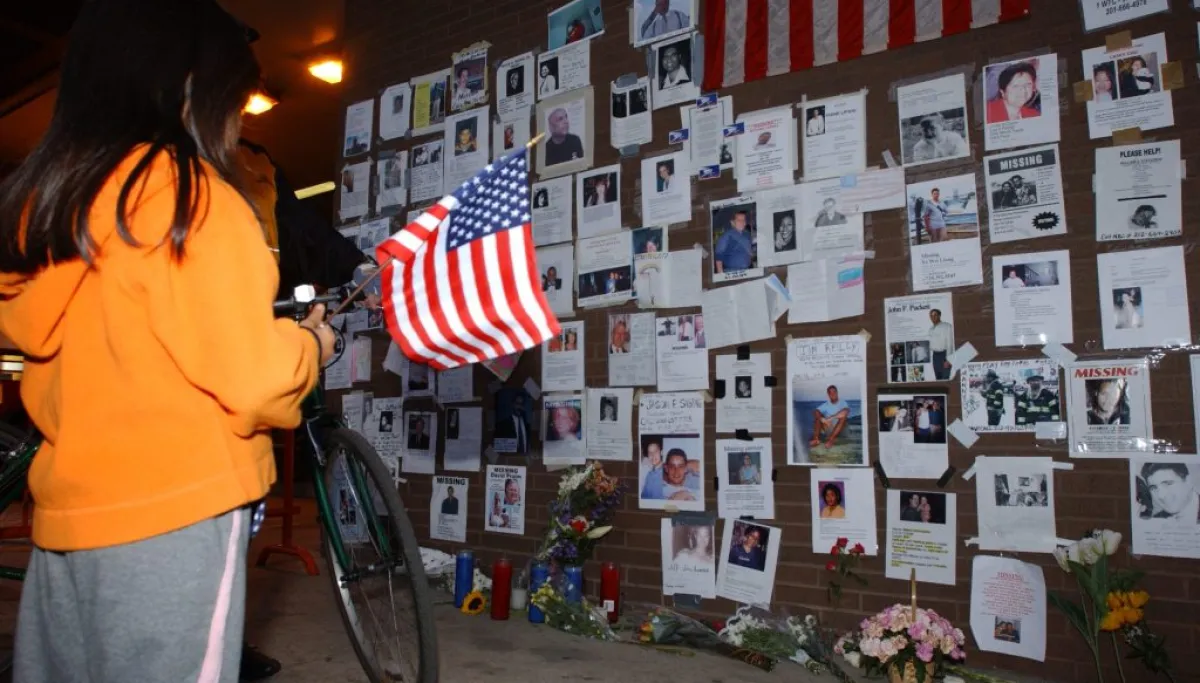
An entire generation of Americans has grown up taking off their shoes at airport security, walking past concrete barriers outside government buildings, and living with a vast national security and surveillance apparatus built to prevent another terrorist attack.Twenty-five years after the Sept. 11, 2001, terrorist attacks, Generation Z has little to no memory of the country before the government’s approach to national security transformed and the national surveillance apparatus expanded. Born between 1997 and 2012, many Gen Zers are now in adulthood, living in an America shaped by the effects of 9/11. Cross Ritchey, now 25 and the national committeeman for the Maryland Young Republicans, was 6 months old when the attacks happened.“We’ve never known anything else,” Ritchey said. “We don’t know a world without 9/11.”Patrick Burke, the first Metropolitan Police Department chief of the Homeland Security Bureau in the District of Columbia, remembers seeing the transition in real time. He watched the second plane strike the World Trade Center from the fifth floor of MPD headquarters and was a part of the whirlwind effort to preempt another attack.Unlike Burke, Ritchey and other younger Americans now judge institutions created in fear and uncertainty after 9/11 without necessarily sharing the experience that justified their creation. Gen Z came of age questioning government surveillance, police power, and military intervention while carrying smartphones that gave them unprecedented access to information about those institutions.For Burke’s generation, the expansion of government power that followed was inseparable from the fear of another attack. Ritchey’s generation inherited the power without the memory of the fear that produced it.Watching a new security system take shape During the attacks, Burke was a lieutenant with MPD assigned to operations command on 9/11, preparing for anticipated World Trade Organization protests when the plane first struck the World Trade Center. He said he remembers precisely why the United States’s sprawling security apparatus was built.After reality struck that a foreign terrorist organization had organized a large-scale attack on Americans, came the task of preparing for the possibility that it could happen again.Burke helped plan evacuation routes out of Washington, including working with transportation officials on how traffic signals could be adjusted to move people out of the city faster.What began as an emergency response eventually became a broader restructuring of how the country approached national security, at a cost many Americans were willing to bear.“When something of that magnitude happens … people are willing to give up civil liberties in the name of safety,” Burke said. “I think generally people trust the government not to abuse those civil liberties.”Congress created the DHS in 2002, bringing nearly two dozen federal agencies and offices under one department. The TSA had been created the previous year, while the USA Patriot Act expanded federal counterterrorism surveillance authorities. The 2004 Intelligence Reform and Terrorism Prevention Act later established the Office of the Director of National Intelligence and further reorganized the intelligence community.While those institutions and reforms happened in the months and years following the attack, Burke said the immediate response was enhancing information sharing to get all departments on the same page, which was later solidified by the DHS and the ODNI.“I think there was a lot of coordination with the FBI and our federal counterparts right after to make sure you know we’ve got intelligence on any potential attacks happening right away,” Burke said. “When DHS was created, you can think about all the changes that happened from the creation of the director of national intelligence to fusion centers … and cooperation with Joint Terrorism Task Force and different efforts, significant efforts to ensure that state, local, federal, and tribal officials are sharing information as a two-way street.”While in the immediate years after the attacks, Americans accepted infrastructure put in place, giving up certain rights, such as privacy, is not something that will always be accepted.“The pendulum swings back and forth,” Burke said.Growing up in an internet-dominant post-9/11 world means questioning ‘everything’ Ritchey’s earliest memories of 9/11 are not of the attacks but of adults teaching him about them.He remembers elementary school teachers reading books about 9/11 and repeatedly returning to the subject as each anniversary approached. At home, he asked his mother what she remembered, to which she explained she had been sitting in their living room holding him as the attacks unfolded.“It hits them differently than it hits me, hits [my] generation,” Ritchey said of hearing his family’s stories of the day. “It’s very much different from someone who lived it, from someone who was born and just heard stories.”Sixty percent of Americans ages 18-24 first learned about 9/11 in school, according to a Pew Research survey released ahead of the 25th anniversary. One in 10 U.S. adults was not yet born when the attacks occurred.Burke said he had a different perspective on his own children, three of whom were 6 or younger during 9/11, and his fourth child was not yet born.“They’ve kind of grown up in that post-9/11 era,” Burke said. “They’ve, I think, been exposed to a lot more surveillance.”He pointed to facial recognition used by the TSA, databases, and the growing use of technology in security.“When you think about civil liberties versus safety,” Burke said, “I think a lot of young people don’t realize that a lot of civil liberties have been forfeited in the name of security.”Ritchey, who has a master’s degree in national security, said his generation is trained to “question everything” and rejected the idea that Gen Z is “anti-security,” arguing instead that young Americans want to know what institutions are doing with the powers they possess.25 YEARS LATER, HOW DO YOU TEACH 9/11 TO A GENERATION WITH NO MEMORY OF IT? Ritchey’s generation grew up with the internet being the main source of information. The World Wide Web also made allegations of government abuses instantly accessible.“We are readily available to a piece of hardware in our pockets that we literally look at every day, and we can find out anything in the world,” Ritchey said. Ritchey argued that the constant access to the internet has encouraged Gen Zers to investigate what institutions are doing, while social media simultaneously acts as a discussion forum and can aid in the spread of misinformation.The threats and national tragedies Gen Z experienced firsthand have also been of a different nature.A Reuters-Ipsos poll released ahead of the 25th anniversary of 9/11 found Americans now view random acts of violence and domestic terrorism as greater dangers than foreign terrorism.For Richtey, one of his generation’s closest equivalents to the national unity seen after 9/11 came in 2012, when a gunman killed 20 children and six educators at Sandy Hook Elementary School.“I remember sitting there thinking, ‘Wow, this could be me,’” he said of learning about Sandy Hook.“How many school shootings have there been since Sandy Hook? You know, there has been a ton,” he added. “There have been so many groups that are anti-this or anti-that that we have become more observant.”Ironically, Ritchey believes the post-9/11 security structure may be part of the reason foreign terrorism feels less immediate to his generation.“We’ve grown up in a world where it’s like ‘Oh well, they’ll never touch me because our government is so powerful,’” he said. “We’ve shifted our focus from outside the United States to inward.”Ritchey added that information is not only readily accessible but also a constant noise surrounding the lives of Gen Zers, letting them know of every crime, accident, or headline right when it happens.“Our head is constantly on a swivel when we go out, when we’re dealing with the public, when we’re in different situations,” he said. “You know, we’re much more observant of what is happening around us, and we try to be. And I think that’s been ingrained in us because of the 24-hour news cycle.”Remembering an America they never knew Burke, who was later appointed by then-President Barack Obama to serve as U.S. Marshal for the District of Columbia, remembers the attack producing something else that cannot be recreated through an institution: a deep sense of patriotism.Law enforcement and the military suddenly had a renewed “sense of purpose,” he said, as Americans rallied around those charged with preventing another attack.“There was a sense of pride and determination that pulled everybody together,” Burke said.Ritchey grew up hearing about that unity from family members, including relatives who enlisted in the military after 9/11.“There was no Democrat, Republican, independent,” he said, recalling how it was described to him. “There was no Left, Right, center.”“I think we just need to get back to being, you know, Americans not defined by a political party,” Ritchey added. “That’s what we’re missing.”It is, in some ways, a memory inherited along with the institutions the attacks produced.JOE CONCHA: WOULD THE NATION UNITE IF ANOTHER 9/11 HAPPENED TODAY?Burke said preserving the connection between the two requires younger Americans to understand why those institutions came to exist.“Get to know your history,” Burke said. “The goal is to ensure that history doesn’t repeat.”
How 9/11 shaped Gen Z’s relationship with a government it never knew before the attacks
Full Article
Original Source
Read the full article at Washingtonexaminer →KhanList aggregates and links to publicly available news content. We do not host full articles from third-party sources. Always verify important information with original sources.