
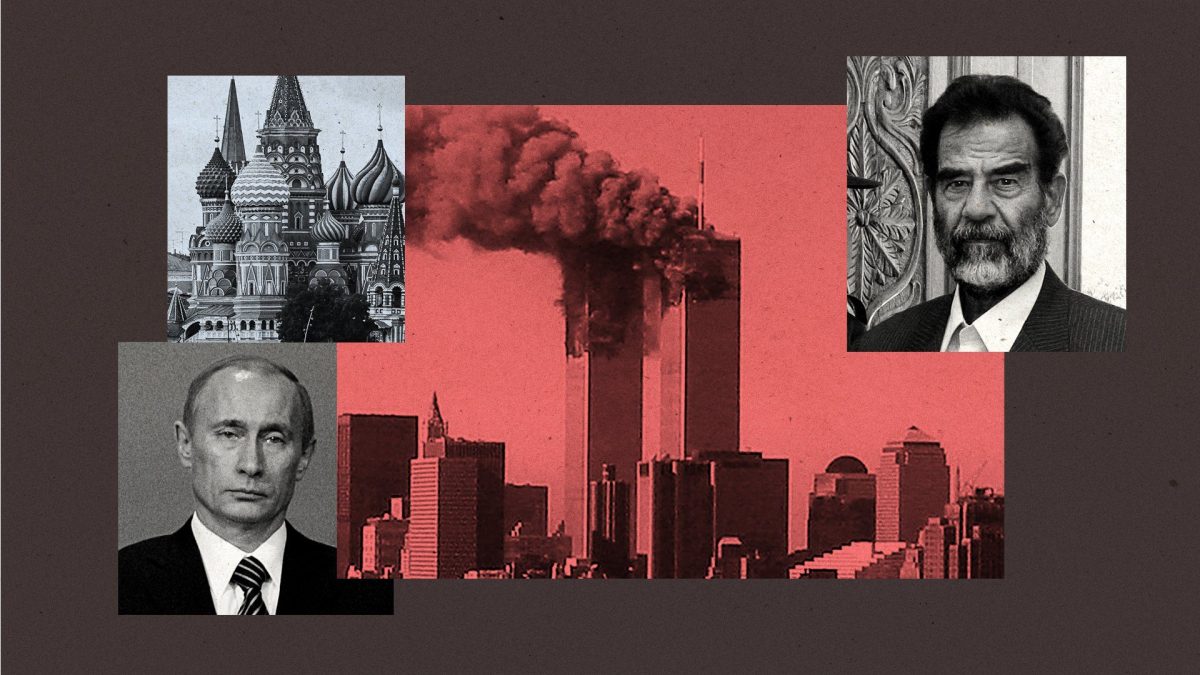
It was a blur of grey dawn, jetlag, and disbelief. After finally getting permission on the evening of Thursday 13 September 2001 to cross the Atlantic, the plane that my employer had chartered for a group of its journalists had landed. United States airspace was still closed. We had flown to Montreal. We continued by road. By late morning on Friday we were in Manhattan. I was able to approach the area where, until 72 hours earlier, the World Trade Center had stood. I broadcast live, describing what I could see and sense: smoke, sorrow, shock, and anger. During those days I reported from New York, smoke still rose from the ruins. The following month I was in Moscow, to report on Russia’s reaction. Today, a quarter of a century later, the legacy of 9/11 has had huge consequences for relations between Moscow and the West. It is a subject I have researched extensively in recent years. After 9/11, Vladimir Putin was the first foreign leader to call President George W Bush. He offered his support. In a televised address, he gave this public pledge, too: “In the name of Russia, I want to say to the American people – we are with you.” United Airlines flight 175 approaches the south tower of the World Trade Center as smoke billows from the north tower in lower Manhattan, New York on September 11, 2001 (Photo: Seth McAllister/Getty Images) His words were well chosen. They anticipated the challenge to the world Bush would soon make. “Every nation, in every region, now has a decision to make. Either you are with us, or you are with the terrorists.” Yet, as the ruins of the World Trade Center still smouldered, some around Bush were preparing to light another fire. Chief among them were vice-president Dick Cheney, secretary for defence Donald Rumsfeld, and the under secretary for defence Paul Wolfowitz. Despite the lack of any reliable evidence that Saddam Hussein, the dictator then leading Iraq, was involved in the 9/11 attacks, they determined that he must go. First, though, came a war in Afghanistan to depose the Taliban who had hosted the 9/11 hijackers. Here too Russia was helpful, raising no objection to the establishment of US bases in the region. The US and its allies attacked targets in Afghanistan in the first week of October. I was in Moscow then. I remember an atmosphere of understanding and acceptance – together with some apprehension. It was not so long since the inglorious end of the Soviet military campaign in Afghanistan. But the response to the invasion of Iraq was different. Claims that Saddam Hussein had weapons of mass destruction (WMD) that might be used against Western targets would prove baseless. Yet, they were used as a justification for invasion. President George W Bush and Russian President Vladimir Putin at the conclusion of dinner at the Bush Ranch in November 2001 during his state visit to the US (Photo: Eric Draper/Greg Mathieson/Mai/Getty Images) Russia had extensive economic interests in Iraq, dating back to the time Saddam was a Soviet ally. Sir David Manning, foreign policy adviser to Tony Blair and later ambassador to Washington during the Iraq war, told me in a 2023 interview that Putin “was resentful that Russian interests were apparently being disregarded – and this despite Moscow having co-operated closely after 9/11 with the US over Afghanistan”. There was something even more serious. Fiona Hill served as a Russia expert in different roles under president George W Bush, president Barack Obama, and, in his first term, President Donald Trump. When we met in Washington in the summer of 2024, she drew my attention to a little-remembered incident in Moscow in the run-up to the invasion: a conversation between Alexander Manzhosin, a Putin aide, and visitors from a Washington think-tank. Talking of Saddam and WMD, Manzhosin asked the Americans: “Do you not see he is bluffing? Our intelligence professionals know this. Don’t yours?” So when the invasion went ahead, the Kremlin was convinced that Washington was acting on false pretences: using the spectre of WMD to justify regime change. Tony Blair’s chief of staff Jonathan Powell was at the heart of decision-making in the run-up to the Iraq war. He is now UK National Security Adviser. When I interviewed him in 2023, he told me Iraq “was really what broke it for us with Putin”. Shorts He added: “I put the fracture then. That’s when they felt that this idea of sucking up to the West in the hope that they’d be taken seriously and put at the top table wasn’t going to work.” During our 2024 conversation, Hill expressed a similar view. “That [the Iraq war] really shifts thinking in Russia and many other places in that world about what the United States was up to.” In the last four years, we have naturally seen Ukraine as the focus of Russia’s renewed confrontational stance with the West. But it also has roots in the Iraq war, the US and UK’s consequential response to that smoke I saw rising from ruins in Manhattan a quarter of a century ago.
How 9/11 set the West on a collision course with Putin
Full Article
Original Source
Read the full article at Inews →KhanList aggregates and links to publicly available news content. We do not host full articles from third-party sources. Always verify important information with original sources.